Wednesday, April 25, 2012

3KCBWDAY3: Knitting heroes

There are people I know in person who I'd think of as knitting heroes - people who use their craft to sustain their sense of self-worth amid mental or physical illness or disability; people who will rip and re-knit the same yarn a dozen times until it becomes that perfect item; people who'll take on a complex project as a relative beginner and come out with a stunning finished object.  And then I was going to play this conventionally today and go for two of the Big Beasts of the knitting world, Kaffe Fassett, king of colour inspiration and Debbie New, knitting genius.

But while I was coming home this evening on the train, reading the business pages and thinking of a couple of conversations I'd had over the last few days, I totally changed my mind.

Knitting hero: Emma Jacobsson


Some of the details here are from Wendy Keele's Poems of Color; some are from Susannah Hansson's wonderful Bohus class last summer at Knit Nation, and some others are from Kjell Andersson's brilliant and moving film on Bohus (available on DVD from Schoolhouse Press).  All errors are my own.


Emma Jacobsson's husband was the governor of Gothenburg in Sweden, at a time when the stone-miners in the Bohuslän quarries were hit by both the Depression and the Second World War.  Thinking of production which could be done without too much equipment but which would bring in a significant amount of income, she settled on knitting - but knitting to rival the great couture houses of New York and Paris.


At one stage, a Bohus twinset, sweater or cardigan rivalled anything available in New York department stores from designers like Ralph Lauren.  The knitting was done on 1.75mm or 2mm needles throughout.  The designs used several colours in a row, and a combination of knit and purl stitches for texture.  The yarn used was a wool and angora blend (again sourced by Jacobsson), which fuzzed out into the most beautiful colour blend.


There are photos of everyone from Princess Grace of Monaco to Audrey Hepburn wearing these sweaters and cardigans.  They were knitted top-down, but worked with seams after the yoke shaping/underarms to give the feel of other couture garments.


The knitters were paid by garment, and quality was strictly monitored.  However, for an industrious knitter, the payment was a huge help to the family; such that it actually caused some family rows on occasion because it meant the woman was earning more than the man.


Gradually, as clothes became more throwaway, it became more difficult for Emma Jacobsson to find new markets in North America, or preserve existing markets.  In the end, the Bohus enterprise closed in 1969, to the regret of many of the knitters, despite the packet of yarns they received as thanks.


I don't think I'd have liked Emma Jacobsson if I'd met her in person.  She seems to have been a somewhat relentless, pushy person who really didn't take "no" for an answer.  In my head, she was a cross between The Killing's Sarah Lund, The Archers' Lynda Snell and Princess Michael of Kent.  And all of those women get things done.


Emma Jacobsson ensured employment for hundreds of women, making a high quality product which was desired worldwide, and for which the knitters were adequately paid.  The knitting itself was extraordinarily beautiful, as seen by the colour combinations above.  The Bohus designers and knitters corresponded back and forth, and all were very skilled.

For 30 years, women in one of the poorest areas of Sweden made knitting pay, thanks to Emma Jacobsson and the team she assembled around her.

All photos taken by consent of Susanna Hansson from her personal collection of Bohus Knitting.  For details on her work,go to http://oneofsusannas.com - if you can attend one of her classes, it's a treat.

Tuesday, April 24, 2012

3CKBWDAY2: Photography challenge day

I'm not going for technically clever here; I'm just hoping for awesomely cute.

The wool dormouse (glis glis lanamicum) in its natural setting. Click to embiggen.


Monday, April 23, 2012

3KCBWDAY1: Colour Lovers

6774275722_fb70cde534

I'm somewhat ill-prepared for this - it was only after Hoxton's post (I love her Electric Sheep podcast) earlier on today that I realised this was happening again this year, and I hadn't missed it...  It's only a week, I thought, when I signed up at lunchtime... and then I looked at the prompts for the week...

But this evening's is relatively easy.  Colour... shutting me up about colour is easier.

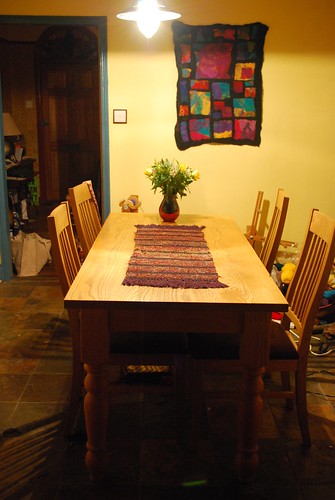
As an example, this is a quick snap of my dining room/door into the living-room taken after I came in this evening (work bag still on the table, but as it's Monday night there isn't a heap of post and other detritus on there...).  I love bright, vibrant colours.  I like to think I don't "do" subtle.  There's weaving, knitting, feltmaking, crochet, embroidery, cross-stitch and stained-glass visible there, and it's all pretty bright...

(It seems that after a brief heady period where Blogger and Flickr frolicked happily together, they're completely incompatible in any of my 3 browsers.  Apologies.  It's taken me over 2 hours to work this out...)


I have Views on certain objects.  Work shoes, my everyday small handbag, my everyday coat, camera bags and my favourite small-project knitting bag need to be black, or as near black as readily obtainable.  Likewise most of the work wardrobe.

This is mainly to provide a backdrop for other things though - nice knitted items; excellent not-everyday-small bags; cool jewellery.  Excellent curtains and beautiful cushions. (The cushions aren't made by me - Wibbo saw my pathetic attempts at crochet and made these two utterly beautiful pillow-sized ones...)


Commuting from a flat Fenland village to central London, for 4-5 months of the year I leave home in the dark and I arrive home in the dark.  I see grey, grey daylight through office windows and on the occasions I force myself to walk on cold streets at lunchtime.

I have colours I gravitate towards; I'm a fan of purple, and burgundy, and magenta; and jade, and turquoise, and aquamarine.  But now I realise I also love golds and yellows, leaf greens and even, god help me, sometimes browns and neutrals.  I think the greyness actually helps to make the idea of colour more valuable.

When yarn clubs work (and there are currently a couple of infamous examples of dysfunctional ones from one UK source), they're brilliant.  They take you out of your little corner and present you with something new - you wouldn't have chosen this one off a table if there was, say, purple, around, but once presented with it in a parcel,on its own, your mind starts reeling with the possibilities. I'm currently signed up to the second part of Yarnscape's Wheel of the Year club, and to a Clan Surprise from The YarnYard; both have opened my mind to the possibilities of less intense colours in the past few months, and beautifully so.

Sunday, April 15, 2012

2012 books, #35

What it is like to go to war, by Karl Marlantes [audiobook]. Read by Jeff Harding. Rearsby, Leics. : Clipper, 2012.

This merits a post on its own.  I think it's probably the modern equivalent of The art of war, and was certainly an excellent thing to be reading over Easter.

Karl Marlantes went to war in Vietnam, and wrote a novel called Matterhorn, which was made into one of the first Vietnam films.  He also writes with the perspective of someone who left a Rhodes scholarship to go to Vietnam and returned to it later; and with the perspective of someone who believes there's a spirituality to war, completely divorced from any individual faith - he calls it the arena of Mars.

This is a considered book, with perspective right up to last year's Libyan conflict, which aims to analyse and give advice on how government, society and the armed forces should look at the very young people who wage war on our behalf.

Marlantes believes we should prepare young soldiers psychologically for war before they are deployed - he asks "Why put on the armor after the war?".   He has interesting things to say about very modern warfare; there are people who are commuting daily to their homes while deploying drones flying in and out of Iraq, Afghanistan and other locations, for instance; soldiers in the field can be shooting at insurgents at 7pm and be talking to their friends and family via Facebook at 8pm.  In Marlantes's opinion, this makes the likelihood of post-traumatic stress greater, because there's less of a distinction between being at war and not being at war.

There's a chapter on the honesty, or lack of it, in reporting of war.  Lying covers up the lack of meaning of war.  Body count statistics count more than strategic importance, and at least in Vietnam, there was no way of independently verifying the field reports.  Within that, there's the idea of standards rather than ideals; everyone knows what the ideals are, but standards can be steadily eroded by the experience of war.

One of the more moving chapters was an account of how Vietnam soldiers were returned to their families, discharged before they returned home, and (until the current post-9/ll fervour) were largely ignored or an embarrassment.  Marlantes fervently believes there should be "some sort of commitment to the future we are returning them to", with a ceremony of handing over weapons and compulsory psychological assessment.

Above all, Marlantes remains a warrior, with the knowledge that in the heat of situations, there's something beyond the individual which needs to be acknowledged in the current bureaucracy.  I'm probably not explaining this very well, but to my mind, when I finished this book on Easter Sunday, the statement that "Some people obviously rate victory as greater than their own death. This does not make them irrational" made a lot of sense to me, while also terrifying me because yes, this is the justification suicide bombers will also use.

Monday, April 09, 2012

2012 books, #31-34

The drop, by Michael Connelly. London: Orion, 2011.

Another Harry Bosch book, and another excellent read.  Bosch has two cases to investigate; one is his Open-Unsolved work - DNA found on a victim is found to be that of a convicted paedophile; but the man was only 8 years old at the time of the murder.  The other case is the apparent suicide of a councillor's son; unfortunately that councillor is Irvin Irving, Harry's nemesis and himself a former senior policeman.  Office politics and some of the darker parts of the history of the Los Angeles Police Department come to the fore, and Bosch risks losing both a good friend and his shift partner while trying to solve both cases.  This was pretty unputdownable; Connelly's consistency is amazing.

Blood hunt, by Ian Rankin writing as Jack Harvey [audiobook]. Read by Christian Rodska. Bath: Chivers, [1995].

Gordon Reeve is a survival expert in the Scottish Highlands, with an SAS past.  Then his journalist brother dies in San Diego, and when Reeve starts to disbelieve the official theory of suicide and investigate the matter, someone starts trying to kill him too.  The action criss-crosses back between Scotland and California, as Reeve goes on the run and tries to shelter his family.  There's a fair amount of gore in this book, and Reeve is seriously out of control at times, which makes for uncomfortable reading.  I think I'd probably have given up on this one before the end if it hadn't been superbly read by Rodska, who slips in and out of Scottish, English and American accents in a convincing way.

They also raise chickens, by Martin Parker. Kindle edition, 2011.

This is a very strange book.  It dots between 1918, 1962 and 1988, sometimes slightly confusingly.  The title comes from a quote by Antoine de Saint-Exupery in The little prince:  "Men", said the fox. "They have guns and they hunt. It is very disturbing. They also raise chickens. These are their only interests."  Two series of murders in the same small town, normally a tranquil place, alert both Harry Dangerfield (then a police sergeant, now an inspector) and his ex-wife Susan (now chief editor of the local paper).  Surely there must be a connection between the two groups of killings, despite the 1962 sequence having been closed after the suicide of a local policeman?  Dangerfield has never really subscribed to this theory, and the repeated rumours of the presence of a WWI soldier in the area enhances his suspicions.  The tone of the book is quite jokey in parts which doesn't really fit with the crimes being committed.  Patchy, but good fun in general.

Tom-all-alone's, by Lynn Shepherd. Kindle edition, 2012.

A new detective novel set among the characters of Dickens's Bleak house (published as The solitary house in the US); but you don't need to have read your Dickens recently (or at all, probably) to enjoy this for its own sake.  Shepherd captures the squalor and degradation of 1850s London, and the lack of law or order in the poor neighbourhoods (it's amusing to find with hindsight that these are Seven Dials and the Strand). The omniscient narrator is able to draw sly 21st-century parallels; this sometimes works very well, and sometimes breaks into the narrative in a disruptive way. The main character, Charles Maddox, is hired by the lawyer Tulkinghorn to investigate a case of anonymous letter-writing, but all is now what it seems with the assignment.  There is also a parallel narration by Hester, as there is by Esther in the original novel; but again, there is a much more sinister story behind this.  Shepherd is able to deal with even more disturbing themes than Dickens was, and Charles's investigations strip away the veneer of respectability to uncover some chambers of horrors.

2012 books, #26-30

Double wedding ring, by Lizbie Brown.  London: Hodder and Stoughton, 1999.

The tone of this book is slightly strange - the protagonist (and I'd imagine the author) are from the US, and it definitely reads like one of the US "cozies" produced around quilting, knitting, sewing etc. - this is set in the UK, and seems to stand out from the rest though, and the first scene - a wedding at which the bride not only turns out not to be the groom's fiancée but is also pregnant with his child - is somewhat arresting!  When the false bride's body is discovered the next morning, Elizabeth Blair (a semi-retired private detective who also runs a quilt shop in Bath) is called in to try to prove that the obvious suspect, the groom, is not guilty of the murder.  It rattles along very nicely; not anything particularly special but a good couple of hours' read.

Lost light, by Michael Connelly [audiobook]. Read by John Chancer. Bath: BBC, [n.d.].

I don't know where this fits into the Harry Bosch series, other than that it's after he was married to Eleanor Wish, after she's had their child, but before he finds out about this...  but as ever, the library gubbins was stuck all over the bibliographic information!  Just when I think I've read all of the Bosch stuff, another one I haven't found yet comes along; which is great, when someone can consistently write at this standard.  Harry has left the LAPD, but is unable to forget one particular case, that of a young woman murdered in the wake of a $2million robbery on a film set.  Released from the day job and unable to decide what to do next, Harry takes the file and continues the investigation, pissing off just about everyone he knows in the process.  Really good stuff, and Chancer reads it very well, as ever.

The secret life of France, by Lucy Wadham. Kindle edition.

Lucy Wadham was married to an upper-class Frenchman for the best part of two decades, has two teenage children and moved from the 16e arrondissement  to la France profonde  following her divorce.  She talks about her experiences of France and the French as someone who married very young, finished her degree at Oxford after having a child and then worked freelance for UK newspapers and the BBC over the years.  A surprising amount of the book is spent on discussing sex and infidelity in a particular very elevated stratum of Parisian society; but when she gets down to subjects such as the French education system, French bureaucracy, the conflict between secularism and Catholicism and so on, she's fascinating.  And it was heartening to find that someone had to go back to the office near Parmentier métro station even more often than I did to obtain that elusive permis de séjour which was needed by all EU citizens before the dawning of the single market in labour, and was notoriously difficult and time-consuming to obtain...  She's loved and hated France in almost equal measure over the years; but despite having children who are now rediscovering the joys of the British sense of humour, she's still there.  And if you want to follow up on a social history of France from the mid-80s to now, Wadham's journalistic sense means she's documented all her sources in the references at the back, which take up nearly a quarter of the book.

The knitter's book of wool: the ultimate guide to understanding, using, and loving this most fabulous fiber, by Clara Parkes.  New York: Potter Craft, 2009.

I'm fairly sure this was a present from Wibbo.  I had a flick through it and registered the lovely patterns in it at the time, but a couple of weeks ago, after I came back from a spinning day at Rampton, I got it off the shelf and took it up into the bedroom as bedtime reading (most of my reading is done in transit, but this is a sturdy hardback with a nice dust-jacket).  And it's fascinating.  Parkes is the person who created the Knitters' Review website, my primary source for all things fibre before Ravelry and still a site I visit, and here she goes back a step from her previous book, The knitter's book of yarn, to talk about sheep, and sheep breeds, and the way that taking raw fleece and turning it into yarn works.  She doesn't automatically assume you want to spin your own yarn, but she does assume that if you're interested in yarn, you have some interest in understanding how different breeds work, and what you might be able to use each yarn for.  However, if you do want to spin your own yarn, there's lots of information there, too.  It's about half information, and half patterns; and the patterns are good, and explain why each yarn has been chosen for each project.

The death of Amy Parris, by T. R. Bowen.  London: Penguin, 1998.

One of the books I picked up while weeding the crime/thrillers at the local library - this one is set in and around Cambridge, and gets the geography right, although there's an awful lot more driving between Cambridge and the North Norfolk coast than most locals would be prepared to do!  John Bewick, formerly of Cambridgeshire police and now seconded to an advanced training unit, is asked to re-investigate what looks like an open and closed case, because the son of friends has been arrested for a murder he claims not to have committed.  Meanwhile a body is found on a North Norfolk beach and turns out to be the best friend of the murdered woman, lost at sea a year before.  There's a very creepy dénouement to this one, and it's tightly-plotted throughout.

Sunday, March 25, 2012

Like clockwork

It's that day - the day the clocks go forward.  Couldn't come soon enough as far as I'm concerned...

I don't hate the cold of winter; as long as my feet are warm and dry, I'm OK.  What I do hate is the lack of light... for the last nearly-six-months, I've left home in the dark and I've got back here in the dark; and more often than not, I haven't been able to leave the building at lunchtime either because there's been a meeting, or something to do over lunch, or whatever... I am so very, very glad for the prospect of light evenings.

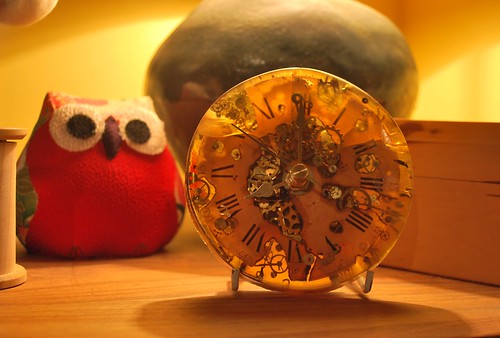
I do like clocks though.  This one is about 4" in diameter and made by Impossible Fossils in resin, with clock parts and burned paper dial.  I bought it to put up in the bedroom, but the light from the lamp in the dining-room makes it look so nice it's never made its way up there.

clock1

I also have this, made by an Extreme Scroll-Saw Man in California - it took me a year to find a clock I wanted for my 40th birthday (parents gave up and sent me a cheque after several months of dithering) and this was it, found on Etsy and assembled with instructions once it got here (sadly, I can't remember the maker's name...   There are 8 angels on this clock, six of them visible in this photo...

clock2

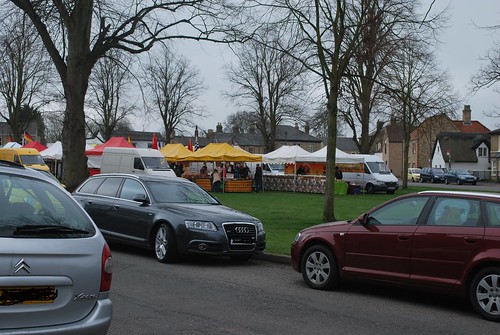
To give you an idea of what the light levels are like in the Fens in "spring", this was what the Green looked like at 10:45am today, just as the fog was clearing:

euromarket

Yes, we haz European Market!  Not a great one (when I say that the cheese stall was provided by the Brits, and consisted mainly of cheddar and Wensleydale adulterated with various fruits and herbs...) but I got olives, feta, duck sausage and a chocolate confection for a present...

When I came out of the house, the guys on the bread-and-olives stall at far right had obviously pegged me as a soft touch, wondering where they could get hot water for a cup of tea...  but the guy who asked looked so very like an Algerian friend from France years ago...  So I went home and put on the kettle (I did get a good discount on olives and feta cheese a bit later.).  I also had take-away tartiflette for lunch.  And warmed-up same for dinner.  I do hope they come back.  Preferably with a better vendor of cheesy comestibles.

And because posts with song-titles need context: here's the Boomtown Rats in 1978, on ToTP.  Probably one of the worst attempts at the obligatory lip-synch in that period of the history of ToTP, although David Coverdale's rendition of "Here I Go Again", where he can clearly be seen saying "oh, f**k this", is also good.


2012 books, #21-25

Homicide: a year on the killing streets, by David Simon. Kindle edition.

This year-long biography of a homicide squad in Baltimore first formed the basis of a 1990s detective series called Homicide, and then led the writer to go on and write The Wire. Simon was allowed to take a year's sabbatical from his job at the Baltimore Herald and spent 1988 in a squad-room, documenting the cases and lives of the men (and at the time they were overwhelmingly men) trying to hold back the mayhem on the streets which led to 250 deaths in the year.  None of the police depicted are stereotypes, although a few are certainly eccentrics.  It's a fascinating look into a world without much in the way of modern forensics, without mobile phones, without much in the way of CCTV footage, and how detection was done.  If you enjoyed Life on Mars, you'd certainly like this.  There's a lot of gallows humour and rounding-up-the-usual-suspects, but there's also a lot of dedication and determination for justice to be done, and an awful lot of slightly scary details on how politics affects policing.

One day in September: the full story of the 1972 Munich Olympics massacre and the Israeli revenge operation "Wrath of God", by Simon Reeve. Kindle edition.

This seems to have been written in around 2002, with various updates, and is the book-of-the-documentary, but stands well on its own.  The first third or so of the book is the factual account of what happened when 9 Israeli athletes were taken hostage by Palestinian terrorists in the Olympic village.  There follows an account of how this changed Israeli policy on pursuing terrorist suspects, and the hunting down and killing of various members of the PLO over subsequent years, including two of the three surviving hostage-takers.  I think what shocked me most was the disclosure of a cover-up by the German authorities of major incompetence by their police and armed forces; almost three decades after the massacre, the families were finally allowed to view the files they'd been told repeatedly didn't exist.  Extremely good and very moving book, anyway.

The good soldier, by Ford Madox Ford. London: Penguin, 2002.

I really loved this when I first read it, almost exactly 20 years ago; this time round, I wondered why on earth I'd kept it fondly in mind.  Stylistically, it's still very beautiful, but this time I found the characters shallow, the setting vacuous, and the ignorance of the narrator of the principal events of the novel unconvincing.  My irritation with it wasn't helped by the preponderance of notes in this edition - I started up looking the annotations up in the back, but they seem to have been prepared for people unfamiliar with both the UK and the US, and indeed the finer points of the English language.  It was a disappointment that a novel I'd held in my mind didn't stand a second reading - but it also showed me that I'm a different person to the one who originally read this book, and that's probably not a bad thing; it would be odder if we never moved on in our analysis of things!

Bad luck and trouble, by Lee Child [audiobook]. Read by Jeff Harding. Whitley Bay, Tyne and Wear: Soundings, 2007.

No time for psychological exploration with this one - Child doesn't do that sort of thing.  Jack Reacher's band of Special Investigators from the forces needs to get together, but five of the eight seem to be missing, and one has turned up dead.  Reacher is summoned to the California desert to find out why someone is torturing his buddies and dropping them from helicopters into the wilderness.  It's the usual all-action high-voltage stuff we expect from Reacher, and extremely good listening.

Sworn to silence, by Linda Castillo.  London: Pan, 2009.

A new-to-me author - but I already have the next one on hold.  Kate Burkholder is the chief of police in Painters Mill, in Amish country.  She's unusual not only for being a relatively young woman in the post, but for being born into an Amish family but having left the faith at the age of eighteen.  A series of brutal murders brings back horrific memories for Kate and the community; someone is using slaughterhouse techniques on young women and carving numbers into them, repeating a series of killings 16 years before.  Kate has more difficulty believing this than other members of the community, though - she knows she killed the perpetrator when she was 14.  This is an excellent book; atmospheric, with characters you care about, and some really tight plotting.

Wednesday, March 07, 2012

2012 books, #16-20

Gosh, I'm a long way behind with these.  To the extent that the next book up is last month's book club book, and the next discussion happened last night...

The help, by Kathryn Stockett.  New York: Berkley, 2009.

This was quite astonishingly good.  The comparison with To Kill a Mockingbird on the cover raised my hackles (any comparison to my favourite novel, in the world, ever, tends to do that); but really, putting that aside, you could see why the analogy was made.  I know I'm very late to the party with this one, and everyone in the world has probably read it; but for anyone who hasn't....  The main voices belong to Aibileen and Minny, two black maids, and Miss Skeeter, a white woman just out of college in 1962, with the urge to become a journalist and no real idea of what she wants to write about.  After one of her contemporaries starts a crusade to segregate bathrooms in people's private houses so they no longer have to use the same loo as their maids, Skeeter decides that real-life accounts of the lives of maids would be an interesting subject for literature.  In this, she entirely fails to understand the danger involved in the enterprise; for her, any suggestion that she sympathises with the civil rights movement leads to social ostracism; for the maids, the danger is much more real and present - Aibileen lives two streets away from Medgar Evers and his family, and Evers' murder features in the story.

I started off with this one with a small measure of dread - Aibileen's account is written in a dialect, which often spells death to my urge to read a book; but it's written well enough that you get caught in very early on and it's just a signal of who's speaking.  Aibileen is the real voice of the novel - compassionate, fierce and courageous.  None of the characters are caricatures, not even the really rather dreadful Hilly who dominates the Women's League, or Mother, who when she believes she is dying keeps a notebook of Fashion Faux Pas to pass on to Skeeter for Future Reference.  There has been some controversy over a white woman writing in a black woman's voice; and maybe my point of view on this shows my ignorance; but what happens if nobody can speak in a voice other than their own?  What would a world without Othello, or Fahrenheit 451, or Alice's Adventures in Wonderland, be like?  A much longer review than usual, but I laughed out loud and cried tears over this book, sometimes simultaneously; and it'll teach me that just because something's incredibly popular, that doesn't mean I won't enjoy it!

Theodore Boone, kid lawyer by John Grisham.  London: Hodder and Stoughton, 2010.

The fact that one copy of this book in the library was in the thriller section and the other in Young Adults is probably just about right.  Theodore Boone is thirteen, and spends more time in the local courthouse than most lawyers.  His parents are lawyers (and liberals; one of Theo's evenings each week is spent at the local soup kitchen).  Most of their friends are lawyers.  (Even the family dog is called Judge.)  Theo wants to be a lawyer one day, and is already dispensing free legal advice to his classmates.  The case of the moment is a spectacular murder, very unusual for the Boones' small town, and Theo finds himself with vital information he doesn't know how to handle, but which proves the accused's guilt much better than the prosecution case can.  This is a lovely, engaging book; I think it's Grisham's first foray into YA fiction but I hope not the last.  I read it in an afternoon while knitting the stocking-stitch body of a sweater and it's a delightful read.

The American future: a history, by Simon Schama [audiobook]. Read by Peter Marinker.  Whitley Bay: Chivers, 2008.

I gather this is a book-of-the-series sort of thing - but as I never saw the series, it stands up very well as an audiobook.  Marinker's reading is excellent, as he switches between US and British English pretty seamlessly. The framing device is the 2008 Presidential election campaign, and particularly the Democratic caucuses where there is a genuine choice between a female candidate and a black candidate for the first time.  As ever in American history, the future is found to have its roots in colonialism and civil war; and some of the individual stories are fascinating.  I think the one I found most interesting was that of the Meigs family, who were around in the colonial era and at the founding of West Point, and who fought in the Civil War, both World Wars, Korea and Vietnam.  There's an interview with the current Montgomery C. Meigs (IV? I'd lost track), who's a professor of military history; for a relatively new country, that's a heck of a dynasty.  I found this moving, funny and profoundly interesting.  I imagine all I'll retain is some flypaper details, as ever, but I'm sure some facts have gone in somewhere!

The retribution, by Val McDermid [audiobook].  Read by Saul Reichlin.  Rearsby, Leics: WF Howes, 2011.

This was a characteristically creepy Tony Hill/Carol Jordan book; Jacko Vance, a serial killer Hill and Jordan managed to arrest in their first case together, has escaped from prison and is determined to exact revenge.  Vance is an ex-Olympic athlete who turned radio presenter after he lost an arm; and it's a testament to McDermid's skill that you don't just stop reading after that description...  Vance is seriously scary and will stop at nothing; and given that we know McDermid doesn't let the fact that a character is well-liked and fairly vital to the plot stop her offing said character if the plot demands it, one or two of the features of this particular book shouldn't surprise or shock; but they do.  Reichlin's another narrator I watch out for - his reading of Steig Larsson's Millennium trilogy added a lot to my enjoyment of them, and he does another excellent job here.

Free fire, by C J Box. Kindle edition.

Joe Pickett again!  This time, he's called in to a very strange series of events at Yellowstone National Park, after a letter was sent to the state governor alleging unspecified crimes were taking place.  In the same area, a lawyer has been acquitted of three murders on the technicality that a local jury couldn't be empanelled due to there being no local residents in the park.  Joe is far from home (although the home he currently has is far from satisfactory) and his family, and the eerie goings on don't help much, either.  For some reason, I didn't enjoy this as much as I did previous books; maybe it's the far-from-home thing...

Tuesday, March 06, 2012

Scarily correct

A colleague, fellow team member and knitting friend spent part of her birthday at the David Shrigley exhibition at the Hayward yesterday, and brought this back for me.  It's a badge I can attach to my work lanyard.  It has amused the friends and colleagues I've shown it to so far; and it's so entirely accurate.

Thankyou, Anya.

Sunday, March 04, 2012

2012 books, #11-15

Catching up with some more of these.  For some reason, it's really difficult to remember to review books read on the Kindle!

Angle of investigation: three Harry Bosch stories, by Michael Connelly. Kindle edition. 2011.

Another set of promotional stories for The Drop put out for 99p by Connelly, and definitely worth the money!  Stories from different points in Bosch's career.  The first story features repeat robberies in a pawnshop; Bosch and Jerry Edgar find the robber dead, apparently electrocuted, in mysterious circumstances. In the second story, a father is distraught at the death of his disabled son, left in an overheated car in his work parking lot - Bosch's partner Ignacio is convinced there's more to it than the man says. The final, title, story takes place over a long period - Bosch, working open-unsolved cases, comes across the case of the first dead body he saw on the job, that of a woman drowned in a bath with her dog.  Coming back to it with both the experience and modern forensics, he uncovers the almost unthinkable.

In plain sight, by C. J. Box. Kindle edition.

Another Joe Pickett story.  Ranch owner Opal Scarlett disappears - the only people who miss her are her sons Arlen, Hank and Wyatt, who settle their problems by trying to beat each other to death with shovels. Joe's daughter Sheridan is friends with Julie, Opal's grand-daughter, and becomes involved accidentally in the feud.  Meanwhile, a relative of Joe's former foster daughter April is out to track Joe down.  Joe's family, job and life are threatened, and his relationship with Randy Pope, the head of the Wyoming Fish and Game service, seems to be going downhill still further.  Another excellently plotted story which also maintains a lot of the existing relationships and characters.

The hard way, by Lee Child [audiobook]. Read by Jeff Harding. Whitley Bay: Soundings, 2006.

While there's often some humour in the Jack Reacher books, Lee Child excels himself here by transforming the latter half of the action in this book to the UK, and specifically to rural Norfolk.  There's a lot of knowingness here from ex-pat British author Child; scenes where six-and-a-half foot Reacher tries to blend into the landscape in a country pub, or has to drive a Mini Cooper around Hyde Park Corner, are extremely funny while the pressure on the plot is fully maintained.  Excellent novel, and very well read by Jeff Harding, himself an ex-pat American living in the UK for the last couple of decades.

Gamble: a Dick Francis novel, by Felix Francis. London: Michael Joseph, 2011.

The existence of this book is pleasing enough - the previous 4 collaborations between Felix and Dick Francis were right back to the standard of the early Francis novels, and this one is also extremely fine.  It covers well-trodden paths, although this time round the protagonist is an ex-jockey who has gone into a firm of independent financial advisors; but honestly, just saying it's a really good Dick Francis novel is probably enough for aficionados.

Lazybones, by Mark Billingham [audiobook]. Read by Steve Perrin. Rearsby, Leics.: Clipper, 2004.

Someone is killing convicted rapists on their release from prison; and one of the difficulties for the police is actually caring about the victims.  Tom Thorne struggles with this as much as his officers do, until he finds a genuine victim in the case.  This really does go for the hairpin bends at the end of the book and the ending is definitely pretty surprising!

Friday, March 02, 2012

Looming back into view

Hello!  This, unbelievably, is the first non-book-review post of the year.

Mostly, this has been due to the usual time-of-year-kicking-me-in-the-head thing; I've also ended up doing some work at home and some earlier mornings/longer days at work; and transport has been a bit terrible too.
I think the low point this year came on the week beginning February 6, when I spent 25 hours just getting to work and back  (normally my week is extreme by some people's reckoning at around 17.5 hours just travelling) and then, as the kicker on the Saturday, failing completely to get to Kew Gardens for a wander about and Cake Crawl with some lovely knitters.  Standing on a station for 45 mins in -13C (Ely; frozen points) has given me a greater appreciation of Arctic/Antarctic explorers; in terms of confirming my belief in their total insanity.

So, anyway; I've been maundering away feeling knackered thinking "nobody's going to be interested in my boring life; I've done nothing..."   And that might be true; but this evening I, and the rest of the carriage, spent 45 minutes being treated to a woman directing her husband around Iceland.  Enthusiastically; and extraordinarily loudly.  Which would have been really interesting if she were talking about the country, rather than the frozen food shop.  Unfortunately, it turns out Mum couldn't get to Iceland so she was going to send Dad round on a string. "Well, yes, chili chicken bits, but ARE THEY BREADED, TONY?  ARE THEY BREADED?"

This set me a somewhat lower bar.

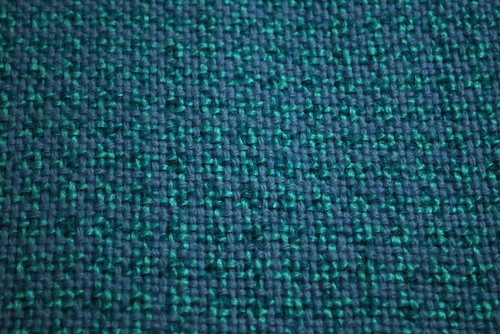
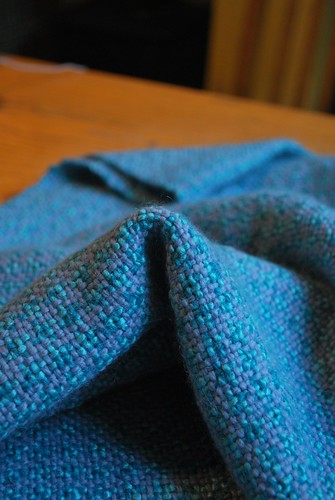
So; I got a loom for Christmas! A 24" Ashford rigid heddle loom, to be specific. It's a lovely beast. I loved it first because it involved the application of wax, a lot of self-assembly, and a wonderfully-constructed set of parts packed by someone from a company which feels confident enough in its workers and training that it gives each packer a business card with "Proudly packed by" on it. I've assembled an Ashford wheel, done bits for an Ashford carder, and now the loom - everything works wonderfully.

While I was waiting for the wax to dry on December 28, I opened my Christmas presents from friends (hadn't had time before I set off to my parents') and had two lovely skeins of sari silk from my friend Chai in Toronto; looking at the colours and the sheen, I wondered about weaving it...

So, this is what I got for my first project;

Picture 012

Warp was a purple bamboo yarn I'd bought to make a hat without realising that actually bamboo + hat probably means cold head. The weft was partly the sari silk and partly remnants of some lovely charcoal grey Jaeger Extra Fine Merino in charcoal. Here's the thing on the table. It's shorter than I was hoping, but taught me a valuable lesson about how much yarn you waste in the weaving process. And it still looks nice on the table...

runnerontable

With Chai (and her February birthday) still in mind, I decided to make a houndstooth check scarf from slightly thicker yarn in two different textures, and that worked out pretty well, too - this is the detail view on the loom

chai_scarf_detail

and this is what it looked like after washing

chai_scarf_dtl

Warping with a yarn with so much angora was probably silly; it took ages; but I did love the final fabric...

And to come full circle; I warped up again the day I couldn't get to Kew. I'm sure Tina is responsible for the amount of red in this project, but it also reflects the amount of red/orange sock leftovers I had kicking about.

Not-Kew_scarf

I'm still weaving this one, and enjoying it, although finding it more difficult to get the edges straight with the finer yarn...

Monday, February 13, 2012

2012 books, #6-10

Snuff, by Terry Pratchett.  London: Doubleday, 2011.

Terry Pratchett is a man with a lot to be angry about, these days, and in this book he finds his perfect vehicle in Sam Vimes.  Vimes has been forced to go on holiday to his (actually his wife's) country estate; and as the bookcover blurb says "It is a truth universally acknowledged that a policeman taking a holiay will barely have had time to open his suitcase before he finds his first corpse."  As ever with the Vimes books, this is darker in quality than some of the others.  There's a lot of justice and injustice in this book, and a lot of righteous anger; the title does refer to tobacco in part, but also to what happens when one group of people declare another group of people not to be people at all, but commodities to be exploited.  This is a Pratchett tour de force and every now and then you're just stunned by the quality of the argument.  Although he's an atheist, he's never afraid to corral religious language when no other will do; at the end of one long ramble by his trainee copper, "the voice of Vimes, and this time sounding rather far away, said, 'Do you know what that little speech you made was called, Mister Feeney?' 'Don't know sir, it's just what I think.' 'It was called redemption, Mister Feeney. Hold on to it.' "  My only reservation with this one is the transformation of Willikins from the perfect gentleman's gentleman to something far more elemental and dangerous; but it does work.  And of course, it's also hilarious; there's the 12-year-old's humour, but also something much more knowing and subversive of literary genres too, and he blends all the strands in wonderfully.


Just my type: a book about fonts, by Simon Garfield. London: Profile, 2011.


This was a Christmas present - thanks, Sue!  I'd heard one of the episodes when this was book of the week on Radio 4 and I was working from home, but had promptly forgotten all the details of the book.  If I'd realised it was the guy responsible for the equally fascinating Mauve, about the history of the chemical dye, I'd have remembered it better!  This is a fascinating roller-coaster ride through the intricacies of font history and design; and I've spent the last week or so looking at packaging and signposting with new eyes.  From Gutenberg to the guy who designed the Rolling Stone masthead and the man responsible for Comic Sans, Garfield explores the history and aesthetics of font design while never losing a sense of humour.  And at the end, his 8 Worst Fonts of All Time are hilarious.


The coldest blood, by Jim Kelly [audiobook]. Read by Ray Sawyer. Oxford, Isis, 2007.


Two men die in the Fens around Ely - both frozen to death in different ways.  Philip Dryden, a former Fleet Street journalist demoted to chief reporter for the Ely Crow, realises there's a link both between the two men and with his own childhood.  He investigates with his unlikely sidekick Humph, and finds himself digging into his own past.  The plot is fascinating and twists and turns nicely, and the geography is spot on; I wasn't sure about Jim Kelly from the previous book of his I read, but will definitely give him another go now.


Hostile witness, by Rebecca Forster. Kindle edition.


Sixteen-year-old Hannah Sheraton is remanded for the murder of her step-grandfather, a retired judge.  Hannah's mother Lynda hires an old college roommate, Josie Baylor-Bates, to represent Hannah who suffers from obsessive compulsive disorder.  Hannah is not a likeable character - spoilt, unaware of the magnitude of her situation and occasionally violent - but as Josie investigates further to find the tangled disfunctional family's secrets, she becomes aware that each time she excavates a layer, the picture becomes completely different.  Excellently plotted with a number of surprises.

Broadmoor revealed: Victorian crime and the lunatic asylum, by Mark Stevens. Kindle edition. 2011.

Mark Stevens is the archivist at the Berkshire records office which holds the records of the Broadmoor Hospital for the Clinically Insane, and has extracted some of the more interesting stories from the archives to give both a profile of the general population of the hospital in the Victorian era, and the stories of some of the more high-profile inmates (Richard Dadd, Edward Oxford, William Chester Minor) and some less-known but typical in some way.  He also explores the Victorian attitude to crime and to mental illness, and does it all tremendously entertainingly.


Sunday, January 15, 2012

2012 books, #1-5

So much for my new year plans to blog more!  However, here are some books.  I hope to have some knitting to show later!


False charity, by Veronica Heley [audiobook]. Read by Patience Tomlinson.  Whitley Bay: Soundings, 2007.

Bea Abbott returns from New Zealand newly widowed and has to decide what to do with The Abbott Agency, a business dealing with domestic crises.  Her son, an MP, thinks she should sell the house to him and move to the seaside, but Bea isn't keen.  While she's been away, her son has hired a secretary, Maggie, who turns out to be great at housekeeping but a dead loss in the office; Maggie in turn has brought in Oliver, an 18-year-old computer whizz who's estranged from his family.  In addition, Bea's late husband has also enlisted her ex-husband, Piers, to look after her.  When Coral, an old friend and long-term client, reports losses due to fraud from a party-organising company working for tsunami charities, the unlikely household investigates.  Very entertainingly written and well-plotted.

The house at Sea's End, by Elly Griffiths. London: Quercus, 2011.

Ruth Galloway's baby, Kate, has now been born, and Ruth is returning to work after maternity leave.  The first case she is called out on is the discovery of six bodies in a grave on the sea-coast, in an area affected by severe coastal erosion.  The bodies are tied together in pairs and seem to have been executed sometime in the middle of the 20th century.  What should be an archaeological puzzle suddenly becomes an active police investigation when a contemporary body washes ashore - someone is killing the witnesses to the event and those investigating.  As well as an excellent plot, the relationship between Ruth, Nelson and their baby is also intriguing, and Griffiths also explores the guilt a single, working mother feels around childcare and trying to juggle two full-time jobs.

Play to kill, by P J Tracy. London: Penguin, 2010.

Another extremely good Gino and Magozzi thriller which discusses wider issues.  This time, what starts off as the mildly bizarre murder of a transvestite in a wedding dress leads to a more serious problem - someone is killing people and posting the videos to YouTube.  Are the murders linked, or is there some sort of group forming which is performing these killings?  As with anything (knitting, for instance), there's strength in numbers out on the Web, and people encourage each other along, in this case to carry out more and more extreme killings.  As ever, the Monkeewrench geeks are also involved.  The characterisation and tight plotting is great, and the relationships between the various characters are lovely.  A slightly odd ending to this one - I'll be intrigued as to what happens next.

Pirate king, by Laurie R King. London: Allison and Busby, 2011.

The latest of the Mary Russell and Sherlock Holmes mysteries.  The plot setup for this one is really bizarre - Russell is despatched to investigate a film company which is making a film about people making a film of The pirates of Penzance.  To add further complication to the story, once the crew reaches Portugal they recruit pirates to play actors playing English gentlemen disguised as pirates.  The absurdity of the situation isn't lost on Russell and King really does run amusingly with it, possibly at the expense of a comprehensible plot and some of Russell's usual common sense.  There isn't as much interaction between Holmes and Russell as usual - Holmes only appears at least halfway through the book - but it's an enjoyable read.

Moon over Soho, by Ben Aaronovitch [audiobook]. Read by Kobna Holbrook-Smith. Oxford: Isis, 2011.

Sequel to Rivers of London; I'd been warned it wasn't as good as the first book, and it couldn't really be, because the entire setup was surprising the first time round and the author is sort of riffing on the atmosphere he's created.  Which is appropriate, as someone seems to be killing jazzmen in Soho clubs.  The sense of humour and absurdity in the style is carried on into this second novel, and the plot barrels along nicely.  The geographic accuracy carries on, too, which is always fun - you can really follow them around the streets...  One of the best elements, though, is that actions and damage are shown to have real consequences.  So many times in novels, our heroes are shot, beaten up, tortured, etc., etc., and bounce back to appear in the next book with only the odd twinge to remind them.  One of the main characters in the previous novel still isn't back at work, or anywhere near it, at the end of this novel, and there's a very moving final scene in this book.

Saturday, December 31, 2011

2011 books, #126-130

Blood ties, by Lori G Armstrong. Kindle edition.

Julie Collins is a sheriff's secretary with a huge chip on her shoulder and the unsolved murder of her half-Native American half-brother hanging around her neck.  Then a girl's body is found in a river, and an investigation is launched.  Shortly afterwards, Julie's best high-school friend Kevin, a private investigator Julie helps out on occasion, tells her that the dead girl's family had hired him to find her.  The plot twists and turns nicely and stays pretty gripping from start to finish.  Julie is a bit irritating, and her choice in men is absolutely terrible, but her relationship with Kevin is interesting and makes the book more likeable than it would otherwise be.  One criticism - did it have to be set in a county called Bear Butte when no other humour is derived from this??

A cold day for murder, by Dana Stabenow. Kindle edition.

Former detective Kate Shugak is a hermit of sorts, after the end of an investigation left her with a ruined voice and a huge scar on her throat - she has retired from Anchorage to her homestead a long way outside Niniltna, Alaska.  However, a game warden has gone missing, and the investigator sent out from Anchorage has vanished too; the investigator was a friend and former colleague of Kate's and she reluctantly agrees to pursue the case.  The cast of characters here is interesting, and the Alaskan scenery is fascinating (and very, very, very cold...)  I'm hoping there are more of these.

A land of ash, by David Dalglish et al.  Kindle edition.

Five authors imagine a catastrophic volcanic eruption in the Yellowstone National Park, with an eastward drift of an enormous ash cloud.  A dozen or so short stories tell stories of the event, the deaths, the immediate aftermath and the struggle for survival as the ash hardens and begins to destroy buildings.  There are one or two stories which make very little sense, but most of them are fascinating in the John Wyndham tradition, and show the best and worst of humanity in the face of an apocalyptic event.

The water room, by Christopher Fowler [audiobook]. Read by Tim Goodman.  Rearsby, Leics.: W F Howes, 2004.

A Bryant and May mystery, and oddly the one I listened to after Rivers of London - there are many of the same elements here, with a supernatural component to the underground historical rivers of London, and a number of deaths in inexplicable circumstances.  The Peculiar Crimes Squad with octogenarian detectives John May and Arthur Bryant investigate.  The plot is maybe a little over-complicated in places but the relationships between Bryant and May and the other characters are beautifully written.

Flash and bones, by Kathy Reichs. London: Heinemann, 2011.

Tempe Brennan investigates a body found embedded in asphalt in a metal drum in a landfill site near a NASCAR race-track.  This leads in turn to the cold missing-persons case of a young couple who were seen leaving a nearby site almost 20 years before.  One of the investigators of that case is working as head of security for NASCAR, having been discredited as a policeman.  It's a good Tempe case, spoiled only by some really unconvincing scenes between Tempe, her ex-husband Pete and Pete's airhead fiancée Summer, and the lack of Andrew Ryan; but if you like the plot bits of Reichs's story but get fed up with the female members of her family, this is a good one.

2011 books, #121-125

Snowdrops, by A D Miller. Kindle edition.

A Kniterati book club book.  A confessional novel written by a Briton called Nick to his fiancée shortly before their wedding, with an account of his time in Russia in the middle years of the last decade.  It's a hallucinatory story, full of oil, booze, drugs and beautiful sisters, who may or may not actually be cousins.  There's a feeling of impending doom throughout the novel, and a sense of a general moral slide...  Pretty compelling stuff, and really draws you in.

Tilting at windmills: how I learned to stop worrying and enjoy sport, by Andy Miller.  London: Viking, 2002.

(Not the same A Miller as the first book, as far as I know!)  Andy Miller hates sport.  All of it.  Well, very nearly all of it - he has a love of minigolf, known to most of us as crazy golf.  Using minigolf as a starting point, he explores the reasons people enjoy sport, from supporting QPR to the Boat Race, tennis at Wimbledon and the British Open golf.  He talks to PE teachers, leading members of the sporting authorities and proponents of sport-as-entertainment such as publicists from the World Wrestling Federation.  Meanwhile, he plays in minigolf tournaments including the European finals in Riga, where the Baltic Times dubs him "the Eddie the Eagle of miniature golf".  It's a slightly puzzling book, in that there is one sport Miller wants to excel in, but it's also fascinating for those of us who were just a bit useless at sport in school, but keen on following sport from our armchairs - there's an interesting window into the psychology of real competitors such as Steve Redgrave.

Rivers of London, by Ben Aaronovich [audiobook]. Read by  Kobna Holbrook-Smith. Oxford: Isis, 2010.

Peter Grant is a trainee detective in the Metropolitan Police who tries to take a witness statement from someone who is dead; this brings him to the attention of Inspector Nightingale, the last wizard in England. Becoming a DC and trainee wizard simultaneously means that Peter's world becomes somewhat more complicated.  There is something very horrible going on in London, and Grant and Nightingale need to follow this to the end, or die in the attempt.  Thanks to Jackie for the recommendation for this - told with considerable wit and inventiveness and a huge amount of humour.  I also loved the reader, who can do everything from Nigerian grandmothers to upper-class twit with facility...

Locked in, by Kerry Wilkinson. Kindle edition.

This was an interesting story - middle-aged people are being found strangled in their own, locked, homes, with no sign of who may have been able to get in and kill them.  There's no obvious collection, and new DS Jessica Daniel is also being hounded by a news reporter who seems to be acquiring information before the police.  The plot is really tight - the main problem seems to be Daniel herself who is just incredibly grumpy for seemingly very little reason, and also prone to jump in without thinking.  It's a little difficult to admire a novel entirely when you think the main character is a little bit of a pillock.

Suicide run: three Harry Bosch stories, by Michael Connolly.  Kindle edition.

Effectively a publicity trailer for the new Harry Bosch book The drop (on order from the library), these three short stories are excellent and from different periods of Bosch's history.  If you have a Kindle, definitely an interesting addition to the Bosch canon, and well worth the 99p cover price.

Thursday, December 29, 2011

When geekeries collide

I should probably be saying something about Christmas and how lovely it was. It was.

But this has it all. Neil Gaiman, "Firefly" and academic freedom. 7 minutes of glorious liberal self-righteousness. (With added Nathan Fillion and plastic dinosaurs.)

Sunday, December 18, 2011

Unilateral declaration of Christmas

I'm still not feeling particularly Christmassy - but it's the last chance I have to put up decorations even though the house isn't tidy and the presents aren't wrapped!

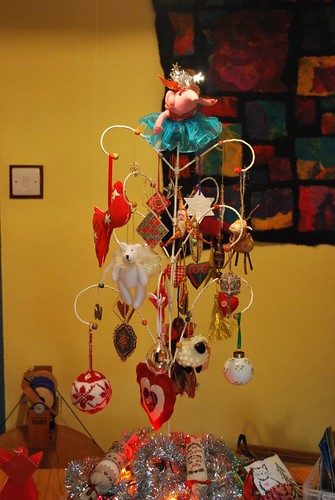
This year, the tree has graduated to the dining table - it's not that the Bug was destructive, but she was inclined just to lean on things persistently enough to push them off the table, and some of these ornaments are fragile, and all have a story attached to them...  As this is a Flickr link, Blogger having changed (yet again) the way it posts photos) you ought to be able to click to embiggen...


Anyway, Tiny Clanger's in her heaven, and I'm off to a friend's house for dinner tonight...  Merry Christmas, all!
 

Wednesday, November 30, 2011

2011 books, #116-120

A full dark house, by Christopher Fowler [audiobook]. Read by Tim Goodman. Rearsby, Leics.: Clipper, 2003.

I enjoyed this immensely while it was happening, but found the plot pretty confusing and the motive unclear.  This may well have been due to no fault of the author though - three of the CDs, including the last one, were really badly damaged.  The final disc looked as if it had been deliberately scratched...  This has a dual setting in the early 2000s and in 1940, when Arthur Bryant and his partner in detection John May first meet at the fledgeling Peculiar Crimes Unit.  It has a great deal of humour and period detail; I'll definitely read another, preferring to believe that it's the jumps in the recording rather than the author's skill which was at fault with this one!

The best American mystery stories 2010, edited by Lee Child. Kindle edition.

Well; if these were the best American mystery stories of last year, it wasn't a great year.  There are a couple of gems - Doug Allyn's An early Christmas, Kurt Vonnegut's Ed Luby's key club and Philip Margolin's The house on Pine Terrace are excellent, but the rest were a combination of the confusing, the somewhat unpleasant, the overly gory and the just plain badly written.  

Fell purpose, by Cynthia Harrod-Eagles [audiobook]. Read by Terry Wale. Whitley Bay, Tyne and Wear: Soundings, 2009.

A young girl's body is found on parkland near Wormwood Scrubs prison.  Fleetingly, Slider's team believe she may have been a prostitute, but it soon turns out that Zellah Wilding was a nice girl from a strict Christian family.  Trying to discover what was happening is steadily more confusing for Slider, as the more he finds out about Zellah, the less he knows.  Excellent vintage Bill Slider, with all the humour and humanity you'd expect.

Open season, by C J Box. Kindle edition.

The first of the Joe Pickett novels - not available on Kindle when I started reading the series.  Joe's daughter tells a tale about a monster who came into their garden the night before - when Joe goes out to reassure her, he finds the bloody body of an outfitter (professional hunter who acts as a guide to amateurs), clutching the handle of an empty cool-box with animal scratch-marks on the inside.  As Joe tries to investigate the murder, all the authorities seem to be against him; he is suspended from his job, and his life and that of his family is threatened.  Box always takes the theme of a good man pushed one step too far; but it's always far more interesting than that.

Betrayal, by Karin Alvtegen [audiobook]. Read by Sophie Ward.  [S.l.]: BBC Audio, 2008.

When Eva discovers her husband is having an affair, she plans her revenge. Before she's able to put her plans into action, she has a one-night stand with a young man who has been keeping vigil beside his much older girlfriend, who has been in a coma for two years.  There's the betrayal of the title in the story, but there's also desperation, and a growing sense of impending disaster.  It's very much in the tradition of the Barbara Vine stories - damaged people coming to a seemingly inevitable collision in the dark.  Not the most cheerful of reading...

Saturday, November 26, 2011

N is for... New ventures

Not mine; but I'm enjoying the reality, and the prospect, of other people's!

Made my first visit to The Sheep Shop this morning - it opened on Wednesday.  And, as ever, I have what a-blogger-whose-name-I-can't-remember dubbed "camnesia" - so no photos.  Picture a traditional Victorian corner shop, with windows on both sides of the corner - but painted white and full of yarn and notions, and  fleece and pattern books.  Lovely choice of yarns, nicely labelled; and masses of natural light to examine it in.  While the shop is still a WIP (I have a lovely handwritten receipt because the till, although present, still needs programming), it has some excellent yarns, a sofa, a table, a coffee machine and a friendly proprietor (thanks for welcoming me, Sarah!).  There was the soft hum of a KnitPicks podcast in the background which was just perfect - not silence, not music, knitting-relevant.

For the public transport user, the location does mean it's a little bit of a trip from the city centre (although it's only 10 minutes on a 10-minutely bus route followed by a short walk) - but if you're in a car and planning to go to the big DIY/business park just opposite, or the Tesco just down the road, it's extremely convenient.  And worth the trip as a completely different alternative to anything else available in Cambridge - this is a true, modern, LYS run by someone who's net-savvy, and we really haven't had that here until now.

I'd love to reveal what I bought - but it's all destined for gift yarn for people who read this, or gifts for people who might read this!  I also got some wooden 4mm KnitPro tips and some small locking stitch-markers for myself.

When I left, clutching my nice paper carrier bag, my stomach reminded me that I was 5 minutes up the road from The Wrestlers - it's been best part of a decade (and possibly more) since a red chicken curry and a pint was part of the routine on a cold Saturday lunchtime. When my ex and I were doing lots of DIY, it was part of the outing; and in fact I've been going there for more than 20 years.  I love the food there; and for the amount of time I'd been away, the prices hadn't gone up as much as I'd have expected.  It was lovely sitting there - with the Kindle rather than the Saturday paper;  time moves on - and noting that the clientele is still half-Thai, half-geek.  (I imagine there's an overlap, but it's not very obvious...)  Anyone visiting the Sheep Shop, take note...

The second new venture is CJ's, a café opening on the Green , next to the SPAR which is opposite my house.  It's the first caff to open in the village as far as I know (well, certainly in the 18 years I've been living here!), and they're doing breakfast and sandwiches and toasties and so on.  I hope it does really well, although its opening hours mean it doesn't coincide well with when I'm around.  The prospect of wandering over the road for a toastie on a lazy Saturday morning is very enticing, though...  And I'm tickled pink by the idea of a local caff being named after a West Wing character.  All power to Cheryl and Elaine who are distributing flyers and cards all over the village.  They're offering Free Stuff on Saturday 10th December, prior to their opening on Monday 12th.

I'm slightly in awe of people trying to start up small businesses in the current climate.  If you're in the general area of either of these and have the slightest interest in their stock, please pop in and spend money.

Saturday, November 19, 2011

2011 books, #111-115

Carved in bone, by Jefferson Bass. London: Quercus, 2008.

The first of the Body Farm novels; I was a bit worried that I'd spoiled myself by reading later books first, but there's much more to this than a case which comes up later. A corpse is found in a cave in a backwoods county of Tennessee, preserved in adipose state, and with a dog-tag around her neck. Bill Brockton is brought in to find out how she died and when, but after threats are made he becomes intrigued as to who the woman is and what her story might be. This does absolutely nothing to challenge some of the 'southern redneck' stereotypes, but many of Bass's characters tend not to lend themselves to typecasting.

No second chance, by Harlen Coben [audiobook]. Read by George Wilson. [S. l.]: Recorded Books, 2004.

This reminded me (in a good way) of Coben's other book Tell No-One. Marc Seidman wakes up in hospital to be told his wife is dead and his 6-month-old daughter Tara has been kidnapped. A ransom drop for the child fails after her grandfather involves the police, and it seems that Marc's sister Stacey was also involved. 18 months later, another ransom note is sent, and Marc and former girlfriend and FBI agent Rachel set out to try to find Tara. There are so many twists and turns in this book, particularly towards the end, that it's slightly dizzying; and I'm not completely sure how convinced I am of the eventual outcome, but it's definitely worth hopping on for the ride.

Dead man's grip, by Peter James. London: Macmillan, 2011.

The latest Roy Grace novel, and a good one. A student is hit by a white van while riding down the wrong side of the road to university, and falls under the wheels of an articulated lorry. Meanwhile, a solicitor on her way to work takes evasive action, ends up hitting a café wall and subsequently tests positive on a morning-after breathalyser. So far, so tragic - but the student is from a New York mafia family, and their rules are somewhat different. Meanwhile Grace is dealing both with Cleo having problems in pregnancy, and trying to have his long-lost wife Sandy declared dead. This all wraps up pretty satisfactorily in terms of the plots for this book, but the characters' ongoing personal circumstances are going to continue to make for good reading in future books.

Free-range knitter, by Stephanie Pearl-McPhee. Kansas City, Miss.: Andrews McMeel, 2008.

Christmas and birthday books always seem not to be read straight away - I think it's the 'having a new hardback and keeping it for best' syndrome... I started this book and for some reason put it back down in the pile, which is a shame, because it's vintage Yarn Harlot - witty, insightful and occasionally very moving. It's a bunch of short essays which talk about knitting's place in a knitter's life, bite-size pieces but there's always something which makes you want to stop and think.

Dead run, by P J Tracy. London: Penguin, 2005.

Four Corners is a pretty dead town in northern Wisconsin even before it is literally a dead town when a milk tanker full of poison gas overturns, killing all life; and Grace MacBride, Annie Belinski and Sharon Muller are heading straight into the area, on their way to help the Green Bay police. Another cracking plot, and the development of the relationships between the characters is part buddy-movie, part Stephanie Plum, and extremely touching and funny.

Friday, November 18, 2011

M is for... Merci

Thanks to everyone who sent commiserations and best wishes after my last post - and to those who e-mailed, texted and remembered the Bug at knitting night. Much appreciated.

I think it'll be a while before I have another cat (and sorry, yes, dog people, it will be a cat - I know some lovely dogs now, but I've just never even imagined myself owning a dog...). The Bug and I had got used to each other for 6 years before I started the new job with the insane hours, which mean feeding happens at Unacceptable Times; introducing a new cat to an owner who's out of the house for 12-15 hours a day during the week would just be unfair (to both of us if the cat resorts to the usual retaliation of shredding-stuff or peeing-on-stuff...). If someone were moving continent and needing to rehome a cat, that might work, but it'd have to come with the equivalent of a current MOT and a full service history, after the insurance travails this year and the realisation of what even a basic set of tests costs... Dealing with vets is a salutary introduction into the world of private medicine. I will comment no further.

Meanwhile; I've discovered my nephew is keen on monkeys these days (up to now his favourite animal has been "spiders" which is somewhat difficult in toy-shops... yes, I have a pattern...). He has the very nice chimp and gorilla I had as a child. My mam was after* a toy orang-utan and I found just the thing on Thursday. Having checked cuteness and price-points are correct, I need to go back and pick him up tomorrow and post him North.

I won't tell you where he is. I need him still to be there tomorrow morning!

*I used this construction, then changed it, then reinstated it. To be "after" something in the North East of England means you're looking fairly seriously for something.

Saturday, November 12, 2011

Bye bye, Bug

Amelia (Jarrahkatt Aimee)
4.9.01-11.11.11


Sadly, after a long hard year of vet's visits and a major operation in the spring, the vet's opinion last night was that it would be kindest to let the Bug go - her kidneys had nearly stopped functioning, she was anaemic and she'd lost yet more weight. It was a horrible decision to have to make but they were brilliant at the surgery. So there's another patch of turned earth in the garden, this time in the border she slept in for most of this summer, and a big empty space around the house.

It's going to be very strange living in a house without cats.

Friday, November 11, 2011

NaBloPoMo - oops...

Well, that didn't work, did it. Last year I didn't post until the 4th - this year I posted until the 4th and then Massive Fail intervened... Oh well.

I'd say it was a long week at work, but I only did 4 days of it; today has been spent taking the Bug to the vet's and waiting for test results. I'm still waiting for a pancreatitis test, and to find out whether they're going to do an ultrasound... sounds likely that they'll keep her in at least overnight, though.

Think I'll go and do some knitting now...

Saturday, November 05, 2011

Knitty Saturday

Good day today - got up late, and meandered into town, snagging the odd Christmas present, disposing of an old camera by giving it to someone who might make use of it, returning a couple of books to the library, picking up materials to make things, and odd bits and bobs from my shopping list. Had lunch, and went knitting.

We were slightly less comfortable than usual - there was a meeting of Serious Gaming Geeks (old-style - cards and dice) somewhat hogging the same space. But there were only a few of us, and it was nice.

I finished up on a test-knit with Katie [Ravelry link], and collected some yarn from Sparkleduck to make a sample of one of Woolly's hats; she'd also brought some yarns she'd dyed in response to my request for a particular colour for a swap.

Really wanted to take a picture to adorn this post, but although the yarn is the purplest purple ever, it's come out as royal blue in all the photos I've been able to take! Trust me, Sparkleduck knows how to enlist my co-operation...


Friday, November 04, 2011

Friday feeling...

... of complete and utter exhaustion. It was a long week at work, and an irritating one, saved by two wonderful guys and their competence with SQL - next week will be better!

It was one of those weeks with a task which was both boring and complex, leading to some interesting dreams when my imagination was set free at night - the dream where Neil Gaiman was driving a bus and then borrowed one of my parents' radiators before he went to a cat shelter was possibly the strangest.

Anyway, a video; read about this in the Standard this evening and it was quite heartwarming.


Apparently after this was all set up, the girlfriend decided she was going to drive in after all that day; at which point the boyfriend went out while she was in the shower, and disconnected the battery on the car...

Thursday, November 03, 2011

2011 books, #106-110

A very private murder, by Stuart Pawson. London: Allison and Busby, 2011.

A Charlie Priest novel; and another excellent one. The girlfriend of a royal prince and the local mayor open a shopping precinct and business park, only to open the curtains on a carefully-crafted swear-word in foot-high lettering. When said mayor is then found dead, the hunt really is on. There are some lovely characters in here, alongside some good detective stuff; and the sort of graveyard humour one hopes for in a Pawson novel.

Silence of the grave, by Arnaldur Idridason [audiobook]. Read by Saul Reichlin. Rearsby, Leics. : Clipper/WF Howes, 2006.

A new author to me - picked it up because of Saul Reichlin's reading, and the recent tales from Iceland told by Franklin. Pretty dark, this one - Detective Erlendur investigates a dysfunctional family from the 1940s after bones turn up during excavations for a new development, while waiting to hear whether his own estranged, junkie daughter will emerge from a coma having lost her baby. There's also domestic violence galore; I think Reichlin's reading of this is the only thing which kept me going with it. I'll try another because Erlendur is an engaging character...

Act of treason, by Vince Flynn. London: Simon and Schuster, 2006.

Another Mitch Rapp thriller, this time dealing with corruption at the highest level of government. When the Republican presidential candidate's wife is killed in an attack on the campaign motorcade, Rapp is called in to track the assassin, but this only really starts a deeper level of intrigue. These books are a somewhat guilty pleasure, given that they can sometimes provide a justification for such modern US "security" measures such as rendition and what constitutes torture. It's a very different mindset.

Hope and glory: the days that made Britain, by Stewart Maconie [audiobook]. Read by the author. Bath: AudioGO, 2011.

Maconie is a bit of a genius - here, he takes ten days, one from each decade of the twentieth century, and uses the themes raised to explore what it is to be British through them. Whether it's the death of Queen Victoria or the Live Aid concert, the Somme or the arrival of the Empire Windrush, he takes the wider ideas of empire and celebrity, war and multiculturalism, and riffs on them as only a former music journalist can. If you've ever heard Maconie on the radio (currently 6 music from 1-4pm, irritatingly), it's impossible to read his books without hearing him reading them, so this audiobook is a special treat.

Solar, by Ian McEwan. Kindle edition.

This was a book club choice (mine) and one that none of us liked very much. Michael Beard is a Nobel prize-winning theoretical physicist; he's also now fat, balding, middle-aged and his fifth wife is shagging his builder. Beard is a very unattractive man in all senses, and his constant womanising, and constant eating of rather disgustingly described food of all sorts, don't help us like him. Sections of the book are curiously old-fashioned, reminding me of Malcolm Bradbury's Eating people is wrong, a Kingsley Amis or an early David Lodge, with its implication that the academic conference circuit is rife with sex and drugs. There are a few funny moments, mainly to do with Beard's chronic lack of self-awareness, but there's a lot of eating without pleasure, having sex through a sense of obligation, earnest banging on about climate change.... As one of my fellow book club participants said, it was difficult to tell what sort of novel this wanted to be, and I'm not sure McEwan ever decides.

Wednesday, November 02, 2011

L is for... Lovely socks


Yes, I know, cop-out on the alphabetical front. Hope you agree with me on the socks, though...

So at the beginning of the year, I signed up for another KAL - this time for Cookie A.'s bookknit.sock.love - so popular it's sold out and is being reprinted at the moment... There are 19 pairs of these socks, and we're knitting them over 20 months. The Ravelry group attached to this KALis an extremely nice place to be - it's a group of generally pretty knowledgeable and skilled knitters sharing information, techniques, and bits and bobs about their lives; it's friendly, it doesn't seem to go round in the endless circles a lot of groups do when people don't read the rest of the thread; and the moderators are excellent. And I now have nine-going-on-10 pairs of extremely nice socks. I'll share the first 5 here, and the second 5 this time next week - I have a reason for this!

All these are knitted top down, and the book is divided into Columns, Tesselations andDiagonals, which express pretty accurately what each category of pattern is doing.

First up, Hedera. This is one I'd sort of been avoiding because a friend had submitted a pattern for the very issue of Knitty this first appeared in, using one repeat of the pattern up the back, and a very interesting construction; it didn't appear in Knitty, but did achieve paid publication in a calendar; but I'd never had the heart to knit these. When I did, though, they're lovely - very stretchy and comfortable, in yarn in a colour called Legolas which Jan had dyed me for Christmas.

The second pair, somewhat more variegated. Again, a pattern republished from a Knitty issue, but this time resized for several widths of foot. What made these fun to knit (as I'd already made one pair when the pattern came out) was the yarn; Lorna's Laces Shepherd's Sock in Franklin's Panopticon colourway, and a gift from the man himself a couple of years ago.

I loved the way these striped so much that I really didn't want to go for the flap-and-gusset heel - so this was my first attempt at an afterthought heel. I'd certainly do that again if I had such very nicely striping yarn - it doesn't break up the colour the way a gusset would, because you don't change the number of stitches on the basic sock.

March/April's pair - wow. While this wasn't a complicated knit in the end, it was a complicated start, with 10 markers on each sock and lots of travelling stitches. This was the first of the Diagonals section, and you can tell... These were a birthday present for my friend Sue. The yarn was some from the Socktopus sock club - Enchanted Knoll Farm in Emerald Lake.

Next up - beautiful colourway, autumnal colours in Cairn from The Yarn Yard. These were a once-only colour so it was difficult to give them away, but they went to Jackie for her birthday. The pattern is Mona, and it was really delightful to knit...

And then finally for this post, May/June's pair, Rhombus. This is definitely the most difficult pair of socks I have ever knitted. And they look so innocuous! I don't know whether it was the two types of make-one-stitch involved, or the fact I never quite managed to memorise the pattern repeat, but I've never been so stymied by a pair of conventionally-constructed socks.

However, eventually they were done, and went to my mam for her birthday in August. She likes purple...

I'm enjoying the KAL immensely but I hadn't realised quite how much of a month is taken up by knitting a complicated pair of socks each month! I've taken nearly a month off this time, because we're slackening up slightly for Christmas, and have got lots of Christmas and test-knitting done in the time I'd normally be making fancy socks...

Speaking of which, there's a hat calling me. Talk to you tomorrow.

Tuesday, November 01, 2011

K is for... KAL (which is for KnitALong )

I always say I'm not a joiner. I never was. I don't do competitive sports (although I love to watch cricket and, these days, cycling.) Somehow, though, if I do something as rash as going to a church or joining a knitting group I always end up on the committee, or as one of the people who you ask about stuff... And every now and then I rebel and wriggle out of my commitments for a while, only to create ties again. I'm one of those people who puts her hand up even at the moment of thinking "oh, no, here we go again"...

And I can't resist a good KAL. Which is why I'm in 3 at the moment, as of this morning. One is very long-term, and I'll talk about that tomorrow. These are the two one-project KALs.

The newest, first instalment November 1, is WoollyWormhead's annual Mystery Hat [Ravelry link]. Or indeed, hats. I'm going to be doing Hat A this year, in some lovely russet possum yarn. But it's not cast on yet as the first bit of the pattern just came out this morning, and I bought my needles for it at book group this evening. Nothing to see here. This might be for my cousin's partner or it might be for me... It's an alternate cable cast-on which I absolutely love as a method (and stop sniggering, Wibbo, that was a variation 2x2rib alternate cast on [with a double dismount], worked while in company). Tomorrow I will stick my earphones in and listen to Calming Music for 10 mins or so while casting on.

The one which is sort-of-in-progress-but-a-bit-late is Ann Kingstone's Tess slippers. Not tardy from Ann's point of view - she's posting the instalments just fine...; it took me a while to get going. Toe-up is not my favourite way to go with socks, and I was doing a couple of test-knits at the time (and I have no idea how many times I needed to watch the YouTube video to make it make sense...) But I have a toe of one, and a cast-on on the other, and while I'm not convinced my colour choice is doing the best justice to the pattern, it looks rather fabulous to me...