Saturday, March 15, 2014

Grand day out: Saltaire

So, I went on PodRetreat in February, and I have photos; but striking while the iron is still reasonably luke-warm, this was last Friday's slightly mad day trip.

Just after Christmas, East Coast had a sale; a ridiculously good sale. Wasn't able to pin family down to dates within the timescale, and there weren't many trains on a Sunday in the offer, so I thought "Wonder how far I can go for £5 each way?" and the answer was York or Leeds. I love York; but I love Leeds more, and all I've done there for the last many years is change train, occasionally popping out of the station for a quick meal between journeys.

I set off at 5:35am from the village (first train out; only the second time I've done that), so by 9:30 I'd got to Leeds, bought my onward ticket, and wandered out to City Square.
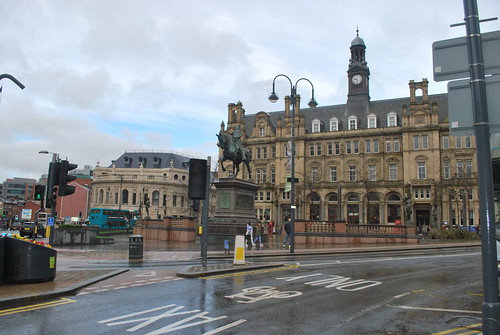
leeds1

As you can see, it's a bit wet; but the forecast for the rest of the day was good.  And there was a happy sight on the way out of the station; Leeds is seriously cheerful about the Grand Départ  in July.

leeds2

(This year, I'm abandoning the French pronunciation of Grand and doing it in a Yorkshire voice in my head...)

Normally, I'm really organised on a visit; this time, other than the tiny map in the Kindle version of the Rough Guide and a quick look-up of bus routes, I was entirely unprepared for the trip after what had felt like an extraordinarily long week.  I also have absolutely no sense of direction, which is always interesting in a strange city, even one I visited briefly last year.  But I had a destination in prospect, and Leeds has lots of maps around at road junctions, so I found the bus stop, and the no. 1 bus; and I reached my destination about 2 minutes before it was due to open. Looked promising!
baaramewe1

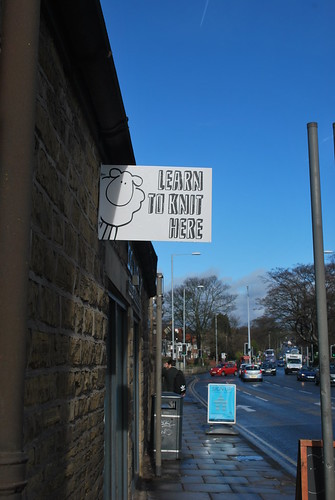
The extremely nice Baa Ram Ewe (Headingley branch); just opposite a big shopping centre, but based in a converted cottage; about 15 minutes from the city centre by bus.  The person in the shop was American, and lovely, and I realised afterwards we hadn't exchanged names (sorry, lovely yarn-shop lady!); conversation ranged from London commuting to Yarndale to the beautiful yarns they had from West Yorkshire Spinners.

baaramewe2

 One of my aims was to fondle some of their own Titus yarn, as I hadn't managed to get anywhere near their booth at Yarndale, particularly given my final destination. A skein of duck-eggy-green, very springlike (Bramley Baths), has accompanied me home, along with a coordinating Crazy Zauberball; once the current knitting project is done that'll be the next thing on the needles! (Also picked up some gift yarn and a couple of skeins of discounted Colinette.)

baaramewe3

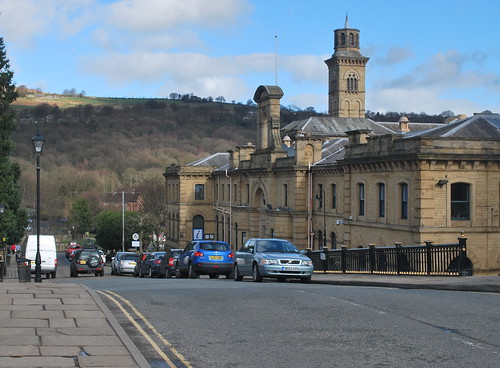
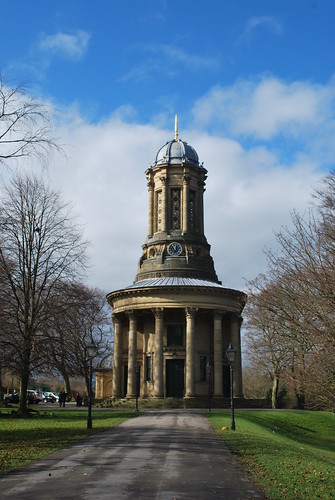
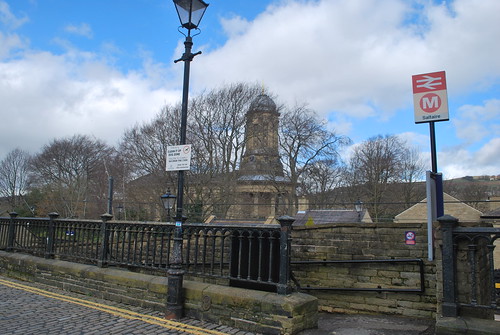
All yarned-up, I got the bus back into Leeds and a train out to Saltaire.  I've been through Saltaire so many times on the way to Keighley for the SkipNorth holiday, and every time I've promised myself that next time... I'd stop.  But I've always had luggage with me, and luggage and cobbled hills don't really match. This time, I could have a ramble round.  It had turned into a perfect spring day by the time I got there...
saltaire1

saltaire2

saltaire_church

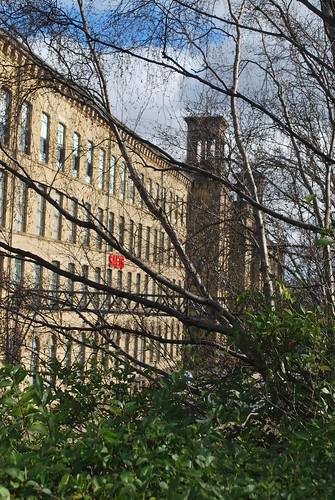
First destination: Salt's Mill.  Built in 1853 by Titus Salt for textile production, and the heart of the planned community which surrounds it.
saltaire3

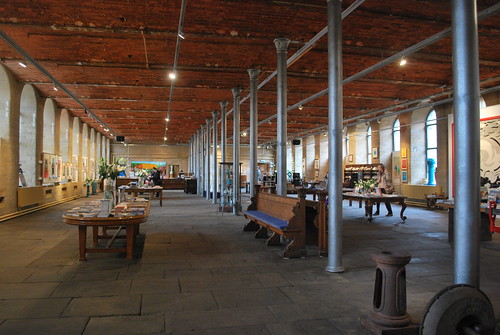
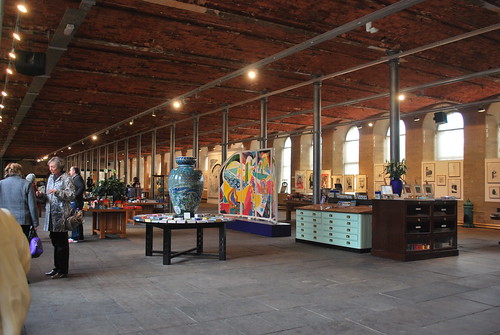
Textile production ended in the 1980s, and the mill was bought by Jonathan Silver. Since then, it's been converted into a series of galleries, shops and restaurants, and contains a huge collection of works by local boy David Hockney.  This is the ground floor gallery
saltaire4

saltaire6

There were some beautiful pots.  Some William de Morgan, some Islamic, some local.

saltaire5

These ones are Burmantofts - I hadn't heard of them before, but they're local, and from a company much better known for tiles and architectural features.  Fabulous things.

saltaire7

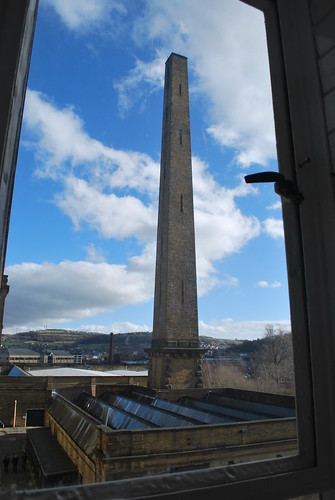
View from the ladies' loo window...

saltaire8

After a lovely smoked chicken salad at Salt's Diner, and a poke around the shops (think I've managed to stock up on cards and small gifts for the next six months or so!), I thought I'd do the walk round the village suggested in the official guidebook.
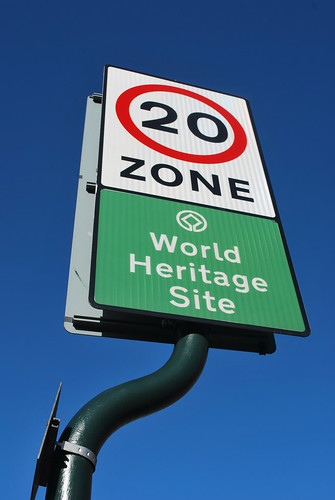
saltaire15

Other than Albert Street and Victoria Street, all  the others are named after members of Titus Salt's family.
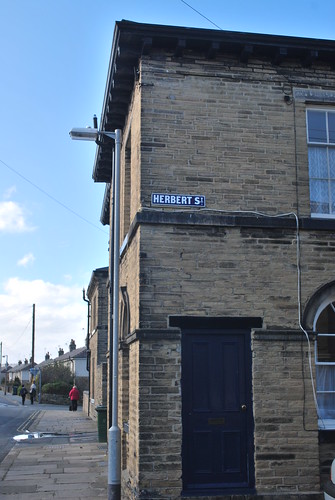
saltaire12

Some of these names work better in a modern context than others.
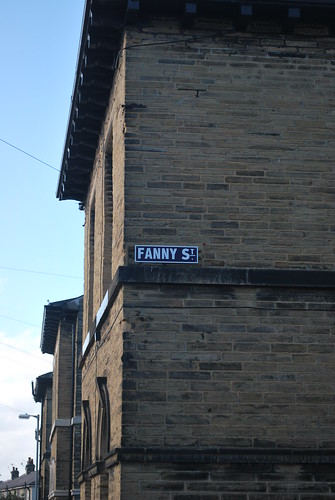
saltaire11

Here are some of the more humble houses

saltaire9

saltaire10

(following the modern rule that Where There Shall Be Houses, There Shall Be Wheeliebins. I'm hoping it's bin day, rather than that being the permanent situation - we used to play in the lane like that behind our house when we were kids).

Here are some of the rather posher ones, belonging to overseers.
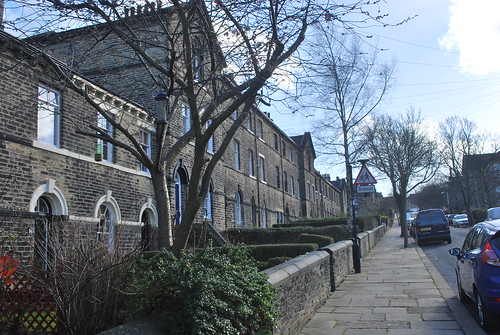
saltaire14


Signs of spring

saltaire13

There are also almshouses

saltaire16

saltaire17

and a concert hall (the Victoria Hall, of course)

saltaire19

and, right next to the station, a pub.  As you can see from the name, not in the original town plan.  Salt doesn't appear to have been anti-alcohol - the mill-owned shops in the village would do off-sales - but preferred to build educational public spaces.
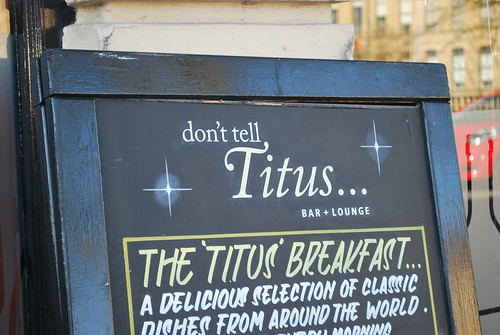
saltaire20

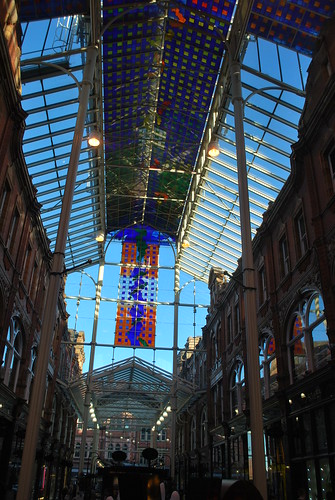
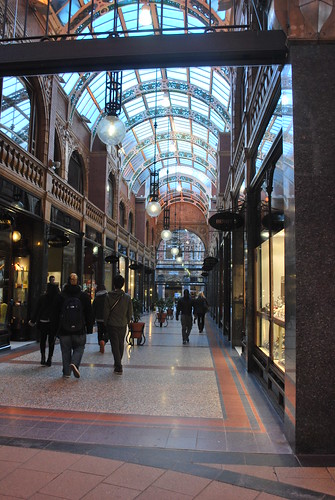
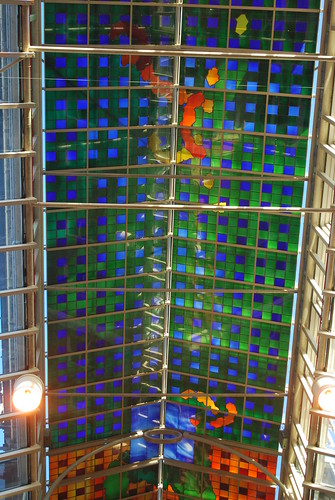
After a restorative pint, I went back to Leeds in mid-afternoon, and had a wander round the city centre. Missed the covered market (due to lack of sense of direction), but found the Victoria Quarter and its rather spectacular stained-glass roofs

leeds3

leeds4

leeds5

and one of my favourite shops - stand aside, Harvey Nicks, this town has a Clas Ohlson!  Realise that not everyone's idea of holiday shopping is buying locks, hacksaws and cleaning materials; I love Clas Ohlson but don't get to Norwich very often...

leeds6

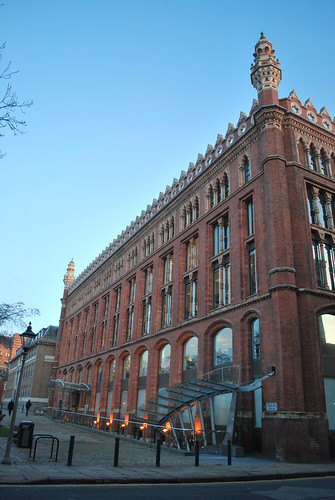
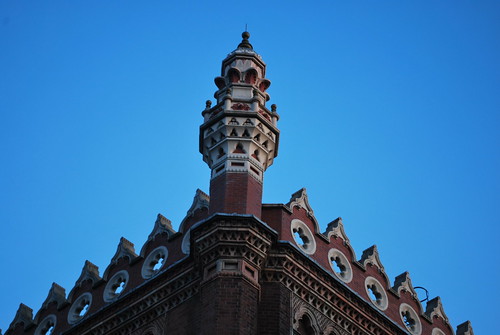
Looking for somewhere to eat on the way back to the station, I again got lost, but heading downhill always seems to be a good move.  I ended up in a Pizza Express (lack of research again!), but it was right next to St Paul's House, a spectacular Hispano-Moorish construction; former cloth-cutting mill which now seems to be full of lawyers.
leeds7

leeds8

I was shattered on the train home and the next day, but it was completely worth it - hills, sunshine, Yorkshire and its sense of solid Victoriana, yarn...  Lovely day.

2014 books, #21-25

Lost river, by Stephen Booth. London: Harper, 2011.

On May Bank Holiday afternoon, Ben Cooper pulls a dead child from a river; the incident is immediately traumatic, but there seems to be something more than accidental death involved and Cooper is led to investigate the girl's family. Meanwhile, Diana Fry is reliving trauma of her own - new DNA evidence has been found by West Midlands police, and the case is Diane's own rape, the event which sent her to Derbyshire in the first place.  This is a slightly disjointed book because of the two settings, and to me there are some slightly strained (and possibly stereotypical) elements - Fry's taking the law into her own hands to the extent she does doesn't seem in character; but the coming-together of the two very disparate plots into similar themes (won't say more, spoilers!) is so skilfully done that Booth's allowed the benefit of the doubt here!

Vengeance [Mystery Writers of America presents...]. Edited by Lee Child. London: Corvus, 2012. [Kindle edition.]

A volume of short stories around the theme of vengeance.  As ever with these anthologies, it's a mixed bag; but some of these stories are extraordinarily good.  Unfortunately, as I never seem to get around to blogging books from the Kindle, I can't really remember which were which!  There are some big names here, as you'd expect from a book with Child's pulling power - Child himself, Michael Connelly, Dennis Lehane and Karin Slaughter, but also some newer authors like Dreda Say Mitchell and Alafair Burke.  (And as far as I remember, it was a very good cheap offer on Kindle at the time!)

A fatal thaw, by Dana Stabenow. [Kate Shugak 2]. Kindle edition.

I got these for Kindle last autumn, but was waiting until it was a bit warmer to read them - they're set in Alaska and Stabenow is extremely good at showing us how cold it is!  Kate Shugak is caught up despite her will in another murder; nine of her neighbours have been killed by a man running amok with a hunting rifle. As investigations continue though, it seems that one of the dead was actually murdered with a different weapon, and just about everyone in the area had a potential motive. Kate and her motley crew of sidekicks including a part-wolf, part-Husky called Mutt and a disabled Vietnam veteran called Bobby take on the case, at some personal cost.

Dead in the water, by Dana Stabenow. [Kate Shugak 3]. Kindle edition.

This time, Kate is investigating the deaths of two crew members on a crab-boat in the Aleutian islands (yes, possibly even colder than the last book) by joining the crew. The work is extraordinarily hard but also pretty lucrative, but she suspects the captain and permanent crew members of having alternative sources of income. She also needs to protect her very young, very naïve roommate Andy from their colleagues, and while she has her usual backup from Jack Morgan on land, she's at sea on her own in every sense. As someone who's part-Aleut, she is also drawn to the people of the islands and their culture, which adds another element of interest.

Meet me in Malmö, by Torquil MacLeod. Kindle edition.

Ewan Strachan, a washed-up arts journalist from Newcastle, goes to Malmö to interview an old college friend, Mick Roslyn, now a successful film director with a film-star wife.  When he gets to Mick and Malin's flat, he finds Malin dead and no sign of Mick. Strachan is held in Malmö, filing despatches about the murder investigation and travel pieces, while inspector Anita Sunderstrom investigates. Meanwhile, we're finding out things about Strachan and Roslyn's relationship, which involves the suspicious death of a woman 25 years before. I wasn't massively convinced by this book; there are too many unconvincing twists and turns, and unlike with masters of these (like Deaver), you can see the mechanism too closely. The end also has a very unconvincing last bite in it.  Not necessarily recommended, although it starts off very well.


2014 books, #16-20

A land more kind than home, by Wiley Cash [audiobook]. Read by Lorna Raver, Mark Bramhall and Nick Sullivan. Rearsby, Leics.: Clipper, 2012.

Based on a true event. An autistic child is smothered during a "healing" service in a snake-wrangling church in North Carolina; the violence which follows in investigated by a sheriff with his own tragedies in the past, and his own axe to grind. The writing here is sometimes astonishingly moving, and the situation - faith, infidelity and the failure of a community to protect its children - very tragic. The multiple narratives wind around each other (this is possibly one where the audiobook format works at its best), and the conclusion is as shocking as it is inevitable. A very, very good book.

Racing hard: 20 tumultuous years in cycling, by William Fotheringham. London: Guardian/Faber, 2013.

I was interested in cycling in the late 80s when living in France, and subsequently watching the Tour highlights in sports bars after a day at the archaeological-finds-classifying tables, but from about 1993 until four years ago, I'd completely lost touch with the world of professional cycling.  This book fills in those gaps wonderfully with accounts of the development of the Tour and its characters, and of the development of the current crop of British cyclists (culminating in Wiggins's win in the 2012 Tour, and the 2012 London Olympics and Paralympics). Fotheringham has written on many more subjects than this but he's decided to confine his scope to those two events here. He combines the viewpoint of the fan with that of the relative insider - his obvious disappointment and distress at the various drugs scandals is clear - and while he could have edited some of his articles extensively, he's reprinted them unedited, with rueful notes on the benefit of hindsight.  Great book.

Gone in seconds, by A J Cross [audiobook]. Read by Anna Bentinck. Oxford: Isis, 2013.

When the skeleton of a young woman is found near a West Midlands motorway, evidence suggests that it is that of teenager Molly James, who went missing five years ago. Forensic psychologist Dr Kate Hanson and the Unsolved Crime Unit are called in to re-investigate Molly's case. The deeper they dig the dirtier the clues get, and when a second set of remains is unearthed Kate suspects they're looking for a Repeater: a killer who will adapt, grow and not stop until they are caught. She also suspects that not all of her colleagues are as keen on investigating the case as she is. Good; tightly plotted.

The shock of the fall, by Nathan Filer. London: HarperCollins, 2013.

This year's Costa winner, and an astonishing book.  The narrator is a mentally ill 19-year-old boy, writing consciously for publication, whose illness seems to have been precipitated by events around the death of his older brother, who had Down's Syndrome, ten years before.  'I'll tell you what happened because it will be a good way to introduce my brother. His name's Simon. I think you're going to like him. I really do. But in a couple of pages he'll be dead. And he was never the same after that.'  The account's both a diary and a memoir, and the text changes font and breaks up at different times to reflect Matt's state of mind. Not a cheerful book, although it's not without hope, but a fascinating read.

The daylight gate, by Jeanette Winterson. London: HarperCollins, 2012.

Written to commemorate the 400th anniversary of the Pendle witch trials, this contains as much sex, violence and persecution as you might expect. Winterson weaves her tale around Alice Nutter, the only witch from the middle classes who was executed at Pendle. In Winterson's version (which she freely admits to be at least part fantasy), Alice makes her fortune by the invention of a colourfast magenta dye beloved of Elizabeth I, and has been in London with John Dee and Shakespeare; she has learned the secret of the elixir of youth from Dr Dee; and she is sheltering Christopher Southworth, one of the Guy Fawkes plotters and a Catholic priest. This is a wild, swirling fantasy which dips in and out of historical events while getting its feet completely soaked in the filth and squalour of the era.


Wednesday, March 05, 2014

2014 books, #11-15

Sycamore Row, by John Grisham. London: Hodder and Stoughton, 2013.

This is a (very belated) sequel to A time to kill, which was made into an extremely good film.  Like the previous chapter of Jake Brigance's story, it's set in the 1980s. Unlike the previous chapter, this is a civil case about a will. Seth Hubbard hangs himself, after posting a handwritten will and covering letter to Jake; the will leaves 90% of his fortune to his (black) housekeeper and revokes a previous testament leaving substantial amounts to Seth's children.  Jake is again in the middle of a viper's nest (and increasingly disenchanted once race comes into the story), and when the principal beneficiary is swooped on by lawyers with an axe to grind, he's on the verge of throwing in the towel.  As ever with Grisham, if you're alert you can see the ending coming way ahead; but it's still worth reading for all that.

No rest for the dead, by various authors. London: Simon and Schuster, 2012.

When the dead body of Christopher Thomas, a ruthless curator at San Francisco’s McFall Art Museum, is found bloodied and decaying in an iron maiden in a museum in Berlin, his wife is the primary suspect. Rosemary Thomas is tried, convicted, and executed, but ten years later, Detective Jon Nunn remains convinced that the wrong person was put to death.  This is a collaboration between over 20 authors, most of them extremely well-known, each taking a chapter.  The chapters are cleverly allocated - Kathy Reichs writes up the forensic reports, Jeffery Deaver presides over a chapter with a couple of the switchback turns he's notorious for, and so on - and the writing remarkably even.  Good plot, and an interesting project; all profits to leukaemia and lymphoma research.

The late scholar: Peter Wimsey investigates. Based on the characters of Dorothy L Sayers, by Jill Paton Walsh. London: Hodder and Stoughton, 2013.

Another excellent Wimsey novel; Paton Walsh treads a fine line between pastiche, fanfiction and new fiction, and comes out on the right side of the line on all counts.  Along with his unwanted Dukedom, Peter has inherited a position as the Visitor at St Severin's College, Oxford, and is called in as the final arbiter in a bitter college dispute which has already proved fatal for at least one of St Severin's dons, and may have accounted for the Warden, too.  And someone is using methods from Peter's cases (as recounted in Harriet's novels) to try and despatch academics.  Really excellent.

Breakdown, by Sara Paretsky [audiobook]. Read by Liza Ross. Oxford: Isis, 2012.

A group of schoolgirls who've gathered in a cemetery to re-enact Carmilla stories (a sort of Twilight-type series of novels for tweens) find a dead body on a slab.  They're not a typical group of girls, though - one is the granddaughter of a billionaire, another is the daughter of a Democratic Senate candidate and two of the others are the children of an illegal immigrant, at the exclusive school on scholarships.  All are now in danger, and VI Warshawski's cousin, a classroom assistant at the school, calls in VI to help. As she does so, she is dragged into a web of deceit and personal danger.  There are, as ever, a couple of slightly unlikely elements in the plot, but it's a very good one and stretches from 1940s Poland to the present day.

The bones of Paris, by Laurie R. King. London: Allison and Busby, 2013.

A follow-up to Touchstone, although you probably don't have to have read that one to enjoy this.  Harris Stuyvesant is in Paris in 1929, hired by an American family to find their missing daughter. While searching, he discovers she may not have been the only missing person to have disappeared in similar circumstances, and is drawn into the circle of a fashionable elite including Man Ray and Picasso, and the macabre world of the Grand-Guignol and a fetishism of death. King slips into the world of the period without obvious anachronisms.  Genuinely scary in parts, and as ever tightly-plotted.


Friday, February 14, 2014

2014 books, #6-10

Dancing with the Virgins, by Stephen Booth. London: HarperCollins, 2001.

The stone circle known as the Nine Virgins has stood on the Derbyshire moors for centuries; a National Parks warden comes across a tenth figure in the circle, a young woman who has been stabbed. There are echos of an attach a couple of months earlier where another woman, a lawyer, had her face slashed open in an incident she prefers not to remember. Diane Fry (newly promoted to Acting Sergeant but waiting for a post elsewhere) and DC Ben Cooper have to put aside their personal differences to work on the investigation; as ever, the dynamic between them adds an extra element to the story.

Liars all, by Jo Bannister [audiobook]. Read by Patience Tomlinson. Whitley Bay: Soundings, 2010.

I got this and wasn't able to remember whether I'd read this one in the series before; turns out I had, but way too quickly to be able to retain it.  I agree with what I said at first reading, except that I think I like Brodie even less at second reading.  It's interesting that Jo Bannister hasn't come back to these characters since - I wonder if she's managed to put herself off Brodie, too, or whether she just doesn't know what to do with the plot at this point!  She's still writing though, just not in this series...

Shane, by Jack Schaefer. [S.l.]: Random House; [n.d.]

We picked this for book group as a classic Western.  The publication details above might give you an idea of how difficult this title is to obtain - the county library system had no copies, and Random House's technical information page (copyright, CIP etc.) concludes with "Random House Children's Books supports the First Amendment and celebrates the right to read" while giving neither a place or date of publication beyond the original in 1946.   Has to be said, this is not your standard children's book of today; there's meaningful violence, language, a very interesting undertone about the relationship between the three adults... And it's immensely enjoyable, and honourable, and brave, and somewhat tear-jerking...  If you'd like my copy, leave me a comment with some information on how I can get in touch with you; I think more people should be able to read this book.

Tigers in red weather, by Liza Klaussmann. London: Picador, 2012.

Another book group book (difficulty in getting hold of Shane meant we had two discussions on that one). Nick and her cousin Helena grew up together sharing long summers at Tiger House, (which I believe is on Nantucket or Martha's Vineyard);  they keep going there with and without husbands and children, but the cracks keep forming.  This novel is written from several different perspectives; and I think the character I most dislike is the focus of the first section, so I did question my sanity in reading it for the first few chapters. Thankfully, nobody else in the book much likes that character either... There's some genuinely sinister stuff here.  The shifting perspectives mean that each narrating character can defend her/himself, and this may be contradictory to the previous narratives; and at book group discussion, we had sharply differing views as to the characters we did and didn't find sympathetic.

The facility, by Simon Lelic [audiobook]. Read by Paul Panting. Isis: Oxford, 2011.

Dystopia. We start with a man being threatened, interrogated and held for an undisclosed offence. He's put on a bus and admitted to a Facility at an undisclosed location, but has no idea why or what's going on.  It's Kafka in the security age.  I sort of don't want to say more because it takes a while to work out what on earth is happening (the Home Office statement on that happens at least a third of the way through).  I would say that if you're OK with conspiracy theories, read or listen to this book. And if you're not, read it anyway because it rattles along very nicely. There is some gruesome stuff, but you'd probably expect that from the title.


Saturday, February 01, 2014

Poetry for St Brigid

St Brigid's Day, and while I'm not sure posting a poem is still an internet Thing, I had a Collected Robert Frost for Christmas, and this one remains a favourite.

Desert Places

Snow falling and night falling fast, oh, fast
In a field I looked into going past,
And the ground almost covered smooth in snow,
But a few weeds and stubble showing last.

The woods around it have it--it is theirs.
All animals are smothered in their lairs.
I am too absent-spirited to count;
The loneliness includes me unawares.

And lonely as it is that loneliness
Will be more lonely ere it will be less--
A blanker whiteness of benighted snow
With no expression, nothing to express.

They cannot scare me with their empty spaces
Between stars--on stars where no human race is.
I have it in me so much nearer home
To scare myself with my own desert places.

And if that one's a bit sad, Frost can be lighter...

[Forgive, O Lord...]

Forgive, O Lord, my little jokes on Thee
And I'll forgive Thy great big one on me.

Saturday, January 25, 2014

2014 books, #1-5

Refusal, by Felix Francis. London: Michael Joseph, 2013.

Another extremely good book by Felix Francis; as Francis finds his stride, he's even dared reprise one of his father's classic heroes, one-handed former jockey (and, when we find him, former private detective) Sid Halley, and managed it very well.  Sid is married, with a daughter, making his living by playing a different sort of form book on the stock exchange, when the chair of the British Horseracing Authority asks him to help in what looks like a serious case of race-fixing.  While Sid is deliberating, the BHA chair dies, apparently having committed suicide, and Sid and his family are threatened.  Classic Francis but with the benefits of technology like GPS tracking the original Halley books would have loved to have employed.

Final jeopardy, by Linda Fairstein. London: Sphere, 1998.

The first of the Alexandra Cooper series - thought I'd go back and read them in order. Alex finds that she has been reported in the media as dead, because someone has been killed in the driveway of her holiday home in Martha's Vineyard; the victim turns out (somewhat improbably) to be a film star Alex has met through a literary agent friend.  The mystery deepens when it becomes apparent the victim was complaining about being stalked, and was also staying with a male friend nobody knew about.  This is well-paced; these books are always somewhat histrionic, but worth sticking with.

Die trying, by Lee Child [audiobook]. Read by Garrick Hagon. Whitley Bay: Soundings, 1998.

A typically excellent Lee Child, one of the early ones. Jack Reacher stops on a Chicago street to help a woman struggling with a door, a crutch and her dry-cleaning, and is abducted along with the woman. When the woman turns out to be an FBI agent, and the daughter of the Joint Chiefs of Staff, he realises this is a high-stakes abduction.  Tightly-plotted as ever. Two slightly comic elements for Brits of a certain age - the FBI agent's name is Holly Johnson, which means I had Two Tribes running round my head throughout the book; and it features the Montana Militia, who are sinister enough, but combine with the original Chicago setting to give the Illinois Nazis...

Raising steam, by Terry Pratchett. London: Doubleday, 2013.

The railways come to Ankh-Morpork.  And in fact, many places on the Disc.  As with any innovation, Moist von Lipwig is right there in the vanguard, or in this case in the guard's van, with Harry King and the Patrician. This is classic Pratchett, not afraid to be a little bit emotional at the power of technology in the hands of Yorkshire lad Dick Simnel, but also slyly combining all of those classic railway moments, such as Brief Encounter and The Railway Children, as well as introducing us to the first trainspotters; and just a hint of sapient machinery. Excellent.

Nightrise, by Jim Kelly [audiobook]. Read by Ray Sawyer. Oxford: Isis, 2012.

Philip Dryden is somewhat surprised to be informed by police that his father has just died in a car accident, as his father drowned during the fenland floods in 1977; Dryden Senior's body was never found though, so Dryden can't help wondering...  Two other stories are demanding Dryden's journalistic attention, though; that of a body found hanging in the middle of a lettuce field, and a couple whose baby daughter's remains were buried in a mass council grave and want to reclaim the body for burial.  Another of Kelly's Ely-based books; the setting, as ever, is very accurate although it would be lovely if there really were a fabulous Italian restaurant in the alley next to Oxfam!

Thursday, January 02, 2014

2013 books, #101-105

Round up of the last few books of last year.  Not quite as many as last year, but I seem to have had a lot of audiobooks I rejected halfway through this year!

Dead water, by Ann Cleeves. London: Pan, 2013.

The fifth of the Jimmy Perez/Shetland series. Perez is still on leave and shattered by recent events, but when the body of a Shetland-born London journalist is found in a racing boat by the Procurator Fiscal herself, he summons up the interest to join DI Willow Reeves and her team.  The Fiscal is definitely hiding something, but so are others in the islands. Sandy Wilson makes another appearance, and I hope we see more of Willow.  This is the sort of tightly-plotted page-turner we're used to from this series.

One cold night, by Katia Lief. Kindle edition.

Susan and her husband Dave are providing a home for Susan's teenage sister Becky; but Susan has a secret - Becky is not her sister, but her daughter. When Becky decides to go looking for her birth-parents, Susan knows it's time to tell the secret. Becky, upset, leaves the house, and is then abducted.  At first all clues seem to lead back to Susan's high-school boyfriend, Becky's father, but it's not as straightforward as that...  This is well-written but somehow I didn't really warm to the characters.

The Moat Farm mystery: the life and criminal career of Samuel Herbert Dougal, by M W Oldridge. Kindle edition.

In 1903, Samuel Herbert Dougal stood trial for the murder of Camille Cecile Holland, a spinster he had seduced and murdered, afterwards clearing out her bank account  This account of Dougal's life shows this to have been the culmination of a thoroughly unpleasant life. After a reasonably successful army career, Dougal soon found he was both entirely unsuited to civilian life, and somewhat irresistible to women.  He tried his hand at pub landlording at Royston but was tried for arson after his pub burned down in suspicious circumstances; he applied for the position of public hangman but was turned down; and he had a history of forging cheques even before he met the wealthy and reclusive Miss Holland.  This narrative is fascinating, if unpleasant, and very readable.

Quiet: the power of introverts in a world that can't stop talking, by Susan Cain. Kindle edition.

This is one of the most interesting books I've read this year - and I can't work out why I didn't review it when I read it in September/October!  Cain talks about the differences between introverts and extroverts, and explains some reasons why contemporary (particularly US) society is more comfortable for extroverts. She talks about the Asian-American experience and how cultural values play into introversion, and discusses situations in which introverts perform more strongly.  This book told me some things I didn't know about myself, and explains some things I did; I found it fascinating.

A shilling for candles, by Josephine Tey [audiobook]. Read by Stephen Thorne. [S. l.]: Chivers, 1993.

I'd forgotten this one despite having read it years ago.  The body of Christine Clay, a prominent film actress, is found on a beach near a cottage she's renting; the initial suspect is a young man who has been lodging with Clay.  Although he's exonerated early on, his continued disappearance is a worry for Grant and his colleagues.  Rivalries on stage and in the theatre are exposed, and recurring Tey characters Grant and Marta Hallard feature.  Having read the excellent Nicola Upson books set among these characters, I found it slightly difficult to straighten out the time period and relationships, and particularly to keep my Lydias straight! Definitely worth re-reading though, and Thorne's dry narrative style fits Tey's sly humour very well.

Saturday, December 14, 2013

2013 books, #96-100

Black diamond, by Martin Walker.  London: Quercus, 2010.

An Inspector Bruno novel.  In this one, Périgord's most prized product, the truffle, is threatened by reports of adulteration at the local market. At the same time, the horrific murder of a local truffle-hunter drags Bruno into French-Algerian history, and past and present crimes intertwine.  As ever, there are some great characters here, and Walker keeps a light touch while talking about serious subjects.  I'm very glad there are a few more of these to read before I catch up...

Shattered, by Dick Francis [audiobook]. Read by Tony Britton. Bath: Chivers/BBC Audiobooks, 2000.

For those who've read all these, this is The One With The Glassblower.  I was spending the weekend at the sewing machine, and wanted something I'd already read - and Tony Britton is such a consummate reader of Francis...  As it was - I really can't remember reading this one at all, so it was a pleasant surprise!  Gerard Logan, the glassblower, goes to Cheltenham Races with his friend jockey Martin Stukely on Millennium Eve; Martin is crushed by his horse and killed, and his valet hands his saddle and a videotape to Gerard. That's when everything goes a bit mad - Gerard's workshop is burgled, as is his house and Martin's, and the tape is stolen without his having an idea of what the thieves wanted.  This is vintage Francis - you learn interesting things about glassblowing, it rattles along at racing pace, and as ever Britton's reading is excellent.

The search for Richard III: the king's grave, by Phillipa Langley and Michael Jones. London: John Murray, 2013.

This is a very readable account both of the short kingship of Richard III and of the recent dig which uncovered his bones under a social services car park in Leicester.  It's arranged in alternate chapters of straight history and fundraising/archaeology/fannishness.  Michael Jones seems to play it quite straight with the history - he's sympathetic to Richard but also concedes his ruthlessness in some circumstances. Phillipa Langley is the first to admit her partiality, but her account of how the dig was arranged is fascinating for anyone (like me) who's worked as a volunteer around an established dig; I could sort of have done without her repeated stressing of her intuition as to where the body was buried, but as she turned out to be right, and as her obsession was a large part of getting the job done in the first place, fair play to her!

The people's songs, by Stuart Maconie. London: Ebury Press, 2013.

I'd forgotten to review this, until I had a short exchange with the chap himself on Twitter earlier and realised that this had had to go back to the library sharpish at the time because there were other people in the queue behind me, so it hadn't hung around on the review pile... This is the book of the recent Radio 4 series - because this is arranged chronologically, and the series wasn't, and I managed only to dip into the series and catch up with more episodes on iPlayer, I'm not quite sure whether these are the scripts for the series slightly elaborated and without the additional voices of people who remember the era, or not.  But actually, that won't matter now the series has ended; it stands up as a book. What you get here is 50 short essays on life in Britain during and after the Second World War, each introduced by one representative track.  So the Asian experience in the UK is represented by Brimful of Asha; pop's social conscience by Do They Know It's Christmas?; Britain's changing climate for LGBT people by Smalltown Boy, etc... This could be an unsophisticated way of looking at the subject - but it's Maconie, so obviously it's way better than that.  These are thoughtful, thought-provoking, entertaining pieces; and it goes without saying that there's a lot of humour, too.

The detective's daughter, by Lesley Thomson. Kindle edition.

Terry Darnell, a detective who's carried on investigating a twenty-year-old crime into his retirement, is found dead outside a Co-Op in the town where the victim was buried.  The death's due to natural causes, but his daughter Stella has to deal with his effects and with clearing out his house, and becomes curious despite herself in the father she's been detached from for most of her life.  As she becomes more and more interested in the mystery, her entirely organised life (running a cleaning business, living in a brand-new spotless flat, dumping the boyfriend when it's all too complicated) also begins to disintegrate, and she makes the acquaintance of Jack, a superb cleaner but a deeply private man... I enjoyed this, despite finding the main character almost entirely unsympathetic throughout, and despite finding a couple of holes in the plot difficult to deal with.  Definitely worth reading.

Friday, December 13, 2013

2013 books, #91-95

Death's door, by Jim Kelly [audiobook].  Read by Roger May. Oxford: Isis, 2012.

On a hot August day in 1994, 76 holidaymakers travel to an island off the North Norfolk coast; only 75 come back. 20 years later, the cold case is revived with the aid of DNA evidence off a beach towel, and the survivors are invited for a mass screening. One of them, Marianne Osborne, is found dead in her bed. Is there a link? As ever, the North Norfolk coast is like another character in this book featuring DI Shaw and DS Valentine, and the finale comes as a genuine surprise.

I am half sick of shadows, by Alan Bradley. [S.l.]: Anchor Canada, 2012.

Flavia de Luce, eleven-year-old chemist and amateur sleuth, is engaged in a plot to trap Santa Claus in the chimneys of her family's crumbling pile at Buckford. Meanwhile, her father has found a way of shoring up the family's fortunes by renting out the stately home to a visiting film company, including the star Phyllis Wyvern. The whole village turns up to see a charity show at Buckford, and is then snowed in; and in the morning, Ms Wyvern is found dead. Flavia investigates.  This is a lovely book - Flavia shouldn't be an engaging character, but her combination of innocence and bookish knowledge are quite delightful, and the rest of the cast of characters are quite fascinating.

Faithless, by Karin Slaughter [audiobook]. Read by LJ Ganser. Rearsby, Leics.: Clipper, 2006.

Sara Linton and Jeffrey Tolliver are walking in the woods when they stumble (literally) upon a buried box which contains the body of a teenage girl; it's obvious that the girl was buried alive. The girl's family are part of an isolated religious community, one which likes to keep its secrets to itself. Also investigating is Lena Adams, a woman who has secrets of her own to hide.  As ever, Slaughter writes a well-constructed, fast-paced thriller with some interesting characters.

Winter in Madrid, by C J Sansom. Kindle edition.

Harry Brett, a traumatised Dunkirk veteran, is sent back to Madrid as a spy; previously, he'd been there during the Spanish Civil War. His quarry is Sandy Forsyth, a former schoolmate. Sandy's "wife" Barbara has her own secrets - she's discovered that her ex-boyfriend Bernie Piper, a soldier with the International Brigades, may still be alive in a prison camp, and is determined to rescue him.  This is a dense, intertwined novel, and very moving in parts. I found the ending somewhat disappointing, but it's a good read for all that.

The death of Lucy Kyte, by Nicola Upson [audiobook]. Read by Sandra Duncan. Rearsby, Leics.: Clipper, 2013.

Josephine Tey has inherited her godmother's house in Suffolk; her godmother was an actress who specialised in playing Maria Martin, the victim of the Murder in the Red Barn, in melodrama.  The house overlooks the site of the Red Barn, and there's something very odd about it.  Josephine begins to investigate, and becomes entwined in the life of both her godmother and the writer of a mysterious diary.  I love these books, and the combination of a historical mystery and a real-life figure is something I think Ms Tey would approve...


Wednesday, November 06, 2013

2013 books, #86-90

The cemetery of secrets, by David Hewson. London: Pan 2009.

Two intertwined narratives here from the start - one from 1733 and one from the present day, both set in Venice and both featuring the same Guarneri violin.  In the present, Daniel Forster arrives in Venice from Oxford to work for the summer in the library of a private collector, and becomes involved in a plan to buy a stolen violin from a petty thief.  In 1733, Lorenzo arrives to become apprenticed to a printer who works with Vivaldi and other contemporary musicians.  The two stories intertwine in music, love, criminality and cultural differences; and I was left with melancholy over how little some things, particularly the exploitation of young and beautiful women, have changed. Highly recommended, though.

The final detail, by Harlen Coben. London: Orion, 2005.

A Myron Bolitar book.  Myron, knocked sideways by the outcome of his previous case and the breakup of his relationship, escapes for an interlude of meaningless sex on a Caribbean island. Unfortunately, in the interim his business partner Esperanza has been arrested for the murder of one of their most longstanding clients, Clu Haid. Esperanza's not talking; Myron can't really believe she's murdered anyone, but he also doesn't understand why she's so tight-lipped.  And then of course there's Win, Myron's real long-time partner, scary patrician par excellence. Well up to the usual standard with switchback twists and turns towards the end.

Telling tales, by Ann Cleeves [audiobook]. Read by Julia Franklin. Whitley Bay: Soundings, 2008.

I'd seen a couple of the Vera series on catch-up TV or at my parents' - this was the first time I'd listened to one, and it was very enjoyable. Jeanie Lang, convicted of the murder of Abigail Mantel 10 years before, kills herself in prison just before being told that her alibi has actually been confirmed and she's about to be released. Vera is called in to re-investigate this Yorkshire murder, and starts stirring up all sorts of old trouble. Somewhere, Abigail's murderer is still around, and there are several people with something to hide.  Really enjoyed this - I may have to postpone seeing any more of the TV episodes based on books until I've read the books.

Dream of darkness, by Reginald Hill [audiobook]. read by Seán Barrett. Oxford: Isis, 2010. Originally published in 1991.

Sairey Ellis's father is writing his memoirs about his career as a diplomat in in Kenya and Uganda; meanwhile Sairey, aged 18, is haunted by nightmares of seeing her mother's body in a coffin.  One night, she goes out into the square outside her house and meets a beautiful, injured boy who later turns out to have a connection with her family. Hill brings all his customary skill to weave a fascinating, scary tale around real events such as the Kikuyu uprising, national security, torture and betrayal in wartime, with what I found a very unexpected ending. This obviously isn't a long book - it only makes 7 hours' audiobook reading - but there's a heck of a lot in it.

Crooked letter, crooked letter, by Tom Franklin. London: Pan, 2011.

This is a wonderful book. I seem to have had a good year for excellent books, but this is one of the best. The author had me by page 8, when he shoots the only character we've met so far.  Up to that point, Larry's someone I sort of like. For another while, you find out he's the town bogeyman, suspected of the death of a young girl after an evening at a drive-in movie... And then the guy investigating his case turns out to be either the best or the worst person to give Larry a fair hearing.  It's a tale of friendship, and danger, and racial politics.  The title, we're told in the epigraph, comes from a spelling rhyme, and that really works; while this book is all about adults, the relationships and attitudes which shape it werew formed in childhood.  This has a detective novel structure, and it's a fine Southern novel within that structure; if you enjoyed To Kill a Mockingbird, or anything by Joshilyn Jackson, you'd love this book.


Friday, October 11, 2013

2013 books, #81-85

The cuckoo's calling, by Robert Galbraith [audiobook]. Read by Robert Glenister. Oxford: Isis, 2013.

I'm not sure I'd have come across this one if it hadn't been for the news that Robert Galbraith and JK Rowling were the same author; and that would've been a shame.  This is an excellent detective novel with two immensely likeable characters in Cormoran Strike and sidekick Robin (yes).  Strike, an ex-military policeman invalided out of the Army after losing a lower leg in Afghanistan, is engaged by John Bristow to investigate the death of Bristow's sister Lula; the police believe Lula's death to be suicide but the client is unconvinced. The plot twists and turns nicely, and Strike navigates Lula's world of extreme glamour and superficiality to uncover the truth.  Now that I know it's by Rowling, I can recognise some of the concerns - there's a lot about the intrusion of the media into private life, compassion for the unfortunate and poor combined with a dislike of the thoughtlessly rich, and a couple of digs about the demonisation of Gordon Brown - but I'm not sure I'd have picked up the similarities otherwise.  I really hope the early revelation of Galbraith's alter ego won't dissuade Rowling from producing more of this series - I really want to know where this huge, scruffy, profoundly decent man goes next.

Bones are forever, by Kathy Reichs [audiobook]. Read by Linda Emond. [S.l.]: RH Audio, 2012.

The bones of a baby are found behind a bathroom cabinet in a squalid Montreal apartment. Tempe Brennan is brought in, and soon discovers two more babies' mummified bodies. The last resident of the apartment was a woman with at least three aliases; when her path is tracked back to Alberta, there are more grounds for suspicion.  I thought this was a better book than the previous couple of Tempe Brennan stories; unfortunately, damage on the last CD in the set means I only have the sketchiest idea of what happened in the end. If I see it in the library, I'll have a flick through the last few chapters...

XO, by Jeffery Deaver [audiobook]. Read by Marin Ireland. Rearsby, Leics.: WF Howes, 2012.

Kayleigh Towns is a successful country singer, but is increasingly worried about a fan, Edwin Sharp, who is stalking her despite letters from her lawyers.  When an accident happens at a concert venue in her home town, and Edwin appears immediately afterwards, she begins to panic.  Kathryn Dance, visiting the area to record some Mexican musicians, is a friend of Kayleigh - she's also an investigator with the California Bureau of Investigation, and when a murder happens in Kayleigh's entourage, she's on the scene immediately.  This is a typical Deaver book with loads of twists and turns, and a cameo appearance by Lincoln Rhyme and Amelia Sachs; there are several endings, each at least as plausible as the others.  I didn't really like the first Kathryn Dance novel, but this one is much more enjoyable.

Blue lightning, by Anne Cleeves. London: Macmillan, 2010.

Bloody hell.  OK.
So, let's go back to the beginning. The manager of a bird observatory on Fair Isle is found dead, just when Jimmy Perez is on the island introducing his fiancée Fran to his parents. Jimmy is called in to the investigation, and realises he's out of his depth from the beginning.  This is tightly plotted, and has a completely shocking ending; I'm really not sure where she's going to go after this one.

Death under sail, by CP Snow. London: Stratus, 2000. Originally published 1932.

Yes; that CP Snow, Strangers and brothers and all that.  This is an earlier book, and very much in the Dornford Yates mode of thrillers involving racy but idealised women, and chaps who can take a month off to go sailing. It follows the detective novel mode while being completely self-conscious about it; I'd have preferred slightly less snark about Sayers given how much was taken from her novels.  But it's good; really very good; and terrifically interesting as a period piece.


Thursday, October 03, 2013

National Poetry Day

It's got to be Heaney, this year.

Westering (in California)

I sit under Rand McNally's
"Official Map of the Moon" -
The colour of frogskin,
Its enlarged pores held

Open and one called
"Pitiscus" at eye level -
Recalling the last night
In Donegal, my shadow

Neat upon the whitewash
From her bony shine,
The cobbles of the yard
Lit pale as eggs.

Summer had been a free fall
Ending there,
The empty amphitheatre
Of the west. Good Friday

We had started out
Past shopblinds drawn on the afternoon,
Cars stilled outside still churches,
Bikes tilting to a wall;

We drove by,
A dwindling interruption
As clappers smacked
On a bare altar

And congregations bent
To the studded crucifix.
What nails dropped out that hour?
Roads unreeled, unreeled

Falling light as casts
Laid down
On shining waters.
Under the moon's stigmata

Six thousand miles away,
I imagine untroubled dust,
A loosening gravity,
Christ weighing by his hands.

Seamus Heaney, from Wintering Out (1972).

Monday, September 30, 2013

Yarndale

So - for only the second time, I met someone yesterday who knows me entirely through this blog (hello Melanie; I tried to find you through Ravelry but wasn't sure I'd got the right person - message me?!), and was reminded (not by M, she was far too nice) that there's been next to no knitting content for the last few months.  I'll maybe talk about that later, in another post.

But I met M at Yarndale; so here's Yarndale.

yd_walk2

The night before, the Keighley Travelodge gave me a quiet evening between a visit to family and the Yarndale throng, and let me watch the first episode of this year's Strictly, and a wonderful programme about Nic Jones's return to folk-singing...  Didn't find the place the first time, but having detoured mistakenly into an industrial estate I found a woman coming out of Aldi, and she gave me directions... (This is fairly standard for me if I don't have a map, and I didn't really find one I could print out...)

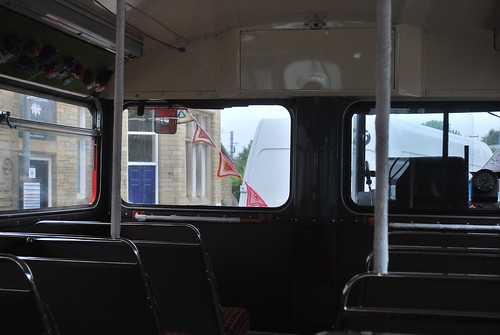
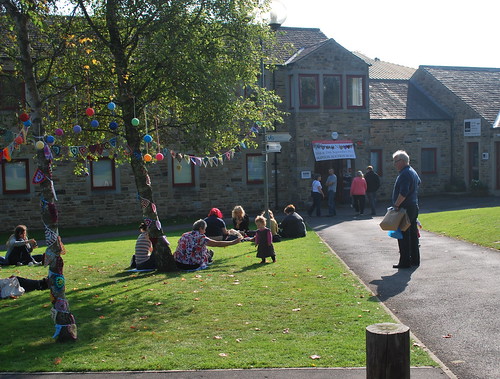
I went to Yarndale by public transport; this seems to have been a good move.  Not least because of the yarnstormed Routemaster bus which pulled up at Skipton station entrance just as I was coming out.

yd_bus1

There were felt panels with sheep and flowers where the ads would usually be...

yd_bus2

I got there before the doors opened, and this also seems to have been the right thing to do. I was able to stash my bag under the Sparkleduck stand (thanks, Heather and Michael!) and could then dive in quickly and have a look around before it all got too busy.

yd_halls1

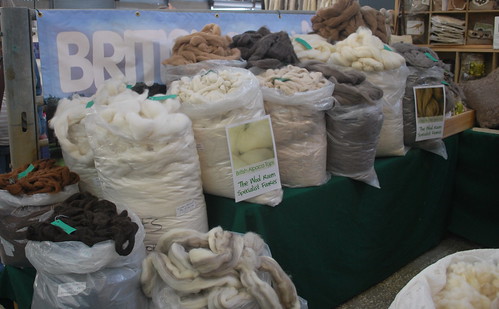
Lovely wool, lovely fibres, lovely fleece...

yd_halls2

And animals.  These were the pretty, pretty bunnies from Bigwigs.

yd_bunnehs

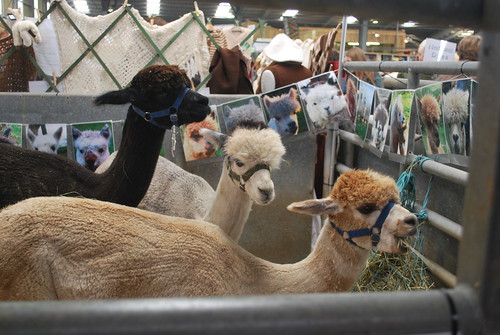
Can anyone help me with whose alpacas these are - they were right at the end of the arena away from the exhibition hall, near the back car-park/bus entrance?  I marked them off on my programme and then promptly lost it (as seems to happen at most shows; I need to hang it round my neck on a lanyard or something).  I meant to go back and get some alpaca fleece from them for spinning... Lovely bright things...

Edited to say thanks to HilltopKatie who also had a beautiful stand there; and has let me know that these are part of the Why Not Alpacas? herd.

yd_halls6

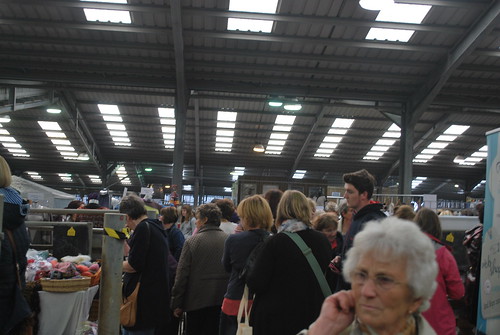
... But the halls definitely filled up quite quickly, and then (speaking as a short person) it became somewhat difficult to see things. Sort of like the Knitting and Stitching Show but without that Huge Horrible Roaring Noise you get in the Great Hall there.  There were, to be honest, some pretty rude people there; none of them, I'm sure, in this photo... More elbows than I'm used to at a fibre event other than Ally Pally, anyway!

yd_halls4

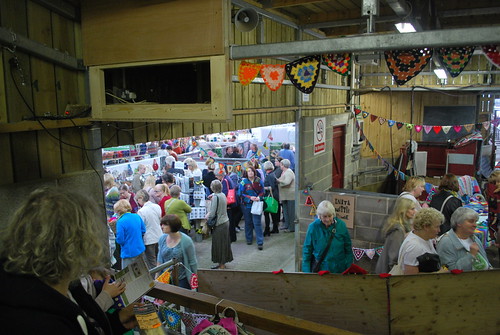
Once I'd fought my way to one end of the building, and then been sent to the other end for (not-on-the-map) loos, and realised that breakfast wasn't going to happen because the queues were too long, I spotted Colourcraft's stand for acid dyes; after three attempts at taking payment with no signal, they went down the old-fashioned route...  Then I was able to meet up with a bunch of people from the Archers group on Ravelry...  We were sitting here, in one of the auction rings...

yd_halls7

looking over this side, too...

yd_halls8

I'd have loved to have taken a group pic, but I'd have been shooting right up people's nostrils, so I didn't. It was lovely to meet Anne, André, Gina, Christine and Susan and see Jill and Brigid again!

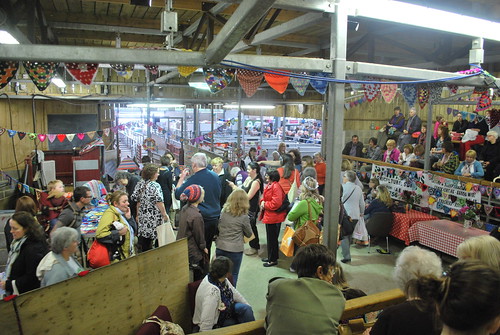
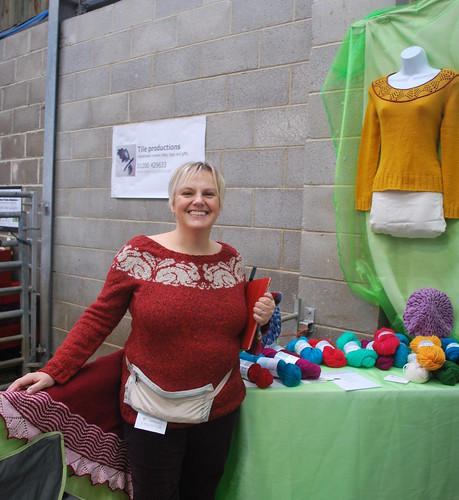
Another couple of friends met were Nic, of the Yarns from the Plain podcast and blog, last seen during the Olympics and first met at Knit Camp in 2010; and another friend first met at Knit Camp, Ann Kingstone; here seen at her stand wearing her lovely William design, and with the Truly shawl and the Mallorn sweater behind her, as well as her range of yarns...

yd_annK

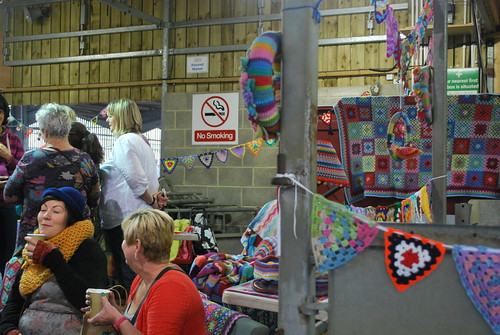
There was a lot of lovely yarnstorming in and out of the hall.  I don't know who the blissful lady was, but I suspect I'd have had a similar facial expression if I'd managed to score a cuppa - it gives an idea of the decor though!

yd_halls3

The bunting in the exhibition hall was extraordinary;

yd_halls5

At about 2:30 I decided I'd probably seen everything I wanted to, and bought what I needed to plus a couple of slightly indulgent things (work's small annual bonus due at the end of September!) - so although I had a couple of hours before I needed to leave, I took the walk through the park, and was glad I'd done it that way round, as most of the walk (after the initial flight of steps) was downhill and I had a wheely holdall...

What had started off as a grey day was now a lovely sunny afternoon

yd_walk1

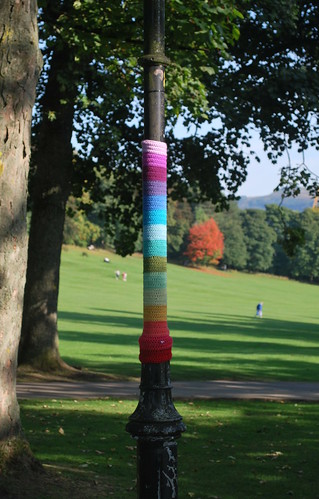
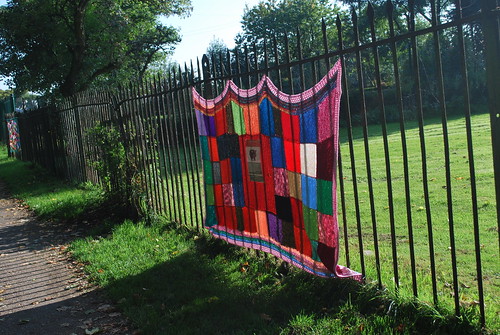
and each time I wondered if I was going the right way, there was something to guide me...

yd_walk3

yd_walk4

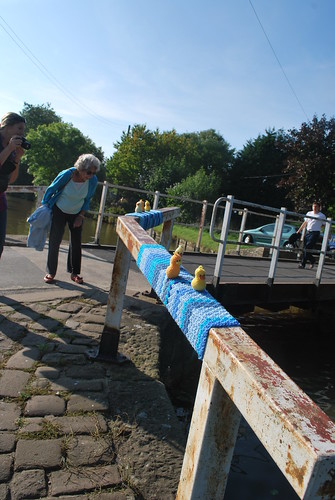
These were particularly wonderful, next to the canal bridge near the station:

yd_walk5

yd_walk6

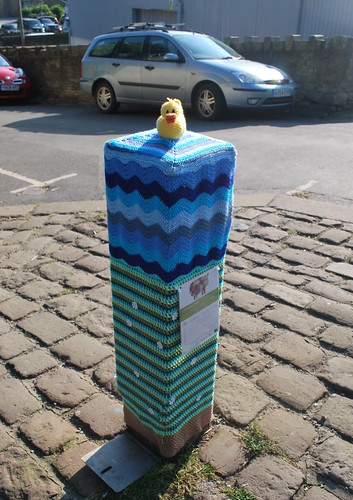
The journey back was... well; I'd have said "epic", but that implies "interesting".  Which it wasn't; but I'm going to write about it anyway. Just missed a half-hourly train at Skipton, which meant that breakfast was a Snickers bar from the vending machine at 3:30; once I got to Leeds I had two hours before my onward train. They seem to be much better at letting you break your journey these days (I suspect all those shopping opportunities beyond the barriers are responsible for that) so I headed into Leeds city centre for some lunch/dinner; Bella Italia isn't my usual favourite place but it was close, and actually really nice service, even if grown men calling me "duck" isn't something I'm used to.  (They were calling each other "duck", too; I hadn't nicked that bollard-cosy to wear as a hat, or anything.)  Then another train from Leeds to Selby; and then the Train from Hull. Didn't bother trying to get into my reserved seat as half the train was full of football supporters celebrating a victory, and therefore Bedlam on Wheels.  The detour via Lincoln and half-hour delay at Peterborough didn't help, either; but the train staff had evidently planned for this journey and had the world's largest supply of cans on board...  We eventually limped into Kings Cross at 10:50pm; but at least that meant a quick trip to M&S for some milk before they closed, and catching the last (packed) train back to Kings Lynn, were still possibilities...

If that sounds like a roundabout way of doing things, your're right.  The quick option is to do Skipton - Leeds - Peterborough - Ely - home.  But that option was £99.50, and the perambulatory alternative (with the final London - home stage on my season ticket) was £22.90.  Money saved on the trip - £76.60.  When you see what I bought...

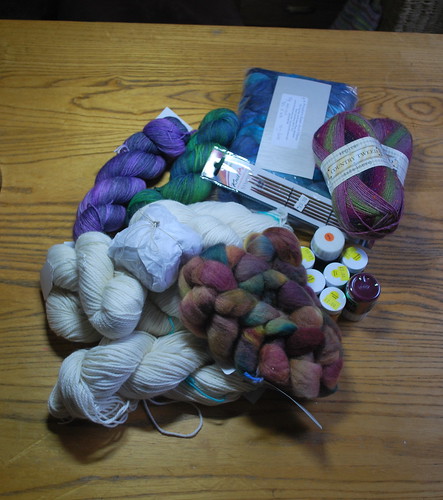
yd_haul

... £76.60 covers everything but the dyes; definitely worth a couple of extra hours of my time!

Clockwise from top left - two skeins of Sparkleduck Socka, which I love for its high twist, and of course Heather's beautiful colours.  The purply one doesn't have a name; the green one's called "The forest began to sing". A bag of fibre from Freyalyn - oatmeal BFL and sik; colour "Sky blue"; 2 balls of King Cole Country Tweed and a set of 2.5mm Harmony needles from Knitting4Fun (I'd gone looking for exactly that sort of yarn, and a new-to-me King Cole yarn is always a bit exciting; I thought I needed the Harmonies but found the set I thought I'd lost in my bag on the way home!); 7 colours of dye from Colourcraft (I hope these are the colours I needed, but forgot to take an inventory before I went); braid of BFL from Wheeldale Woolcrafts; 4 skeins of organic merino aran yarn from John Arbon's bargain box - 400g for £12.

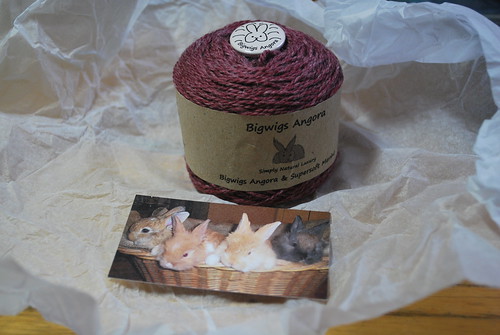
That little tissue-wrapped parcel nearly didn't make it home - it skippety-hoppeted out of the top of my bag on the train as I was getting up north of Cambridge, and was retrieved by a member of British Transport Police (they usually send a couple of police up on the last train home as it all gets a bit lairy at Cambridge); he asked what it was and I said "knitting wool; well, wool and angora, for knitting" - turns out I got a knitting member of BTP.  He makes socks, apparently, but not boring black uniform ones...  Here it is, unwrapped...

yd_angora

I have a small collection (3 balls) of slightly exotic stuff, none of which are quite the same thickness as each other.  I'm hoping this is going to be the same weight as one of the others - I'd love a pair of nice warm gloves for this winter.

So - that was Yarndale.  I'd definitely go again, particularly if it's at this time of year and I can combine it with a visit to other bits of Yorkshire - Skipton itself looked lovely, and it's been ages since I went to Bradford or Leeds; keep meaning to stop off in Saltaire at some point, too... There were teething troubles with catering and parking, but I imagine those will get themselves sorted out for next year; essentially, a really nice show.

Monday, September 23, 2013

2013 books, #76-80

The chessmen, by Peter May. London: Quercus, 2013.

The final part of the Lewis trilogy; and another very good book.  Fin is now working as a game warden on the local estate and finding one of the disadvantages of local knowledge; one of the trickier poachers is a schoolfriend.  One day, a weird geological event leads to the discovery of a small plane they both know, with a body in it. The body's identified as their mutual friend Robbie, a musician with a now internationally-renowned band, and a man who'd disappeared 17 years before.  But various things don't add up, it's immediately obvious that the body in the plane was murdered... One of the good things of signposting a series of books as a trilogy is that plots from previous books can rumble on, notably the church court case against Donald Murray for the events in The Lewis man.  

Night watch, by Linda Fairstein [audiobook]. Read by Barbara Rosenblat. Rearsby, Leics.: Clipper/WF Howes, 2012.

I've listened to a couple of these so far; this one was very enjoyable for being set partly in Mougins, near Grasse in the South of France.  Fairstein's style's a bit overwrought, but Rosenblat just goes with this in her superb reading, and it's all very entertaining and goes into both New York dining history and the financial business of running a restaurant.

Broken homes, by Ben Aaronovitch.  London: Gollancz, 2013.

Another really excellent book in the Peter Grant series.  I didn't notice whether others have had THE END on the last page, but I'm really hoping this isn't the last book - there's one huge question still to be resolved!  In this one, a mutilated body is found in Crawley, and a town planner goes under a Tube train; Peter and Lesley are led to the Skygarden, a South London estate designed by an insane but idealistic architect and seemingly built for maximum discomfort.  As ever, the ideas are excellent and the plot really works; and it's just incredibly funny.  It riffs off all the fantasy you've read, and all the procedural thrillers, and makes something completely different.  I love these books so much.

Red bones, by Ann Cleeves. London: Pan, 2010.

A young policeman discovers his grandmother Mima is dead; what looks at first like a tragic shooting accident becomes more sinister when Jimmy Perez starts to talk to the family and finds feuding and secrecy. The discovery of bones in a nearby archaeological dig and Mima's reaction to them also comes into play, and generations of secrets begin to be revealed.  This is the book dramatised in the recent Shetland series, which also included a couple of Kate Davies knitted items; the book is much better than that drama, though.

The dark vineyard, by Martin Walker. London: Quercus, 2009.

The second of the Inspector Bruno books; and another good one.  Bruno is called to a fire in a nearby field, to find that the field was being used as a research station for genetically modified crops. Meanwhile, an American wine conglomerate (reminiscent of the Gallo family) is trying to buy up most of the valley to create a new appélation, and Bruno is pursuing his relationship with Isabelle, with mixed results.  There's a small element in the unravelling of the plot which I'd quibble with on the grounds of our not being able to make things add up, but it's a minor point...


Saturday, August 31, 2013

2013 books, #71-75

My father and other working-class football heroes, by Gary Imlach. London: Yellow Jersey Press, 2006.

This is a wonderful book.  Gary's father Stewart Imlach played in a cup-winning team for Notts Forest, and in a World Cup for Scotland, in the 1950s.  After Stewart's death, Gary realises that he knows much too little about his father's life and times, and goes to investigate.  What results is a picture of English and Scottish football of the 1950s and early 60s, and the vast gulf between these professionals and contemporary footballers. Gary Imlach is an excellent sports journalist, particularly known for his cycling coverage, and managed to draw me in to that sport; it shouldn't really be a surprise that he had me completely absorbed by football half a century ago, but this is definitely one for anyone interested in social history or family research, whether interested in football or not.

Compulsion, by Jonathan Kellerman [audiobook]. Read by Jeff Harding. Oxford: Isis, 2008.

Really couldn't get into this one, and thought the plot was a bit of a mess.  Jeff Harding's reading meant I'd go through to the end with it, but really, I couldn't do a proper summary of this one.  If you like Alex and Milo working as a team, it's probably an OK one, but I couldn't get enthusiastic about it...

A faint cold fear, by Karin Slaughter. London: Arrow, 2004.

Sara Linton is called to the local college campus to examine the body of a young man who has apparently jumped off a bridge into the lake; while Sara is engaged in this, her heavily-pregnant sister Tessa is brutally attacked. Sara and estranged husband Jeffrey investigate, but their task isn't helped by former policewoman Lena Adams, now a security guard from the college, who appears to be hiding things.  Very good, tightly-plotted novel; one slight whinge is the late discovery of something the readers couldn't have been expected to guess (is there a technical word for this?), but the result is satisfying enough that this isn't overly annoying...

Savage moon, by Chris Simms [audiobook]. Read by Toby Longworth. Bath: BBC/Chivers, 2008.

I was beginning to think I'd gone off audiobooks after several I couldn't really concentrate on; not this one, though.  Something, or someone, is killing and savaging people in the Saddleworth Moor area where there have been mysterious sightings of a large black cat. The victims are found with their throats ripped out and clutching long black hairs. DI Jon Spicer is unconvinced by the big cat theory, and finds himself hunting down a killer; meanwhile, he's worried about his wife, who is becoming obsessed by civilian deaths in Iraq and may not be coping with their new baby. Toby Longworth's reading is as good as you'd expect from this veteran of the BBC radio theatre company.

Bruno, chief of police, by Martin Walker. London: Quercus, 2008.

I heard about this series on Radio 4's Food programme, due to the concentration there is on the food of the area. When that area's Périgord, it makes for excellent reading and eating...  At first, I wondered if this series was going to be rather like the Hamish Macbeth books; but there's a harder edge to these, both in subject-matter and in a lack of romanticism where it matters.  The local mayor, for instance, could be a comic figure, but turns out to be an énarque with his fingers in many important political pies; and the eventual dénouement of the plot is buried deep in France's history of racial and political tension. I'll certainly be reading more of these; it's an area I love and there are some very engaging characters here.


Friday, August 30, 2013

Postscript

Seamus Heaney,  13 April 1939 - 30 August 2013

Saddened and surprised to hear of Seamus Heaney's death today.  I still have the much-annotated A-level Selected poems 1965-1975*, and have continued to read and collect his poems and essays over the nearly 30 years since.  Stepping stones is still sitting on the "unread" pile on the piano.

I have too many favourites; but I love the last lines of this, as someone who spends too little time living in the moment.

Postscript

And some time make the time to drive out west
Into County Clare, along the Flaggy Shore,
In September or October, when the wind
And the light are working off each other
So that the ocean on one side is wild
With foam and glitter, and inland among stones
The surface of a slate-grey lake is lit
By the earthed lightening of flock of swans,
Their feathers roughed and ruffling, white on white,
Their fully-grown headstrong-looking heads
Tucked or cresting or busy underwater.
Useless to think you'll park or capture it
More thoroughly. You are neither here nor there,
A hurry through which known and strange things pass
As big soft buffetings come at the car sideways
And catch the heart off guard and blow it open 

From The spirit level, 1996.

*One of the first things I knew about Heaney was that he was prepared to engage with his readers; my English teacher had been to several talks he'd given, and when we had a somewhat lively dispute in one lesson on what was meant in a particular poem, Mr Doyle wrote to Heaney asking which version was right, thinking that he might answer.  A month or two later, there was a reply; neither version was what Heaney had been thinking while writing the poem, but both were really interesting interpretations; and he added that we sounded like a fun group to teach.  Lessons learned: a) authors are actual people who sometimes write back; and b) this writing and reading thing is a two-way street. Now, in the age of interactivity, both are somewhat taken for granted; then, it felt like a total revelation.

Sunday, August 18, 2013

2013 books, #66-70

On Canaan's side, by Sebastian Barry. London: Faber and Faber, 2011.

Lilly and her fiancé Tadg flee Ireland for America; Tadg is in the Black-and-Tans and has been put onto a death-list by Republicans for alleged atrocities.  Seven decades later, Lilly tries to make sense of her life as an 89-year old, in the context of the death of her soldier grandson.  Lilly's story mirrors the history of the twentieth century, but weaves obliquely in and out of it.  This is a sad, sad book, with luminous moments of language.  Lilly is an everywoman, present at the Easter Rising, with a brother in WWI, a friend in WWII, an employer involved in the Civil Rights movement, a son in Vietnam and a grandson in the Gulf War; and still remains somehow wrapped in her own cocoon.  There is so much loneliness here...  and, if you're me, quite a lot of frustration at Lilly's lack of curiosity about the world around her...  Barry's skill at writing a first-person female narrative is impressive, though.

The kill room, by Jeffery Deaver. London: Hodder, 2013.

A Lincoln Rhyme/Amelia Sach book; and another excellent one.  An anti-globalisation activist is killed in the Bahamas, and an assistant district attorney comes to Rhyme saying she wants to prosecute the head of an ultra-secret government agency for commissioning the death.  Rhyme can't mobilise his usual forces, but Lon Selitto is never averse to working as a double agent, and there's an excellent new character, a police sergeant in the Bahamas.  Meanwhile, someone is working to get Sach out of the police force on medical disability, and Rhyme has surgery of his own to face.  As ever, Deaver merges the personal and the criminal, but this time it has a twist of the post-9/11 political, too.  And as ever, there are twists, turns, and false alarms; increasingly, he's taking you along with these as a knowing participant.  Most of the time.

Gone tomorrow, by Lee Child. London: Bantam, 2009.

After about two pages of this, I realised I'd already read it.  Or had had it read to me.  I see I completely failed to register any plot details that time round...  The initial scene is extraordinarily arresting, and somewhat terrifying. After that, the rest of the plot is slightly amorphous; there are atrocities in Afghanistan, there are killings in New York, but the reason I couldn't remember what happened is that once you get onto the plot track, there's one seismic shock, but it has a lot less in the way of plot than most of the Jack Reacher books do.  A good read for all of that.  Again.

Dead man's time, by Peter James. London: Macmillan, 2013.

Creepy one, this.  We already know that an ex-convict and Roy Grace's ex-wife are moving closer and closer to him, his new wife Cleo and their infant son Noah. In the middle of this slow burn, a 98-year-old woman is tortured to death in her home while an estimated £10 million of antiques are stolen, and her 95-year-old brother, an equally wealthy antiques dealer, is using his connections to find and punish the people responsible.  The story starts in the early 20s in New York, and the stories are intertwined; I think I enjoyed this even more than the last couple of Roy Grace novels.

Six years, by Harlan Coben [audiobook]. Read by Kerry Shale. Rearsby, Leics.: Clipper, 2013.

The love of Jake Fisher's life, Natalie, married another man six years before the story starts.  When Fisher comes across the husband's obituary, he can't stay away and attends the funeral.  But the grieving widow isn't Natalie. As Jake investigates, he finds that the more he discovers, the less he knows - and there are a number of people who are extremely keen to keep him in ignorance.  This is Coben at his best - you're as lost as Jake is, and each time a new explanation seems to work, it gets darker and darker. An excellent reading by Kerry Shale, justifying his near-national-treasure status again...

Wednesday, August 07, 2013

Hatopia

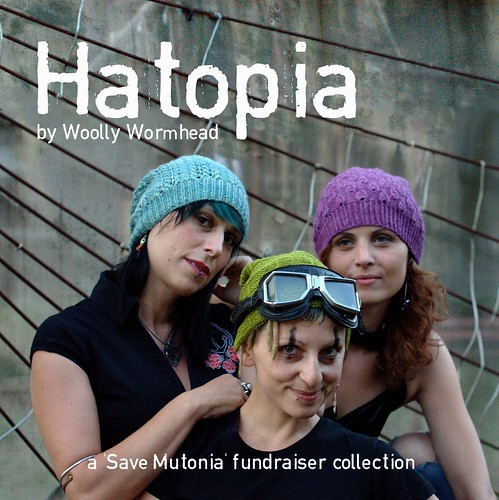
Contributing to the announcement of a new collection by Woolly Wormhead.  But this one, with a difference.

Hatopia.Front.Cover

People who follow Woolly's blog will find mentions of the community in northern Italy she and her family moved to several years ago.  Now that community is threatened by the actions of one local person, and its residents, many of them artists, face substantial legal fees in their battle to remain and preserve the artworks around the site.

So, what do you do as a designer when faced with that sort of fundraising challenge?  You put together a collection, and donate the proceeds to the fund.

And a fine collection it is (as copy-editor, I had a sneak preview, obviously!).  I've only knitted two of these, Encircle:

Hatopia.Encircle.Silvia

(Silvia rocks this design above - this is my more staid and much more fluffy version below)

wwhat12

and Pavone (Italian for peacock)

Hatopia.Pavone.Sara

(Sara wearing a less drapy version than the one I test-knitted, modelled by Anya against the background of the building we work in)

pavone3

I can attest to the excellence of both.  Looking forward to choosing the next one...

You can buy the collection through Ravelry (recommended if you're a member - then it's in your library and you can print out bits and bobs as you need them); if you're not a Ravelry member, you can also get it via Woolly's website.

I'm going to finish with the words of the community in their Statement.  And when you've read it, if you want to know more and offer support, there's a Facebook page; and there's a petition at Change.org, and the Twitter hashtag in English is #savemutonia.

Our Statement

 The Mutoid Waste Company arrived in Santarcangelo di Romagna, Italy in 1990 to perform in that year's "Festival Dei Teatri", a renowned annual festival held in the town. From that time on Santarcangelo became a base for the group and it became their home. Their art, their way of life and they themselves became an accepted part of life in Santarcangelo. Over the last 23 years they have increasingly collaborated on projects with local institutions such as schools, and their ties with the local community have strengthened. In recent years some of the Mutoids have chosen the Yard as a safe place to raise their own children.

The Yard is unique: a place that follows the rules whilst living completely outside them, a place that advocates an alternative outlook on life, a place that allows people to discover new things - and it's wonderful that such a place is considered a true part of Santarcangelo and that the locals readily accept the Yard as part of their community.

Unfortunately the Yard currently finds itself under a very real and serious threat of eviction - a reality which would not only destroy this unique community but also disperse its inhabitants and their artwork. 

 Despite these many years of mutually respectful cohabitation there is one voice that has continually spoken against the Mutoids presence; a single objector who now seriously threatens this culturally important phenomenon.

 Mutonia is not a campsite (even though its inhabitants live in caravans, buses, trucks and temporary constructions that look more like works of art than houses); it's not a standard travellers site (although many of its inhabitants have a semi-nomadic lifestyle); and the group have never illegally occupied the land.

 In recent years Santarcangelo's local council has been searching for a solution to the situation, seeking help from other government bodies, with the ultimate aim of declaring the Mutoid Yard as a Site of Cultural Interest.


Photos in this post copyright (c) Woolly Wormhead (1, 2, 4), (c) Franklin Habit (3) (c) Liz Marley (5).

Thursday, August 01, 2013

2013 books, #61-65

On the road bike: the search for a nation's cycling soul, or, Sniffing the yak-skin shoe, or, The great eccentrics of British cycling, by Ned Boulting. London: Yellow Jersey Press, 2013.

This is another lovely book by Ned Boulting.  Taking 2012's Tour de France victory by Bradley Wiggins as its starting point, it looks at the people who quietly, doggedly kept British cycling going over the years before this recent trend, in near-invisibility.  He talks to people you'd expect - Chris Boardman, for whom he has a huge respect belied by their banter on the ITV4 coverage and podcasts, and David Millar. But he also talks to David Millar's mum; and Ken Livingstone, about cycling in London; and finds there are two Tommy Godwins, very different personalities but champions at the same time; and interviews professional cyclists from the 1950s, 60s and 70s only real aficionados would previously have heard of. Oh, and he goes for a ride with Gary Kemp out of Spandau Ballet and his New Romantic Ride; sort of.

Boulting's not a technical nerd - he's quite happy to admit that he glazes over when people start talking about gear ratios and bottom brackets, and is probably the only person whose puncture Chris Boardman's mended in the last few years - and he came to the sport at the elite level with Tour de France punditry, and only later got back on his bike and started cycling seriously.  He still regards himself as an outsider to the sport, and is therefore able to explain beautifully to other outsiders.  He's genuinely fascinated by people, what drives them, and their stories, and plays this wonderfully here.  If you like Stuart Maconie's books about Britain, I suspect you'll enjoy this one very much - the same sort of affectionate, humorous curiosity and genuine respect for endurance and eccentricity is at work.

Sample (from about two-thirds of the way through): In 1937, Ossie set out to reclaim his record. At exactly the same time an English resident, a Frenchman of Scottish descent (I am not making these people up) called René Menzies launched his campaign. Ossie prevailed, riding a staggering 62,657 miles, beating Menzies by just 1,096 miles. Intriguingly, although scarcely of any relevance, Menzies, who had been decorated for valour in the First World War, went on to become Charles de Gaulle's chauffeur during the next war, a bizarre biographical detail which, by now, probably won't surprise you.

Force of nature, by C. J. Box. Kindle edition.

The third of the Lyon books, and another crackingly good Joe Pickett novel.  I think I've said everything there is to say about these over the years, but the way Box keeps producing a consistently high, interesting standard of novel is quite stunning.  Again, the theme is very much what people will do when forced to the edge, and as this one focuses on Nate Romanowski and his history in Special Forces, it can be a pretty gory read.  Box keeps the characters straight and consistent, though, and the mystery which is set up in Cold wind is finally explained.

The bomber, by Liza Marklund. London: Corgi, 2011.

Can't remember how I came to order this one from the library, but if someone reading this recommended it, thank you!  Stockholm is hosting the Olympics, but there's an explosion in the main arena; when all the pieces are collected and DNS analysis is done, the victim turns out to be the head of SOCOG, a former banker.  As Annika Bengtzon of the Stockholm evening paper investigates, she discovers a curious absence in the accounts of the victim's life - her husband speaks of her as if he were her PR, and her daughter with hatred.  Sources are also telling her that this was an inside job, not international terrorism.  And then the bomber strikes again... Tautly plotted and an excellent read.

Maxwell's island, by M J Trow. London: Allison and Busby, [2011].

Picked this up at the library when I realised I was going to be handing in all my reading material; I love these books.  Maxwell is at his hilarious best in this one, which involves him, Jacquie and son Nolan reluctantly leading a Year Seven school trip to the Isle of Wight after another member of staff falls down some stairs. This is not the only mishap to befall the cast of this book, and it turns out that the Year Sevens are the least of everyone's problems.  There's a huge great plot-plant at the end - one of those things you couldn't possibly have worked out from the previous information in the book - so if you don't like those, you're forewarned; but to be honest, that isn't what you read these for...

Time bomb, by Jonathan Kellerman [audiobook].  Read by Jeff Harding.  Oxford: Isis, 2009. [Originally published 1999.]

I'm not the world's biggest fan of Alex Delaware (Kellerman's main protagonist), it has to be said.  I picked this one up because I just love the sound of Jeff Harding's voice.  But this has an excellent plot, with twists and turns, and a lot to think about.  Here, a seemingly straightforward school shooting turns into something very different, and Delaware and Milo are drawn into something horrible and sinister. If you're a conspiracy theorist, this is the one for you. If you're not, it's still pretty diverting.