Longbourn, by Jo Baker. London: Transworld, 2013.
A book group book, and not one I was particularly looking forward to - yet again, I was pleasantly surprised. This is Pride and prejudice told from below stairs, and to my non-Austenite mind, the lack of concern the Bennets' servants pays to them does them credit. There are descriptions of the hard reality of early 19th century servanthood - the chilblains, the swill buckets, the emptying of the gazunders and all - but also a more sweeping, less confined view of the world than the gentry are allowed. We see the impact of the Napoleonic wars, and the ways the characters have made their money (I don't know whether the Bingleys did make their fortune in sugar plantations, but it leads to some interesting ideas); and there's a really rather wonderful and powerful love story in the middle of it all. Maybe two. I'd completely recommed this as a Good Read
Good as dead, by Mark Billingham [audiobook]. Read by the author. Oxford: Isis, 2011.
Tom Thorne is called in personally to help with a siege in a newspaper shop. The owner, a man whose son had killed himself in prison, has kidnapped Helen Weeks, a policewoman involved in family cases and another man; Tom has to investigate the son's death, the original case and also try to make sure that both hostages stay safe. I'm not doing a good job at describing this one, but it's another really good Mark Billingham plot and keeps the tension ramped up.
The ghost fields, by Elly Griffiths. London: Quercus, 2015.
A Ruth Galloway novel, and an excellent one. This time, Ruth is called in to look at bones found in a WWII aeroplane found in a field during building works. Weirdly, the body isn't decomposed in the way Ruth would expect - it seems to have been buried in different earth entirely. There's the usual cast of characters, with a return from Frank Barker whose TV company wants to make a documentary on the US involvement in WWII... and the introduction of the rather sinister Blackstock family. The plot takes you along, the relationships are complicated and interesting, but as ever, it's Ruth and her personality and observations which keep me reading.
"Ruth switches on Radio 4 for comfort but it's a dramatisation of Wuthering Heights, and after a few minutes of desolate moorland and doomed love, Ruth turns it off again. I cannot live without my life. I cannot live without my soul. That's all very well, Ruth tells Cathy, but sometimes you just have to."
The brutal telling, by Louise Penny [audiobook]. Read by Adam Sims. Oxford: Isis, 2009.
Gamache is back in Three Pines; this time, the body of a man has been found in the village bistro. Nobody seems to know who the stranger is, or where he's come from; but as the details appear, we seem to know even less about how he died, and why. Gamache is with Beauvoir and Lacoste, both of whom have troubles of their own; and we encounter old friends including mad poet Ruth Zardo and the continuingly odd Peter and Clara Morrow with their artistic rivalry. In the end, the revelation is genuinely shocking; while I've never considered this series belonging to the "cozy" category, I'm now sure that Penny is another of those authors like McDermid who's unafraid of the demolition of a well-loved character.
Silent voices, by Anne Cleeves [audiobook]. Read by Charlie Hardwick. Oxford: Isis, 2011.
Vera Stanhope is a very reluctant gym-user, but has been pressured into it by her GP. When she finds a woman's body in the steam room, she hopes she's just come across a natural death from over-exertion, but no such luck. Vera investigates with her usual vigour, trampling witnesses and colleagues in her path... This is a brilliant reading by Charlie Hardwick who's able to distinguish between a variety of North East accents.
Saturday, October 31, 2015

Saturday, September 05, 2015
2015 books, #51-55
How to speak money, by John Lanchester. London: Faber, 2015.
A book group book; and fascinating. Lanchester starts with a brief introduction to how he came to write this book, and some background on the financial system as it exists today; then the bulk of the book is an alphabetical dictionary of financial terms; and then he wraps up with some thoughts about the way he sees people's attitude to money changing in the present and the future. This could be an extremely dry read, but Lanchester has come at this book as a layman, and a funny, engaging layman at that. (And he does distinguish between BULLSHIT and NONSENSE quite early on...) Highly recommended. I'd quote some things, except that my copy's now at work as a quick reference for the next tricky financial term that comes along...
The bones beneath, by Mark Billingham. London: Sphere, 2015.
Absolutely gripping from start to finish. Stuart Nicklin, a serial killer Tom Thorne put behind bars a decade before, announces that there's another body to find on an isolated Welsh island; but he'll only tell the police where it is if Thorne accompanies him to the island, and another prisoner comes with him to ensure his safety. Thorne reluctantly agrees. Despite the accompanying police and prison officers, Thorne is uneasy about the scary, amoral Nicklin, and this concern only deepens as the weather on the island worsens. While this could be one of those classic "what's that noise outside; let's split up" stories, it's Billingham so it's way better than that. And there's a strange accompanying narrative which suddenly snaps into focus... in my case, too late... This is one I couldn't read at bedtime because the suspense was too much to be reading it in the dark!
Natural causes, by James Oswald. London: Penguin, 2013.
DI Anthony McLean has quite enough to deal with; he's been assigned an obviously old murder in the basement of a mansion, while trying to cope with the death of the grandmother who brought him up. Meanwhile, someone is killing old and influential men... The cases intertwine... I liked this because we really genuinely get to care about McLean's colleagues, and that's an essential as far as I'm concerned; and because there are a number of twists in the tail of this one. Oswald's definitely one to watch.
The woods, by Harlan Coben [audiobook]. Read by Carol Monda and David Chandler. Rearsby, Leics: WF Howes, 2008.
Twenty years ago, four teenagers at a summer camp walked into the woods and were never seen again. The brother of one of those teenagers is now the county prosecutor, and is taken to see the body of a recently-dead man who bears an uncanny resemblance to one of the missing. This is another great book by Harlan Coben, where nothing is as it seems and where the lead character doubts his sanity at various points. Really excellent stuff, and two very good readers.
The dying season, by Martin Walker. London: Quercus, 2015.
A Bruno, Chief of Police novel and another extremely good one. Bruno is attending a 90th birthday party for a war hero; the following day, one of the guests is found dead. While the man was a known alcoholic and ostensibly the death isn't suspicious, Bruno is wary of taking it at face value. Meanwhile, Bruno has his somewhat complicated relationship with Pamela, and the presence of hundreds of feral deer encouraged by a fervent but misguided écolo to deal with. Again, the food, the wine and the landscape of Périgord noir feature as characters in this book, and it's not one to read if you're at all peckish at the time!
A book group book; and fascinating. Lanchester starts with a brief introduction to how he came to write this book, and some background on the financial system as it exists today; then the bulk of the book is an alphabetical dictionary of financial terms; and then he wraps up with some thoughts about the way he sees people's attitude to money changing in the present and the future. This could be an extremely dry read, but Lanchester has come at this book as a layman, and a funny, engaging layman at that. (And he does distinguish between BULLSHIT and NONSENSE quite early on...) Highly recommended. I'd quote some things, except that my copy's now at work as a quick reference for the next tricky financial term that comes along...
The bones beneath, by Mark Billingham. London: Sphere, 2015.
Absolutely gripping from start to finish. Stuart Nicklin, a serial killer Tom Thorne put behind bars a decade before, announces that there's another body to find on an isolated Welsh island; but he'll only tell the police where it is if Thorne accompanies him to the island, and another prisoner comes with him to ensure his safety. Thorne reluctantly agrees. Despite the accompanying police and prison officers, Thorne is uneasy about the scary, amoral Nicklin, and this concern only deepens as the weather on the island worsens. While this could be one of those classic "what's that noise outside; let's split up" stories, it's Billingham so it's way better than that. And there's a strange accompanying narrative which suddenly snaps into focus... in my case, too late... This is one I couldn't read at bedtime because the suspense was too much to be reading it in the dark!
Natural causes, by James Oswald. London: Penguin, 2013.
DI Anthony McLean has quite enough to deal with; he's been assigned an obviously old murder in the basement of a mansion, while trying to cope with the death of the grandmother who brought him up. Meanwhile, someone is killing old and influential men... The cases intertwine... I liked this because we really genuinely get to care about McLean's colleagues, and that's an essential as far as I'm concerned; and because there are a number of twists in the tail of this one. Oswald's definitely one to watch.
The woods, by Harlan Coben [audiobook]. Read by Carol Monda and David Chandler. Rearsby, Leics: WF Howes, 2008.
Twenty years ago, four teenagers at a summer camp walked into the woods and were never seen again. The brother of one of those teenagers is now the county prosecutor, and is taken to see the body of a recently-dead man who bears an uncanny resemblance to one of the missing. This is another great book by Harlan Coben, where nothing is as it seems and where the lead character doubts his sanity at various points. Really excellent stuff, and two very good readers.
The dying season, by Martin Walker. London: Quercus, 2015.
A Bruno, Chief of Police novel and another extremely good one. Bruno is attending a 90th birthday party for a war hero; the following day, one of the guests is found dead. While the man was a known alcoholic and ostensibly the death isn't suspicious, Bruno is wary of taking it at face value. Meanwhile, Bruno has his somewhat complicated relationship with Pamela, and the presence of hundreds of feral deer encouraged by a fervent but misguided écolo to deal with. Again, the food, the wine and the landscape of Périgord noir feature as characters in this book, and it's not one to read if you're at all peckish at the time!
Wednesday, August 05, 2015
2015 books, #46-50
Bad blood, by Linda Fairstein [audiobook]. Read by Barbara Rosenblat. Rearsby, Leics.: Clipper Audio, 2007.
Another Alexandra Cooper book, and for me a curiously flat one. Cooper is prosecuting Brendan Quillan, a rich businessman who's accused of killing his wife. When Quillan's estranged brother is killed in a tunnelling accident, the focus of the investigation shifts and Cooper investigates. This one fills in a bit of detail about Cooper's later boyfriend (this is a rare series I'm not reading in order) but otherwise really didn't appeal to me; Rosenblat did the usual bang-up job with the reading, but I couldn't stop it just being background noise.
Common people: the history of an English family, by Alison Light. London: Fig Tree, 2014.
Weirdly, a colleague and I found we were reading this one at the same time. We then worked out we'd both heard about it via the BBC History Magazine... This is a strange book; Light looks at the history of her family, but uses it to mirror the history of England at the time. There's a huge amount of poverty and an unexpected amount of mobility (geographical and only occasionally social), and she takes us through the world of the workhouse, the mental hostpiral and the building trade as these affected her family in their time. I couldn't keep track of who all the people were, but it didn't seem to matter; it's a fascinating book which talks about profoundly ordinary people through the last couple of centuries.
Flowers stained with moonlight, by Catherine Shaw. London: Allison and Busby, 2005.
Another not-in-order series... Vanessa Duncan is a teacher in a Cambridge school for girls, but a notorious court case she was involved in four years before has brought her to the attention of a distraught mother. Mrs Bryce-Fortescue's daughter is accused of murdering her husband, an extremely wealthy landowner living near Haverhill. While Vanessa doesn't believe Sylvia committed the murder, she also doesn't believe Sylvia's story. Investigation of the case takes her to Paris (with her fiancé and two other mathematicians) and to Calais. I guessed what was going on quite quickly, although there was a twist I wasn't prepared for; and there's a fascinating real little episode in mathematical history built in (Catherine Shaw's alter ego is a professor of maths at Jussieu in Paris).
The truth about the Harry Quebert Affair, by Joël Dicker. Translated from the French by Sam Taylor. London; MacLehose Press, 2014.
This is a brilliant book. I wish I'd been able to sit down and devour it in one sitting, but it's a brick of a book so not one I could carry around. Young star-of-the-moment author Marcus Goodman has a mentor, Harry Quebert; when bones are unexpectedly dug up in Quebert's garden in 2008, Harry tells Marcus of a love affair he had with a 15-year-old girl, Nola Kellergan, in 1975. The bones are identified as Nola's, and Harry is arrested. Marcus is suffering from severe writer's block (that difficult second novel) and when his publisher gives him the alternative task of writing Harry's story, he takes it on both to save his skin and to try and prove Harry innocent. On the way, many secrets and lies are uncovered and there are some real switchbacks which make you re-examine everything which has gone before. It's also a book intertwined with ideas of fame, and the art of writing, and reputation; a tour de force. (Ironically, Dicker is now in the position Marcus was in at the beginning of the book.) The front cover says it's a Great American Novel in all but authorship, and I think this is probably true; there's a slight detachment from American life which is probably necessary, but it feels American in the way that an Edward Hopper painting does - there are gaps, and loneliness, and everyone has a story to tell.
Dust, by Patricia Cornwell [audiobook]. Read by Lorelei King. Rearsby, Leics.: Lamplight, 2013.
I shouldn't have started listening to this. I really shouldn't. But some of the recent Scarpetta books have been quite good. This, however, isn't one of them. Kay and her husband Benton (and every time she calls "Benton" I think of that bloke in the park, which really doesn't help) investigate a series of murders; while simultaneously trying to avoid Benton's evil boss. It goes along really pretty tediously for about 9 of the 11 discs in this set, and then I had to listen to disc 10 three times to work out what the hell was going on. The plot was OK (given that)... I think the thing which irritated me most was Cornwell/Scarpetta's inherent rush-to-judgment; always there but so much in this book. "It's a masculine space, lacking warmth or creativity" (WTF?)... and while I don't have the exact quote, there was a statement that the lack of pens/pencils/mugs on a desk was an exact correlative to a lack of hobbies and hinterland... And why use more frigid when you mean colder? Yes, I'm really grumpy. Lorelei King does her best with this one, but really... no.
Another Alexandra Cooper book, and for me a curiously flat one. Cooper is prosecuting Brendan Quillan, a rich businessman who's accused of killing his wife. When Quillan's estranged brother is killed in a tunnelling accident, the focus of the investigation shifts and Cooper investigates. This one fills in a bit of detail about Cooper's later boyfriend (this is a rare series I'm not reading in order) but otherwise really didn't appeal to me; Rosenblat did the usual bang-up job with the reading, but I couldn't stop it just being background noise.
Common people: the history of an English family, by Alison Light. London: Fig Tree, 2014.
Weirdly, a colleague and I found we were reading this one at the same time. We then worked out we'd both heard about it via the BBC History Magazine... This is a strange book; Light looks at the history of her family, but uses it to mirror the history of England at the time. There's a huge amount of poverty and an unexpected amount of mobility (geographical and only occasionally social), and she takes us through the world of the workhouse, the mental hostpiral and the building trade as these affected her family in their time. I couldn't keep track of who all the people were, but it didn't seem to matter; it's a fascinating book which talks about profoundly ordinary people through the last couple of centuries.
Flowers stained with moonlight, by Catherine Shaw. London: Allison and Busby, 2005.
Another not-in-order series... Vanessa Duncan is a teacher in a Cambridge school for girls, but a notorious court case she was involved in four years before has brought her to the attention of a distraught mother. Mrs Bryce-Fortescue's daughter is accused of murdering her husband, an extremely wealthy landowner living near Haverhill. While Vanessa doesn't believe Sylvia committed the murder, she also doesn't believe Sylvia's story. Investigation of the case takes her to Paris (with her fiancé and two other mathematicians) and to Calais. I guessed what was going on quite quickly, although there was a twist I wasn't prepared for; and there's a fascinating real little episode in mathematical history built in (Catherine Shaw's alter ego is a professor of maths at Jussieu in Paris).
The truth about the Harry Quebert Affair, by Joël Dicker. Translated from the French by Sam Taylor. London; MacLehose Press, 2014.
This is a brilliant book. I wish I'd been able to sit down and devour it in one sitting, but it's a brick of a book so not one I could carry around. Young star-of-the-moment author Marcus Goodman has a mentor, Harry Quebert; when bones are unexpectedly dug up in Quebert's garden in 2008, Harry tells Marcus of a love affair he had with a 15-year-old girl, Nola Kellergan, in 1975. The bones are identified as Nola's, and Harry is arrested. Marcus is suffering from severe writer's block (that difficult second novel) and when his publisher gives him the alternative task of writing Harry's story, he takes it on both to save his skin and to try and prove Harry innocent. On the way, many secrets and lies are uncovered and there are some real switchbacks which make you re-examine everything which has gone before. It's also a book intertwined with ideas of fame, and the art of writing, and reputation; a tour de force. (Ironically, Dicker is now in the position Marcus was in at the beginning of the book.) The front cover says it's a Great American Novel in all but authorship, and I think this is probably true; there's a slight detachment from American life which is probably necessary, but it feels American in the way that an Edward Hopper painting does - there are gaps, and loneliness, and everyone has a story to tell.
Dust, by Patricia Cornwell [audiobook]. Read by Lorelei King. Rearsby, Leics.: Lamplight, 2013.
I shouldn't have started listening to this. I really shouldn't. But some of the recent Scarpetta books have been quite good. This, however, isn't one of them. Kay and her husband Benton (and every time she calls "Benton" I think of that bloke in the park, which really doesn't help) investigate a series of murders; while simultaneously trying to avoid Benton's evil boss. It goes along really pretty tediously for about 9 of the 11 discs in this set, and then I had to listen to disc 10 three times to work out what the hell was going on. The plot was OK (given that)... I think the thing which irritated me most was Cornwell/Scarpetta's inherent rush-to-judgment; always there but so much in this book. "It's a masculine space, lacking warmth or creativity" (WTF?)... and while I don't have the exact quote, there was a statement that the lack of pens/pencils/mugs on a desk was an exact correlative to a lack of hobbies and hinterland... And why use more frigid when you mean colder? Yes, I'm really grumpy. Lorelei King does her best with this one, but really... no.
Saturday, July 04, 2015
2015 books, #41-45
Never go back, by Lee Child [audiobook]. Read by Jeff Harding. Whitley Bay: Soundings, 2013.
Jack Reacher finally makes it to Virginia to meet a woman whose voice he liked over the phone. When he arrives, not only is she absent, but he finds himself arrested by the military police for a 16-year-old assault, and is also under disciplinary proceedings for having fathered a child at about the same time. Reacher finds himself being summoned back under military discipline, and confronted with all the exasperation that being under a bad commander can bring. Absolutely up to the usual standard; and the Reacher/Susan Turner combination is a wonderful thing.
Dreaming spies, by Laurie R. King. London: Allison and Busby, 2015.
Mary Russell heads back to Oxford to study, and partly to give herself and husband Sherlock Holmes some space after a long voyage. What she finds on her doorstep when she comes back home one evening plunges her back into events on that voyage between Mumbai and Edo, and into the Japanese culture she and Holmes encountered there. The Russell books have sometimes been a little variable in quality, but this is one of the good ones, and highly recommended.
The Zig-zag girl, by Elly Griffiths [audiobook]. Read by Daniel Philpott. London: Quercus, 2014.
Not a Ruth Galloway book, this one - and set around Griffiths's home town of Brighton. Three veterans of a secret army unit are brought together by the murder of a magician's assistant, found chopped neatly into three in three trunks. Edgar Stephens, now a policeman, tracks down old comrade Max Mephisto, only to find that the victim is known to him. Stephens's theory that the murder has something to do with his, and Mephisto's, army experience is borne out by another murder, and it then becomes a fight against an unknown enemy, with a twist in the tail I'd guessed, but only just guessed... This appears to be the beginning of another series - I'd happily read about Stephens again.
Eddy Merckx: the cannibal, by Daniel Friebe. London: Ebury, 2012.
I learned a lot from this book - the climate of cycling in the 1970s, why Merckx was feared so much by his fellow riders because of his ferocious need to win in all circumstances, where he fits in with cycling history, and so on. But sadly I didn't learn to like the man. I wanted to - Friebe obviously does - but somehow I just couldn't take to him... An interesting, well-written read though!
Recipe for life: the autobiography, by Mary Berry [audiobook]. Read by Patricia Hodge. Rearsby, Leics.: WF Howes/Lamplight, 2013.
Another biography, but this time a bit more of a known quantity. Mary Berry doesn't confound expectations here - she has the blend of the highly conventional (she has strong opinions on nose-piercing, tight maternity wear and inappropriate dress) and the groundbreaking (working constantly from the early 1960s when finding a husband would have been perfectly acceptable to her family), and her wicked sense of humour shines through. She doesn't flinch from describing either her parents' bewilderment at her lack of academic achievement at school, or the death of her son William as a teenager in his first car. It's a story of constant reinvention. One of the things which stood out for me was also her generous praise for other cookery presenters and writers, particularly those like Jamie Oliver who have a completely different style. The reading by Patricia Hodge is predictably wonderful.
Jack Reacher finally makes it to Virginia to meet a woman whose voice he liked over the phone. When he arrives, not only is she absent, but he finds himself arrested by the military police for a 16-year-old assault, and is also under disciplinary proceedings for having fathered a child at about the same time. Reacher finds himself being summoned back under military discipline, and confronted with all the exasperation that being under a bad commander can bring. Absolutely up to the usual standard; and the Reacher/Susan Turner combination is a wonderful thing.
Dreaming spies, by Laurie R. King. London: Allison and Busby, 2015.
Mary Russell heads back to Oxford to study, and partly to give herself and husband Sherlock Holmes some space after a long voyage. What she finds on her doorstep when she comes back home one evening plunges her back into events on that voyage between Mumbai and Edo, and into the Japanese culture she and Holmes encountered there. The Russell books have sometimes been a little variable in quality, but this is one of the good ones, and highly recommended.
The Zig-zag girl, by Elly Griffiths [audiobook]. Read by Daniel Philpott. London: Quercus, 2014.
Not a Ruth Galloway book, this one - and set around Griffiths's home town of Brighton. Three veterans of a secret army unit are brought together by the murder of a magician's assistant, found chopped neatly into three in three trunks. Edgar Stephens, now a policeman, tracks down old comrade Max Mephisto, only to find that the victim is known to him. Stephens's theory that the murder has something to do with his, and Mephisto's, army experience is borne out by another murder, and it then becomes a fight against an unknown enemy, with a twist in the tail I'd guessed, but only just guessed... This appears to be the beginning of another series - I'd happily read about Stephens again.
Eddy Merckx: the cannibal, by Daniel Friebe. London: Ebury, 2012.
I learned a lot from this book - the climate of cycling in the 1970s, why Merckx was feared so much by his fellow riders because of his ferocious need to win in all circumstances, where he fits in with cycling history, and so on. But sadly I didn't learn to like the man. I wanted to - Friebe obviously does - but somehow I just couldn't take to him... An interesting, well-written read though!
Recipe for life: the autobiography, by Mary Berry [audiobook]. Read by Patricia Hodge. Rearsby, Leics.: WF Howes/Lamplight, 2013.
Another biography, but this time a bit more of a known quantity. Mary Berry doesn't confound expectations here - she has the blend of the highly conventional (she has strong opinions on nose-piercing, tight maternity wear and inappropriate dress) and the groundbreaking (working constantly from the early 1960s when finding a husband would have been perfectly acceptable to her family), and her wicked sense of humour shines through. She doesn't flinch from describing either her parents' bewilderment at her lack of academic achievement at school, or the death of her son William as a teenager in his first car. It's a story of constant reinvention. One of the things which stood out for me was also her generous praise for other cookery presenters and writers, particularly those like Jamie Oliver who have a completely different style. The reading by Patricia Hodge is predictably wonderful.
Tuesday, June 09, 2015
2015 books, #36-40
Exposed, by Liza Marklund [audiobook]. Read by India Fisher. Bath: AudioGo, [n.d.]
Annika Bengtzon is on a summer internship from her provincial newspaper, working at Sweden's largest tabloid newspaper. She's not initially impressed at being assigned to the tip-off line, but then has a call to say that a young woman's body has been found at a cemetery. Fiercely ambitious, Annika is not always an attractive character - she's prepared to use people for her own purposes - but the plot is gripping, involving senior politicians, nightclub strippers and rival newspapers. I did feel that the ending let it down somewhat, but I'd read another in this series. The main plot, it's explained, is an incident which happened to Marklund herself when she was a journalist; and India Fisher's reading is very good (I was somewhat worried when I realised she is the breathy voice of Masterchef, but she was considerably less mannered here!).
Put me back on my bike: in search of Tom Simpson, by William Fotheringham. London: Yellow Jersey, 2002.
A biography of Tom Simpson by someone who admires him, but is also concerned with drug-taking in sport; Simpson comes over as a tremendously attractive, flawed character and I really hadn't realised quite how famous he was in his time, as the first British cycling superstar. Fotheringham tells the story of Simpson's life and tragically early death, and also talks to medical experts and those who were around at the time about the use of amphetamines, alcohol and other substances in Simpson's time. It's an unvarnished account, but the respect for the man's achievement shines through both in the main narrative and in the interviews with those who were close to Simpson.
A slip of the keyboard: collected non-fiction, by Terry Pratchett [audiobook]. Read by Michael Fenton Stevens. Oxford: Isis, 2014.
Oh, Pterry; we miss you. And never as much while listening to the acerbic wit of the man talking about how to look after authors on tour; how not to piss off authors by sending them unsolicited manuscripts; how to become an author; what it's like writing for local newspapers and as a nuclear power station press officer... Tour diaries, articles for newspapers, introductions for SF Con programmes... it's all here. And then, towards the end, the fury and exploration after the Alzheimer's diagnosis, and the passionate belief in the right to decide on the manner and moment of one's death. I'm not sure you even need to have enjoyed anything by Terry Pratchett to enjoy reading this...
The absolutely true diary of a part-time Indian, by Sherman Alexie. London: Andersen Press, 2007.
This was my annual "challenged" book. The American Library Association puts out a list each year of the 10 books which have been subject to the most attempted bannings at libraries. This year, this was the top book so, as far as I was concerned, a must-read. Apparently unsuitable due to being "anti-family, cultural insensitivity, drugs/alcohol/smoking, gambling, offensive language, sex education, sexually explicit, unsuited for age group, violence. Additional reasons: “depictions of bullying”
So, obviously, I had high hopes of this one going in, and they weren't disappointed.
Arnold/Junior is an energetic, opinionated, bright narrator, with a huge determination to succeed. After a couple of terrible events, he decides that only enrolment at the local selective, white high school will get him out of his current situation in a Native American reservation. Unfortunately this alienates many of his previous friends while failing to win him new ones. This is a brilliant depiction of teenage life, lack of belonging, the beauty of realising how your family and community fit into the wider world... It's told with compassion and a huge amount of humour - it's a hilarious book - and I'm so glad the ALA brought it to my attention...
The library paradox, by Catherine Shaw. London: Allison and Busby, 2006.
Vanessa Weatherburn, married to Maths don Arthur and living peacefully in Cambridge with her children Cecily and Cedric in the late 1890s, has a penchant for private investigation. When she's asked by dons from London to investigate what is essentially a locked-room mystery, she can't resist. The investigation brings Vanessa into contact with the Hasidic community in North London, and the academic community based around King's College London. The dénouement is somewhat weak, but the colours and flavours, and the exposition of Victorian attitudes towards Judaism, is rather wonderful. And there's some Dreyfus Affair, which was about the only thing in late 19th century French history which really intrigued me.
Annika Bengtzon is on a summer internship from her provincial newspaper, working at Sweden's largest tabloid newspaper. She's not initially impressed at being assigned to the tip-off line, but then has a call to say that a young woman's body has been found at a cemetery. Fiercely ambitious, Annika is not always an attractive character - she's prepared to use people for her own purposes - but the plot is gripping, involving senior politicians, nightclub strippers and rival newspapers. I did feel that the ending let it down somewhat, but I'd read another in this series. The main plot, it's explained, is an incident which happened to Marklund herself when she was a journalist; and India Fisher's reading is very good (I was somewhat worried when I realised she is the breathy voice of Masterchef, but she was considerably less mannered here!).
Put me back on my bike: in search of Tom Simpson, by William Fotheringham. London: Yellow Jersey, 2002.
A biography of Tom Simpson by someone who admires him, but is also concerned with drug-taking in sport; Simpson comes over as a tremendously attractive, flawed character and I really hadn't realised quite how famous he was in his time, as the first British cycling superstar. Fotheringham tells the story of Simpson's life and tragically early death, and also talks to medical experts and those who were around at the time about the use of amphetamines, alcohol and other substances in Simpson's time. It's an unvarnished account, but the respect for the man's achievement shines through both in the main narrative and in the interviews with those who were close to Simpson.
A slip of the keyboard: collected non-fiction, by Terry Pratchett [audiobook]. Read by Michael Fenton Stevens. Oxford: Isis, 2014.
Oh, Pterry; we miss you. And never as much while listening to the acerbic wit of the man talking about how to look after authors on tour; how not to piss off authors by sending them unsolicited manuscripts; how to become an author; what it's like writing for local newspapers and as a nuclear power station press officer... Tour diaries, articles for newspapers, introductions for SF Con programmes... it's all here. And then, towards the end, the fury and exploration after the Alzheimer's diagnosis, and the passionate belief in the right to decide on the manner and moment of one's death. I'm not sure you even need to have enjoyed anything by Terry Pratchett to enjoy reading this...
The absolutely true diary of a part-time Indian, by Sherman Alexie. London: Andersen Press, 2007.
This was my annual "challenged" book. The American Library Association puts out a list each year of the 10 books which have been subject to the most attempted bannings at libraries. This year, this was the top book so, as far as I was concerned, a must-read. Apparently unsuitable due to being "anti-family, cultural insensitivity, drugs/alcohol/smoking, gambling, offensive language, sex education, sexually explicit, unsuited for age group, violence. Additional reasons: “depictions of bullying”
So, obviously, I had high hopes of this one going in, and they weren't disappointed.
Arnold/Junior is an energetic, opinionated, bright narrator, with a huge determination to succeed. After a couple of terrible events, he decides that only enrolment at the local selective, white high school will get him out of his current situation in a Native American reservation. Unfortunately this alienates many of his previous friends while failing to win him new ones. This is a brilliant depiction of teenage life, lack of belonging, the beauty of realising how your family and community fit into the wider world... It's told with compassion and a huge amount of humour - it's a hilarious book - and I'm so glad the ALA brought it to my attention...
The library paradox, by Catherine Shaw. London: Allison and Busby, 2006.
Vanessa Weatherburn, married to Maths don Arthur and living peacefully in Cambridge with her children Cecily and Cedric in the late 1890s, has a penchant for private investigation. When she's asked by dons from London to investigate what is essentially a locked-room mystery, she can't resist. The investigation brings Vanessa into contact with the Hasidic community in North London, and the academic community based around King's College London. The dénouement is somewhat weak, but the colours and flavours, and the exposition of Victorian attitudes towards Judaism, is rather wonderful. And there's some Dreyfus Affair, which was about the only thing in late 19th century French history which really intrigued me.
Sunday, June 07, 2015
2015 books, #31-35
Knife edge, by Paul Adam [audiobook]. Read by Seán Barrett. Oxford: Isis, 2009.
In London, a Kurdish immigrant is murdered and found on Hackney Marshes; Joe Verdi, an investigative reporter, makes contact with part of the man's family, but the man's wife Irena has vanished into the world of illegal agricultural workers in Norfolk. Joe tries to track Irena down, and investigate the trade in illegal workers, by going undercover as a Romanian migrant worker. Meanwhile his partner Ellie is investigating the death of a neighbour due to typhoid, and making connections between the two cases. This is an occasionally horrifying exploration of the world of illegal immigration, and of the price we pay for cheap food; the geography of the Downham/Lynn area is spot on here, and Barrett's reading is as excellent as ever.
Blaze: the forensics of fire, by Nicholas Faith. New York: St Martin's, 1999.
This book looks at the history of fire investigation through examples of some of the most infamous fires in the UK, Ireland and the US. It's extremely well-written, as you might expect from a guy who has been in editorial posts at the Sunday Times and the Economist; and what surprised me was how recently forensic investigation, used in crime detection for so long, was introduced to the area of fire research. There's also a description of how computer modelling is used to explain the causes of many fires. I picked this up a a result of the Val McDermid book, where it was cited several times, and will try and track down some of Faith's other books on crime and air accident investigation. Slightly harrowingly, one of the fires discussed is at the World Trade Centre, but this book was written before September 11, and the assurance Faith has that the fire precautions there worked extremely well seems sadly dated now.
How to build a girl, by Caitlin Moran. London: Ebury Press, 2014.
I am eating this noise like mouthfuls of freezing, glittering fog. I am filling with it. I am using it as energy. Because what you are, as a teenager, is a small, silver, empty rocket. And you use loud music as fuel, and then the information in books as maps and co-ordinates, to tell you where you're going.
This is brilliant. Moran emphasises that this book isn't autobiographical - it's just about some other girl who grew up in Wolverhampton with a lot of siblings at exactly the same time as she did... She does a fabulous job of remembering exactly what it was like being a teenage girl in a dull town; and interweaves it with tales of overly precocious (and hilarious) rock journalism and excess; she takes you along for the ride while also being able to laugh at herself in retrospect. It's a wonderful, wonderful book. It is, as you'd expect, very sweary and pretty no-hold-barred; and all the better for it.
Rough ride, by Paul Kimmage. London: Yellow Jersey Press, 2007. (E-book version)
(Couldn't have a set of book reviews without a cycling book, obviously!)
Paul Kimmage had four seasons as a professional bike racer in the late 1980s, leaving the sport in 1990. He has immense affection for the sport, and a total hatred of the dopers who brought it down. He's very honest about his own professional career, and gives a good idea of the life of a professional domestique in an era with considerably less money in the sport, where cyclists had to wash their own kit after seven hours on the road and accommodation was occasionally on school floors. And he's also followed all the scandals, and the scientific developments, which are included in a series of epilogues to the different editions (this was originally published shortly after his retirement in 1990). It's an excellent, predictably moving account of what happens to the majority of contenders in professional sport; but with the additional horrible twist that nothing in cycling in that era or the succeeding one was as it seemed. I started reading this in the immediate aftermath of the rather puzzling CIRC Report, with its unsubstantiated claim from one (unnamed) rider that 80% of the peleton were still doping; it does make quite sad reading.
Teenage revolution, by Alan Davies. London: Penguin, 2009.
Alan Davies was born at the other end of the country from me, but only a year before; so many of the people and events he talks about in this book are recognisable and familiar - I suspect I spent a lot of the time reading this book nodding my head... Davies canters through his adolescence and student years in full recognition that he was a bit of an idiot a lot of the time; some of it's hilariously funny, and some quite moving, but all of it's entertaining.
In London, a Kurdish immigrant is murdered and found on Hackney Marshes; Joe Verdi, an investigative reporter, makes contact with part of the man's family, but the man's wife Irena has vanished into the world of illegal agricultural workers in Norfolk. Joe tries to track Irena down, and investigate the trade in illegal workers, by going undercover as a Romanian migrant worker. Meanwhile his partner Ellie is investigating the death of a neighbour due to typhoid, and making connections between the two cases. This is an occasionally horrifying exploration of the world of illegal immigration, and of the price we pay for cheap food; the geography of the Downham/Lynn area is spot on here, and Barrett's reading is as excellent as ever.
Blaze: the forensics of fire, by Nicholas Faith. New York: St Martin's, 1999.
This book looks at the history of fire investigation through examples of some of the most infamous fires in the UK, Ireland and the US. It's extremely well-written, as you might expect from a guy who has been in editorial posts at the Sunday Times and the Economist; and what surprised me was how recently forensic investigation, used in crime detection for so long, was introduced to the area of fire research. There's also a description of how computer modelling is used to explain the causes of many fires. I picked this up a a result of the Val McDermid book, where it was cited several times, and will try and track down some of Faith's other books on crime and air accident investigation. Slightly harrowingly, one of the fires discussed is at the World Trade Centre, but this book was written before September 11, and the assurance Faith has that the fire precautions there worked extremely well seems sadly dated now.
How to build a girl, by Caitlin Moran. London: Ebury Press, 2014.
I am eating this noise like mouthfuls of freezing, glittering fog. I am filling with it. I am using it as energy. Because what you are, as a teenager, is a small, silver, empty rocket. And you use loud music as fuel, and then the information in books as maps and co-ordinates, to tell you where you're going.
This is brilliant. Moran emphasises that this book isn't autobiographical - it's just about some other girl who grew up in Wolverhampton with a lot of siblings at exactly the same time as she did... She does a fabulous job of remembering exactly what it was like being a teenage girl in a dull town; and interweaves it with tales of overly precocious (and hilarious) rock journalism and excess; she takes you along for the ride while also being able to laugh at herself in retrospect. It's a wonderful, wonderful book. It is, as you'd expect, very sweary and pretty no-hold-barred; and all the better for it.
Rough ride, by Paul Kimmage. London: Yellow Jersey Press, 2007. (E-book version)
(Couldn't have a set of book reviews without a cycling book, obviously!)
Paul Kimmage had four seasons as a professional bike racer in the late 1980s, leaving the sport in 1990. He has immense affection for the sport, and a total hatred of the dopers who brought it down. He's very honest about his own professional career, and gives a good idea of the life of a professional domestique in an era with considerably less money in the sport, where cyclists had to wash their own kit after seven hours on the road and accommodation was occasionally on school floors. And he's also followed all the scandals, and the scientific developments, which are included in a series of epilogues to the different editions (this was originally published shortly after his retirement in 1990). It's an excellent, predictably moving account of what happens to the majority of contenders in professional sport; but with the additional horrible twist that nothing in cycling in that era or the succeeding one was as it seemed. I started reading this in the immediate aftermath of the rather puzzling CIRC Report, with its unsubstantiated claim from one (unnamed) rider that 80% of the peleton were still doping; it does make quite sad reading.
Teenage revolution, by Alan Davies. London: Penguin, 2009.
Alan Davies was born at the other end of the country from me, but only a year before; so many of the people and events he talks about in this book are recognisable and familiar - I suspect I spent a lot of the time reading this book nodding my head... Davies canters through his adolescence and student years in full recognition that he was a bit of an idiot a lot of the time; some of it's hilariously funny, and some quite moving, but all of it's entertaining.
Saturday, May 09, 2015
2015 books, #26-30
The burning room, by Michael Connelly. London: Little, Brown, 2014.
Harry Bosch has been teamed up with a new partner, Lucia Soto, and they have a case which is both cold and live at the same time: a mariachi musician who was shot in an apparently gang-related incident ten years before dies from his injuries, and Bosch and Soto can finally take charge of the bullet. As they begin to investigate, Bosch suspects that Soto is not entirely focused on the case; he challenges her, and suddenly they have two cases on their hands... Another excellent book with the very likeable Bosch; and with a very unexpected ending which leaves the reader in suspense about Bosch's future...
Forensics: the anatomy of crime, by Val McDermid [audiobook]. Read by Sarah Barron. Whitley Bay: Clipper, 2015.
I'd heard the abridged version of this on Radio 4 earlier in the year, and went to the exhibition at the Wellcome Trust, which was fascinating; when it was mentioned again somewhere, I thought I'd get the full version out in hopes that Ms McDermid would be reading it*. She wasn't, but this reader is excellent; sounds enough like McDermid in the main narrative, and is able to produce accents from all over the place to differentiate the various experts. If you're interested in the history of forensic science it (and the exhibition) won't tell you anything very new, but it's a great shortish introduction, and rattles along, much like a McDermid novel.
*My main criticism of our new library catalogue is that although you can search by reader, it doesn't appear on the record display, so if you're interested in the title, you have to search multiple times to make sure it's not being read by someone you really dislike...
I know why the caged bird sings, by Maya Angelou. London: Virago, 2014 (originally published 1969).
The first of Angelou's seven volumes of autobiographies, this one starts with young Marguerite (Maya) Johnson and her brother Bailey Jr growing up in Stamps, Arkansas, having been delivered to her maternal grandparents at the ages of 7 and 6. It's a childhood defined by the walls of church, school and the racism endemic in the South in the 1930s, with some truly shocking illustrations of how respectable black people were subject to humiliation by white people, even the "powhitetrash". Maya and her brother are transferred between Stamps and California to stay with one parent or another; during one of the California stays, something happens to 8-year-old Maya which ends her childhood way too early and she returns to Stamps. While this could be the worst of misery memoirs, which much justification, little Maya's (and grown-up Maya's) humour and appetite for life shine through, and there is hope and joy in this book. This was a book group book, one I've meant to re-read for a while, and I have the second volume of the autobiography on hold at the library.
Second term: a story of spin, sabotage and seduction, by Simon Walters. London: House of Stratos, 2001.
As you can probably tell from the date, the second term of the title is that of a fictional PM rather like Tony Blair, had Blair been a hospital doctor before his arrival in politics. PM Stephen Cane does have a pitbull-like Press Secretary, in this case a Liverpudlian redhead called Charlie Redpath, a fearsome woman with seemingly no scruples. While it's fascinating in its imaginings of the lengths politicians will go to to retain power, and in the characters crushed in their paths, it ultimately fails because there are no likeable characters in this book at all. It's interesting as a roman à clef, trying to imagine who's who, though, given that the author had been a political journalist for 20 years at the point of writing this book.
Runaway, by Peter May. London: Quercus, 2015.
This, on the other hand, has sympathetic characters galore. Jack, Maurie and Dave escape their various family and carers to follow their 50-year-old path back to London, as a dying wish to Maurie; the body of a man they'd all assumed long dead has just been discovered, and Maurie knows who the murderer is. The book switches between the 17-year-olds in 1965 and the 67-year-olds now; with the addition of Jack's grandson Ricky who they've more-or-less kidnapped. It has elements of early Iain Banks in its humour and slight absurdity (think Espedair Street or The crow road); and is also able to turn instantly from farce to tragedy. The plot's good, but the plot's largely unimportant compared to this cast of wonderful characters. Different from the other May I've read, and absolutely brilliant.
Harry Bosch has been teamed up with a new partner, Lucia Soto, and they have a case which is both cold and live at the same time: a mariachi musician who was shot in an apparently gang-related incident ten years before dies from his injuries, and Bosch and Soto can finally take charge of the bullet. As they begin to investigate, Bosch suspects that Soto is not entirely focused on the case; he challenges her, and suddenly they have two cases on their hands... Another excellent book with the very likeable Bosch; and with a very unexpected ending which leaves the reader in suspense about Bosch's future...
Forensics: the anatomy of crime, by Val McDermid [audiobook]. Read by Sarah Barron. Whitley Bay: Clipper, 2015.
I'd heard the abridged version of this on Radio 4 earlier in the year, and went to the exhibition at the Wellcome Trust, which was fascinating; when it was mentioned again somewhere, I thought I'd get the full version out in hopes that Ms McDermid would be reading it*. She wasn't, but this reader is excellent; sounds enough like McDermid in the main narrative, and is able to produce accents from all over the place to differentiate the various experts. If you're interested in the history of forensic science it (and the exhibition) won't tell you anything very new, but it's a great shortish introduction, and rattles along, much like a McDermid novel.
*My main criticism of our new library catalogue is that although you can search by reader, it doesn't appear on the record display, so if you're interested in the title, you have to search multiple times to make sure it's not being read by someone you really dislike...
I know why the caged bird sings, by Maya Angelou. London: Virago, 2014 (originally published 1969).
The first of Angelou's seven volumes of autobiographies, this one starts with young Marguerite (Maya) Johnson and her brother Bailey Jr growing up in Stamps, Arkansas, having been delivered to her maternal grandparents at the ages of 7 and 6. It's a childhood defined by the walls of church, school and the racism endemic in the South in the 1930s, with some truly shocking illustrations of how respectable black people were subject to humiliation by white people, even the "powhitetrash". Maya and her brother are transferred between Stamps and California to stay with one parent or another; during one of the California stays, something happens to 8-year-old Maya which ends her childhood way too early and she returns to Stamps. While this could be the worst of misery memoirs, which much justification, little Maya's (and grown-up Maya's) humour and appetite for life shine through, and there is hope and joy in this book. This was a book group book, one I've meant to re-read for a while, and I have the second volume of the autobiography on hold at the library.
Second term: a story of spin, sabotage and seduction, by Simon Walters. London: House of Stratos, 2001.
As you can probably tell from the date, the second term of the title is that of a fictional PM rather like Tony Blair, had Blair been a hospital doctor before his arrival in politics. PM Stephen Cane does have a pitbull-like Press Secretary, in this case a Liverpudlian redhead called Charlie Redpath, a fearsome woman with seemingly no scruples. While it's fascinating in its imaginings of the lengths politicians will go to to retain power, and in the characters crushed in their paths, it ultimately fails because there are no likeable characters in this book at all. It's interesting as a roman à clef, trying to imagine who's who, though, given that the author had been a political journalist for 20 years at the point of writing this book.
Runaway, by Peter May. London: Quercus, 2015.
This, on the other hand, has sympathetic characters galore. Jack, Maurie and Dave escape their various family and carers to follow their 50-year-old path back to London, as a dying wish to Maurie; the body of a man they'd all assumed long dead has just been discovered, and Maurie knows who the murderer is. The book switches between the 17-year-olds in 1965 and the 67-year-olds now; with the addition of Jack's grandson Ricky who they've more-or-less kidnapped. It has elements of early Iain Banks in its humour and slight absurdity (think Espedair Street or The crow road); and is also able to turn instantly from farce to tragedy. The plot's good, but the plot's largely unimportant compared to this cast of wonderful characters. Different from the other May I've read, and absolutely brilliant.
Monday, April 13, 2015
2015 books, #21-25
Inside Team Sky, by David Walsh. London; Simon and Schuster, 2014.
A much more encouraging book about cycling, this one, and one I was reading the week of the (rather unsatisfactory) CIRC report into doping. Walsh, as a famous sceptic about the use of drugs in the sport, is invited by Sir Dave Brailsford to spend a year, or chunks of it, with Team Sky; he's asked to live with the team, ask any questions he wants, wander into any room, open all the cupboards and just generally poke around for any evidence that Sky's famous commitment to clean riding isn't as it seems. Walsh comes at the task as someone who's almost afraid to believe that a team is this squeaky clean - and with the awareness that Sky have been caught out once over Geert Leinders's involvement - because his heart has been broken repeatedly by the sport he loves. He's gradually won over by the 2013 Tour de France, and living on the inside of the team; Froome's success in that race makes this book a lovely thing to read.
Thinking about it only makes it worse, by David Mitchell. Kindle edition.
I've been reading this book in bits on the Kindle - I think reading it all in one chunk would be Too Much of a Good Thing, and might also make you feel quite depressed about the state of the world, which isn't what Mitchell's intending. At least, I don't think that's what he's intending. This is a collection of Mitchell's columns collected together in themes. Some of them I remember from the original, some I don't; in any case, it makes a fascinating picture of the things we've been obsessed with as a country over the last few years, and immensely readable.
The murder stone, by Louise Penny [audiobook]. Read by Adam Sims. Oxford: Isis, 2009.
Armand Gamache and his wife Reine-Marie have gone to celebrate their 35th anniversary at the Manoir Bellechasses, a luxury hotel they first visited before they were married. All the other rooms have been booked up for a family reunion of the Finneys, a strange and disfunctional family who are present to honour the memory of Charles Moreau, Mrs Finney's ex-husband. When a murder happens, the family are most disconcerted to find that they have the chief of the Bureau d'homicide du Sûreté du Québec in their midst. As ever with these books, the plot dances along, and Sims gives his usual excellent reading.
The devil's edge, by Stephen Booth [audiobook]. Read by Mike Rodgers. Rearsby, Leics: WF Howes, 2011.
Ben Cooper starts investigating some aggravated burglaries in the Peak District, one of which has involved the murder of a whole family. Meanwhile Diane Fry is, predictably, hating her secondment to management training in a nearby force. When Ben's brother shoots a man attempting to burgle his farm, Diane returns to investigate the incident; Ben, meanwhile, is partnered with an old school friend and finding connections between the crimes and events in Sheffield. This is, as ever, extremely well-written; there's not enough Fry-Cooper interaction for my taste but the new dynamic is interesting, and this is a good reading.
One summer: America 1927, by Bill Bryson [audiobook]. Read by the author. Bolinda Audio [Audible]: [S. l.], 2013.
It may be that if you look at any year, you can see many things coming together at once, but so many things which shaped 20th century America, and indeed the world, seemed to have their confluence in the summer of 1927. Bryson looks at Charles Lindbergh's flight across the Atlantic; Babe Ruth's unbelievable summer of home runs; the executions of Sacco and Vanzetti; and the birth of the talking picture; and many more topics important at the time but since largely forgotten, like a devastating flood of the Mississippi. The characters weave in and out of each other's stories like foxtrotting couples on a dance floor, and Bryson is at his entertaining best with the incidental details and the interesting factoid. He's also a chap who reads his own work well, so this is highly recommended as an audiobook.
A much more encouraging book about cycling, this one, and one I was reading the week of the (rather unsatisfactory) CIRC report into doping. Walsh, as a famous sceptic about the use of drugs in the sport, is invited by Sir Dave Brailsford to spend a year, or chunks of it, with Team Sky; he's asked to live with the team, ask any questions he wants, wander into any room, open all the cupboards and just generally poke around for any evidence that Sky's famous commitment to clean riding isn't as it seems. Walsh comes at the task as someone who's almost afraid to believe that a team is this squeaky clean - and with the awareness that Sky have been caught out once over Geert Leinders's involvement - because his heart has been broken repeatedly by the sport he loves. He's gradually won over by the 2013 Tour de France, and living on the inside of the team; Froome's success in that race makes this book a lovely thing to read.
Thinking about it only makes it worse, by David Mitchell. Kindle edition.
I've been reading this book in bits on the Kindle - I think reading it all in one chunk would be Too Much of a Good Thing, and might also make you feel quite depressed about the state of the world, which isn't what Mitchell's intending. At least, I don't think that's what he's intending. This is a collection of Mitchell's columns collected together in themes. Some of them I remember from the original, some I don't; in any case, it makes a fascinating picture of the things we've been obsessed with as a country over the last few years, and immensely readable.
The murder stone, by Louise Penny [audiobook]. Read by Adam Sims. Oxford: Isis, 2009.
Armand Gamache and his wife Reine-Marie have gone to celebrate their 35th anniversary at the Manoir Bellechasses, a luxury hotel they first visited before they were married. All the other rooms have been booked up for a family reunion of the Finneys, a strange and disfunctional family who are present to honour the memory of Charles Moreau, Mrs Finney's ex-husband. When a murder happens, the family are most disconcerted to find that they have the chief of the Bureau d'homicide du Sûreté du Québec in their midst. As ever with these books, the plot dances along, and Sims gives his usual excellent reading.
The devil's edge, by Stephen Booth [audiobook]. Read by Mike Rodgers. Rearsby, Leics: WF Howes, 2011.
Ben Cooper starts investigating some aggravated burglaries in the Peak District, one of which has involved the murder of a whole family. Meanwhile Diane Fry is, predictably, hating her secondment to management training in a nearby force. When Ben's brother shoots a man attempting to burgle his farm, Diane returns to investigate the incident; Ben, meanwhile, is partnered with an old school friend and finding connections between the crimes and events in Sheffield. This is, as ever, extremely well-written; there's not enough Fry-Cooper interaction for my taste but the new dynamic is interesting, and this is a good reading.
One summer: America 1927, by Bill Bryson [audiobook]. Read by the author. Bolinda Audio [Audible]: [S. l.], 2013.
It may be that if you look at any year, you can see many things coming together at once, but so many things which shaped 20th century America, and indeed the world, seemed to have their confluence in the summer of 1927. Bryson looks at Charles Lindbergh's flight across the Atlantic; Babe Ruth's unbelievable summer of home runs; the executions of Sacco and Vanzetti; and the birth of the talking picture; and many more topics important at the time but since largely forgotten, like a devastating flood of the Mississippi. The characters weave in and out of each other's stories like foxtrotting couples on a dance floor, and Bryson is at his entertaining best with the incidental details and the interesting factoid. He's also a chap who reads his own work well, so this is highly recommended as an audiobook.
Saturday, March 21, 2015
2015 books, #16-20
Adventures in stationery: a journey through your pencil case, by James Ward. London: Profile, 2014.
This is a lovely romp through the history of familiar stationery, from the "lead" pencil to the paperclip via the Bic biro, with its historical rivalries and patent wrangles. A large amount of its charm is the familiarity of the objects discussed. If you've ever enjoyed a book by Simon Garfield, this may be the one for you...
Oranges are not the only fruit, by Jeanette Winterson. Library eBook.
Sorry for the lack of publication information - the library seems somewhat coy about which supplier it's using! Think it might be OneClick Digital though. This book was much funnier than I was remembering, but also more insubstantial somehow - it may just be that it's not out there on its own as a diary of teenage lesbian experience and religious strangeness - definitely worth a re-read though.
Criminal enterprise, by Owen Laukkanen [audiobook]. Read by Jeff Harding. Bath: Oakhill, [n. d.]
Carter Tomlin seems to have a perfect life - big house, lovely wife, pair of charming children and a senior job in accountancy. When his job goes south in the recession of 2008, and he's waiting to negotiate a loan at a new bank, he makes a spur-of-the-moment decision to rob it instead. Then he robs another. FBI Special Agent Carla Windermere hones in on Tomlin from one direction, while Minnesota state investigator Kirk Stevens picks up the trail from another. The two cops haven't talked since their first case together, but that's all going to change very quickly; Carter Tomlin's decided he likes robbing banks for the thrill of the thing, and this makes it all very dangerous. This is a second book by Laukkanen (although sadly the library doesn't have the first one yet), and an accomplished, well-plotted book.
Seven deadly sins: my pursuit of Lance Armstrong, by David Walsh. London: Simon and Schuster, 2013.
More David Walsh - this is almost the story of LA Confidentiel, reviewed in the last set; why it came to be written, and what happened next. There's a lot more Walsh and a lot less Armstrong in this one; Walsh admits that Armstrong took over his life, and his family, and his energies, for thirteen years, since the first Tour de France victory Walsh simply couldn't believe. This is fascinating from the point of view of the recent history of cycling, but also as the story of an obsesstion; and as well-written as you'd expect from an award-winning journalist.
The crime writer's guide to police practice and procedure, by Michael O'Byrne. London: Robert Hale, 2009.
Michael O'Byrne uses his expertise in the police in Hong Kong, London, Surrey, Thames Valley and Bedfordshire, where he retired as chief constable, to write this guide for crime writers - he also declares an interest as a yet-to-be-published crime writer himself. This is a wonderfully readable short guide to current police procedure, from the beginning of an investigation (plot tip: PCSOs are much less likely to throw up at the scene of a murder than CID officers, because they see dead bodies more regularly) through to forensics, presenting evidence in court, collaboration with international agencies and so on. In each chapter there are also the odd hints and tips about how, while staying within believability, tension or plot elements might be introduced; and it's all presented with the idea that if you're going to throw away the rulebook to make a good story, you may as well know what that rulebook is. Highly recommended for all readers of crime.
This is a lovely romp through the history of familiar stationery, from the "lead" pencil to the paperclip via the Bic biro, with its historical rivalries and patent wrangles. A large amount of its charm is the familiarity of the objects discussed. If you've ever enjoyed a book by Simon Garfield, this may be the one for you...
Oranges are not the only fruit, by Jeanette Winterson. Library eBook.
Sorry for the lack of publication information - the library seems somewhat coy about which supplier it's using! Think it might be OneClick Digital though. This book was much funnier than I was remembering, but also more insubstantial somehow - it may just be that it's not out there on its own as a diary of teenage lesbian experience and religious strangeness - definitely worth a re-read though.
Criminal enterprise, by Owen Laukkanen [audiobook]. Read by Jeff Harding. Bath: Oakhill, [n. d.]
Carter Tomlin seems to have a perfect life - big house, lovely wife, pair of charming children and a senior job in accountancy. When his job goes south in the recession of 2008, and he's waiting to negotiate a loan at a new bank, he makes a spur-of-the-moment decision to rob it instead. Then he robs another. FBI Special Agent Carla Windermere hones in on Tomlin from one direction, while Minnesota state investigator Kirk Stevens picks up the trail from another. The two cops haven't talked since their first case together, but that's all going to change very quickly; Carter Tomlin's decided he likes robbing banks for the thrill of the thing, and this makes it all very dangerous. This is a second book by Laukkanen (although sadly the library doesn't have the first one yet), and an accomplished, well-plotted book.
Seven deadly sins: my pursuit of Lance Armstrong, by David Walsh. London: Simon and Schuster, 2013.
More David Walsh - this is almost the story of LA Confidentiel, reviewed in the last set; why it came to be written, and what happened next. There's a lot more Walsh and a lot less Armstrong in this one; Walsh admits that Armstrong took over his life, and his family, and his energies, for thirteen years, since the first Tour de France victory Walsh simply couldn't believe. This is fascinating from the point of view of the recent history of cycling, but also as the story of an obsesstion; and as well-written as you'd expect from an award-winning journalist.
The crime writer's guide to police practice and procedure, by Michael O'Byrne. London: Robert Hale, 2009.
Michael O'Byrne uses his expertise in the police in Hong Kong, London, Surrey, Thames Valley and Bedfordshire, where he retired as chief constable, to write this guide for crime writers - he also declares an interest as a yet-to-be-published crime writer himself. This is a wonderfully readable short guide to current police procedure, from the beginning of an investigation (plot tip: PCSOs are much less likely to throw up at the scene of a murder than CID officers, because they see dead bodies more regularly) through to forensics, presenting evidence in court, collaboration with international agencies and so on. In each chapter there are also the odd hints and tips about how, while staying within believability, tension or plot elements might be introduced; and it's all presented with the idea that if you're going to throw away the rulebook to make a good story, you may as well know what that rulebook is. Highly recommended for all readers of crime.
Saturday, February 28, 2015
2015 books, #11-15
A wanted man, by Lee Child [audiobook]. Read by Jeff Harding. Whitley Bay: Soundings, 2012.
Lee Child and Jeff Harding are pretty much the dream team as far as I'm concerned; but this is also a really gripping book. Reacher, still with the injuries incurred in The Affair, is hitching a lift to Virginia, hoping to meet the FBI agent he'd connected with during those events. After a long time, he's picked up by three strangers, ostensibly work colleagues on a marketing trip. But are they? And why have they picked up Reacher, whose facial injuries make him look even more dodgy than usual? Something is wrong, and by the time Reacher works out what it is, he's in it up to his neck. Classic Lee Child; not a word wasted (certainly not by Reacher, who characteristically "says nothing" many, many times) and gripping to the end.
LA confidentiel: les secrets de Lance Armstrong / Pierre Ballester et David Walsh. [Paris]: Editions de la Martinière, 2004.
This one took a while - my French cycling/drugs vocabulary needed a bit of brushing up - but definitely worth a read. Written in 2004, this book was the first journalistic exploration of Lance Armstrong's use of EPO and other banned substances, and interviews a selection of people including Frankie Andreu, Greg LeMond, and several other less famous cyclists whose careers were ended either by the side-effects of banned drugs, or the refusal to take them. Several interviews with Armstrong himself are included. Walsh has written since on this subject, but the fact that this book accelerated the investigation into Armstrong and the US Postal team makes it a powerful document.
I'll catch you, by Jesse Kellermann [audiobook]. Read by Adam Sims. Oxford: Isis, 2012.
The world's best-selling thriller writer, William de Vallée, disappears from his luxury yacht; his friend and fellow writer Arthur Pfefferkorn decides to pick up where Bill left off, and steals his manuscript (and leading man, Dick Stapp, a Reacher/Mitch Rapp hybrid). Pfefferkorn has no idea where this theft will lead him, and descends into more and more farcical adventures in East and West Zlavia, including several escapes, a brace of resurrected dictators and a lot of unlikely facial hair. This is an extremely funny parody of the hard-boiled spy novel, with the knowledge of thrillers picked up both from Kellermann's own previous novels but also those of his parents Faye and Jonathan; Lee Child meets Tom Sharpe in a picaresque adventure.
Village of secrets: defying the Nazis in Vichy France, by Caroline Moorehead. London: Chatto and Windus, 2014.
I heard an interview with Moorehead on the BBC History podcast and was intrigued by this book, which tells the story of the people of the Plateau Vivarais-Lignon and particularly the town of Chambon, who sheltered hundreds of Jewish children during the Vichy period and helped thousands more Jewish people to escape to Spain, Italy and Switzerland. Moorehead was intrigued both by the story of these ordinary people who, inspired by their Protestant faith, set out to protect vulnerable Jews, and who subsequently went unacknowledged for many years. It's a fast-paced, moving account of individuals in a terrible time; and while there has been a lot of argument in recent years as to the degree of collaboration and resistance which went on, the basic goodness of people who had very little themselves in quietly defying the authorities shines through.
At death's window, by Jim Kelly. London: Severn House, 2014.
A family out on a sand-bank discover the tethered body of a man; meanwhile burglaries with a political dimension have been happening to second homes all around the area. Initially, the murder looks like the act of gangs of rival samphire pickers, but Peter Shaw and George Valentine aren't so sure. Then a second body is discovered, and everything becomes, if anything, less clear. As ever, this is set on the North Norfolk coast; while this is a well-written, intriguing thriller with a genuinely good twist in the tail, Kelly's ability to describe the villages and skies of the coast is alone worth reading this book for.
Lee Child and Jeff Harding are pretty much the dream team as far as I'm concerned; but this is also a really gripping book. Reacher, still with the injuries incurred in The Affair, is hitching a lift to Virginia, hoping to meet the FBI agent he'd connected with during those events. After a long time, he's picked up by three strangers, ostensibly work colleagues on a marketing trip. But are they? And why have they picked up Reacher, whose facial injuries make him look even more dodgy than usual? Something is wrong, and by the time Reacher works out what it is, he's in it up to his neck. Classic Lee Child; not a word wasted (certainly not by Reacher, who characteristically "says nothing" many, many times) and gripping to the end.
LA confidentiel: les secrets de Lance Armstrong / Pierre Ballester et David Walsh. [Paris]: Editions de la Martinière, 2004.
This one took a while - my French cycling/drugs vocabulary needed a bit of brushing up - but definitely worth a read. Written in 2004, this book was the first journalistic exploration of Lance Armstrong's use of EPO and other banned substances, and interviews a selection of people including Frankie Andreu, Greg LeMond, and several other less famous cyclists whose careers were ended either by the side-effects of banned drugs, or the refusal to take them. Several interviews with Armstrong himself are included. Walsh has written since on this subject, but the fact that this book accelerated the investigation into Armstrong and the US Postal team makes it a powerful document.
I'll catch you, by Jesse Kellermann [audiobook]. Read by Adam Sims. Oxford: Isis, 2012.
The world's best-selling thriller writer, William de Vallée, disappears from his luxury yacht; his friend and fellow writer Arthur Pfefferkorn decides to pick up where Bill left off, and steals his manuscript (and leading man, Dick Stapp, a Reacher/Mitch Rapp hybrid). Pfefferkorn has no idea where this theft will lead him, and descends into more and more farcical adventures in East and West Zlavia, including several escapes, a brace of resurrected dictators and a lot of unlikely facial hair. This is an extremely funny parody of the hard-boiled spy novel, with the knowledge of thrillers picked up both from Kellermann's own previous novels but also those of his parents Faye and Jonathan; Lee Child meets Tom Sharpe in a picaresque adventure.
Village of secrets: defying the Nazis in Vichy France, by Caroline Moorehead. London: Chatto and Windus, 2014.
I heard an interview with Moorehead on the BBC History podcast and was intrigued by this book, which tells the story of the people of the Plateau Vivarais-Lignon and particularly the town of Chambon, who sheltered hundreds of Jewish children during the Vichy period and helped thousands more Jewish people to escape to Spain, Italy and Switzerland. Moorehead was intrigued both by the story of these ordinary people who, inspired by their Protestant faith, set out to protect vulnerable Jews, and who subsequently went unacknowledged for many years. It's a fast-paced, moving account of individuals in a terrible time; and while there has been a lot of argument in recent years as to the degree of collaboration and resistance which went on, the basic goodness of people who had very little themselves in quietly defying the authorities shines through.
At death's window, by Jim Kelly. London: Severn House, 2014.
A family out on a sand-bank discover the tethered body of a man; meanwhile burglaries with a political dimension have been happening to second homes all around the area. Initially, the murder looks like the act of gangs of rival samphire pickers, but Peter Shaw and George Valentine aren't so sure. Then a second body is discovered, and everything becomes, if anything, less clear. As ever, this is set on the North Norfolk coast; while this is a well-written, intriguing thriller with a genuinely good twist in the tail, Kelly's ability to describe the villages and skies of the coast is alone worth reading this book for.
Friday, February 13, 2015
2015 books, #6-10
A willing victim, by Laura Wilson [audiobook]. Read by Séan Barrett. Oxford: Isis, 2012.
In 1956, DI Ted Stratton is investigating the death of Jeremy Lloyd in London; his enquiries take him to the countryside, to the Foundation for Spiritual Understanding founded by a Mr Roth. There, he's bewildered by a cast of rather strange characters, including an immaculately-conceived child, Michael. When a woman's body is found in nearby woods, Stratton presumes that it's Michael's mother, but events become steadily stranger. Well written and with a twist in the tail.
A blind eye, by GM Ford [audiobook]. Read by Jeff Harding. Whitley Bay: Chivers/BBC, 2006.
Frank Corso and Meg Dougherty are ostensibly heading out for a photography shoot for Corso's latest true crime book; it isn't until a little later that Corso reveals he's skipping town to avoid a grand jury subpoena. They're caught in a blizzard driving between airports, and shelter in a semi-derelict house; when they tear up some floorboards to make a fire, they find the bodies of a family. Minus the wife, who turns out to have a string of aliases. Corso teams up with the local sheriff (an attractive woman) to investigate. Tightly plotted, a lot of humour, and you can't go wrong with a Jeff Harding reading...
Fathomless riches, or, How I went from pop to pulpit, by the Rev Richard Coles. London: Weidenfeld and Nicholson, 2014.
This was a lovely book; despite many of the events depicted in it! Richard Coles has written this autobiography and confession telling about the absurdities of 1980s pop-stardom (doing Red Wedge gigs between tours of unimaginable excess), the horror of living in the generation decimated by AIDS, the years between where he was lost and drifting, and his religious reawakening and eventual ordination. He brings wit and extreme honesty to his story, and describes his religious experience with a combination of matter-of-factness, incredulity and joy with which I could really empathise. And it sounds like him speaking, which isn't the case with all autobiographies.
The cruellest month, by Louise Penny [audiobook]. Read by Adam Sims. Oxford: Isis, 2007.
It's Easter; but the egg-hunt isn't the only thing going on in Three Pines. Someone's attempting a resurrection of another kind, holding a séance at the old Hadley House, scene of previous crimes; and the result is another death, a woman apparently frightened to death. Armand Gamache is called in again with his team, but they have more than one worry. Someone is out to discredit and disgrace Gamache; someone very close to him. Another wonderfully written book by Louise Penny, with some excellent three-dimensional characters...
Etape: the untold story of the Tour de France's defining stages, by Richard Moore. London: HarperSport, 2014.
Moore has explored the Tour de France by selecting classic, representational or quite frankly bonkers stages over the last 40 years; and, with only one exception (that of Marco Pantani) interviewed the main players. This book features interviews with Chris Boardman, Mark Cavendish, Bernard Hinault, Greg LeMond, Eddy Merckx, David Millar and, controversially, Lance Armstrong (who, as we now know, never won anything at all...) It gives a flavour of the biggest bike race in the world from the point of view of riders, trainers, coaches and administrators, and does it all wonderfully entertainingly. You get the stage, but you also learn about the background, what made this stage so important, and the repercussions; and you're also constantly reminded about the dark, doping days in cycling's history.
Of which, more in the next set of reviews...
In 1956, DI Ted Stratton is investigating the death of Jeremy Lloyd in London; his enquiries take him to the countryside, to the Foundation for Spiritual Understanding founded by a Mr Roth. There, he's bewildered by a cast of rather strange characters, including an immaculately-conceived child, Michael. When a woman's body is found in nearby woods, Stratton presumes that it's Michael's mother, but events become steadily stranger. Well written and with a twist in the tail.
A blind eye, by GM Ford [audiobook]. Read by Jeff Harding. Whitley Bay: Chivers/BBC, 2006.
Frank Corso and Meg Dougherty are ostensibly heading out for a photography shoot for Corso's latest true crime book; it isn't until a little later that Corso reveals he's skipping town to avoid a grand jury subpoena. They're caught in a blizzard driving between airports, and shelter in a semi-derelict house; when they tear up some floorboards to make a fire, they find the bodies of a family. Minus the wife, who turns out to have a string of aliases. Corso teams up with the local sheriff (an attractive woman) to investigate. Tightly plotted, a lot of humour, and you can't go wrong with a Jeff Harding reading...
Fathomless riches, or, How I went from pop to pulpit, by the Rev Richard Coles. London: Weidenfeld and Nicholson, 2014.
This was a lovely book; despite many of the events depicted in it! Richard Coles has written this autobiography and confession telling about the absurdities of 1980s pop-stardom (doing Red Wedge gigs between tours of unimaginable excess), the horror of living in the generation decimated by AIDS, the years between where he was lost and drifting, and his religious reawakening and eventual ordination. He brings wit and extreme honesty to his story, and describes his religious experience with a combination of matter-of-factness, incredulity and joy with which I could really empathise. And it sounds like him speaking, which isn't the case with all autobiographies.
The cruellest month, by Louise Penny [audiobook]. Read by Adam Sims. Oxford: Isis, 2007.
It's Easter; but the egg-hunt isn't the only thing going on in Three Pines. Someone's attempting a resurrection of another kind, holding a séance at the old Hadley House, scene of previous crimes; and the result is another death, a woman apparently frightened to death. Armand Gamache is called in again with his team, but they have more than one worry. Someone is out to discredit and disgrace Gamache; someone very close to him. Another wonderfully written book by Louise Penny, with some excellent three-dimensional characters...
Etape: the untold story of the Tour de France's defining stages, by Richard Moore. London: HarperSport, 2014.
Moore has explored the Tour de France by selecting classic, representational or quite frankly bonkers stages over the last 40 years; and, with only one exception (that of Marco Pantani) interviewed the main players. This book features interviews with Chris Boardman, Mark Cavendish, Bernard Hinault, Greg LeMond, Eddy Merckx, David Millar and, controversially, Lance Armstrong (who, as we now know, never won anything at all...) It gives a flavour of the biggest bike race in the world from the point of view of riders, trainers, coaches and administrators, and does it all wonderfully entertainingly. You get the stage, but you also learn about the background, what made this stage so important, and the repercussions; and you're also constantly reminded about the dark, doping days in cycling's history.
Of which, more in the next set of reviews...
Sunday, February 01, 2015
Poem for St Brigid
I'm not sure this is still a Thing; but I realised today that it was St Brigid's day. And I said a prayer for the Brigids/Bridgets I know, and celebrated that it's Candlemas Eve and we may be able to see our way out of the dark from here. This was helped by a final Christmas celebration, eating and exchanging presents with a friend.
I was given a complete Robert Frost for Christmas 2013; this poem seems to sum up the fragility so many of us feel at this time of year
Peril of hope, by Robert Frost.
It is right in there
Betwixt and between
The orchard bare
And the orchard green,
When the boughs are right
In a flowery burst
Of pink and white,
That we fear the worst.
For there's not a clime
But at any cost
Will take that time
For a night of frost.
I was given a complete Robert Frost for Christmas 2013; this poem seems to sum up the fragility so many of us feel at this time of year
Peril of hope, by Robert Frost.
It is right in there
Betwixt and between
The orchard bare
And the orchard green,
When the boughs are right
In a flowery burst
Of pink and white,
That we fear the worst.
For there's not a clime
But at any cost
Will take that time
For a night of frost.
Saturday, January 24, 2015
2015 books, #1-5
Cop town, by Karin Slaughter [audiobook]. Read by Lorelei King. Oxford: Isis, 2014.
Kate Murphy, a Vietnam War widow, decides she can't just sit around waiting for her Country Club parents to pick up her bills, and joins the police in Atlanta in 1974. She pairs up with Maggie Lawson, who has a brother and an uncle in the police service, and becomes embroiled in a situation which involves Ken Lawson's partner and his family... Good reading, as ever, by Lorelei King; slightly overwrought writing, as ever, by Karin Slaugher; entertaining, and well-plotted. The sexual and racial politics of 1970s policing in the US South are particularly interesting points...
A restless evil, by Ann Granger [audiobook]. Read by Judith Boyd. [Rearsby, Leics.]: WF Howes, 2002.
A Mitchell and Markby book. While looking for a house as a pre-condition to marriage, Meredith stumbles across a corpse in the local church. And as it turns out, the house was also involved in a disappearance and murder in the past. A nicely judged book with a twist in the tail...
Blessed are those who thirst, by Anne Holt. London: Corvus, 2013.
Hanne Wilhelmsen is sent out, repeatedly, to Saturday night massacres; vast quantities of blood, with a mystery number at the centre. Meanwhile, she's investigating a particularly nasty rape. As Hanne gradually becomes aware that the cases are connected, more random facts threaten to throw her off track; and the victims are also taking action. This is more of a novella at just over 200 pages, but holds the attention...
Foxglove summer, by Ben Aaronovitch. London: Gollancz, 2014.
Fifth in the Peter Grant series. Grant's sent well out of his comfort zone into the Cotswolds to investigate the disappearance of two children. He's brought his wellies. This is an excellent follow-up to the other books in this series; particularly liked the lack of country stereotyping. Not sure it drives what seems to be the main plot arc all that far, but it's very good reading for all that.
The good, the bad and the furry: life with the world's most melancholy cat and other whiskery friends, by Tom Cox. London: Sphere, 2014.
The next in the series of these entertaining, hilarious books. If you've ever been under the delusion you've owned a cat, or recognised that a cat owns you, it's a lovely, quick, diverting book, with a cast of characters including Tom's Dad, who speaks entirely in capitals and advises everyone to look out for FOOKWITS AND LOONIES; and, of course, The Bear, a 19-year-old philosopher and mystic disguised as a small black cat.
Kate Murphy, a Vietnam War widow, decides she can't just sit around waiting for her Country Club parents to pick up her bills, and joins the police in Atlanta in 1974. She pairs up with Maggie Lawson, who has a brother and an uncle in the police service, and becomes embroiled in a situation which involves Ken Lawson's partner and his family... Good reading, as ever, by Lorelei King; slightly overwrought writing, as ever, by Karin Slaugher; entertaining, and well-plotted. The sexual and racial politics of 1970s policing in the US South are particularly interesting points...
A restless evil, by Ann Granger [audiobook]. Read by Judith Boyd. [Rearsby, Leics.]: WF Howes, 2002.
A Mitchell and Markby book. While looking for a house as a pre-condition to marriage, Meredith stumbles across a corpse in the local church. And as it turns out, the house was also involved in a disappearance and murder in the past. A nicely judged book with a twist in the tail...
Blessed are those who thirst, by Anne Holt. London: Corvus, 2013.
Hanne Wilhelmsen is sent out, repeatedly, to Saturday night massacres; vast quantities of blood, with a mystery number at the centre. Meanwhile, she's investigating a particularly nasty rape. As Hanne gradually becomes aware that the cases are connected, more random facts threaten to throw her off track; and the victims are also taking action. This is more of a novella at just over 200 pages, but holds the attention...
Foxglove summer, by Ben Aaronovitch. London: Gollancz, 2014.
Fifth in the Peter Grant series. Grant's sent well out of his comfort zone into the Cotswolds to investigate the disappearance of two children. He's brought his wellies. This is an excellent follow-up to the other books in this series; particularly liked the lack of country stereotyping. Not sure it drives what seems to be the main plot arc all that far, but it's very good reading for all that.
The good, the bad and the furry: life with the world's most melancholy cat and other whiskery friends, by Tom Cox. London: Sphere, 2014.
The next in the series of these entertaining, hilarious books. If you've ever been under the delusion you've owned a cat, or recognised that a cat owns you, it's a lovely, quick, diverting book, with a cast of characters including Tom's Dad, who speaks entirely in capitals and advises everyone to look out for FOOKWITS AND LOONIES; and, of course, The Bear, a 19-year-old philosopher and mystic disguised as a small black cat.
Tuesday, December 30, 2014
2014 books, #96-100
Dead cold, by Louise Penny [audiobook]. Read by Adam Sims. Oxford: Isis, 2006.
The rather dreadful CeCe, an incomer who has made no effort to make friends in Three Pines, is fatally electrocuted at the annual Boxing Day curling match. Armand Gamache returns to the village to discover a history of secrets and enemies, and a connection in the dead woman's past to Three Pines. This is the second of the Gamache books, and many of the same characters as before reappear; while I guessed the murderer early on, there were many twists and turns which led me to doubt my judgment. A good one to listen to at this time of year, and an excellent reading by Adam Sims.
Fury, by G M Ford [audiobook]. Read by Jeff Harding. Whitley Bay: Chivers, 2004.
Frank Corso is a pariah—a journalist once vilified for making up "facts" on a major crime story. Yet slow, sheltered Leanne Samples trusts no one but Corso to tell the world that her courtroom testimony that put Walter Leroy "Trashman" Himes on Death Row was a lie. Convicted of the savage slaying of eight Seattle women, Himes is only six days from execution, unless Frank Corso and outcast photographer Meg Dougherty into a struggle that goes far beyond right, wrong, truth, and justice. Because the lowly and the powerful alike all want Himes dead at any cost—despite startling new evidence that threatens to devastate a city once again.
The gods of guilt, by Michael Connelly. London: Orion, 2014.
Micky Haller unexpectedly gets a call to a murder case; and then discovers he's about to defend a man accused of the murder of Glory Days, a prostitute he'd known several years before as a client and friend. As his investigations continue, Micky realises he may have been responsible for what happened to Glory, and acts principally through a sense of guilt. Another excellent thriller by Connelly, with a tiny cameo appearance by Harry Bosch.
The affair, by Lee Child [audiobook]. Read by Jeff Harding. Whitley Bay: Soundings, 2011.
Finally, this one's the account of how Jack Reacher left the army. A woman has had her throat cut in a bar in Carter Crossing, Mississippi. Reacher, still an Army major, is sent undercover to investigate; and meets the local sheriff, a stunningly beautiful ex-Marine. As the case progresses, Reacher realises that if he does what the Army wants, he may not be able to live with himself, or the Army with him. An excellent book, and as ever with a great deal of humour mixed in...
The taxidermist's daughter, by Kate Mosse. London: Orion, 2014.
A book group book; this time sent by the publisher which was terribly nice of them! Sussex, 1912: and in the churchyard, a group of men gather on St Mark's Eve (April 24). Sinister birds fly out of the church, but a more sinister act is taking place while the men are distracted. Constantia Gifford, the taxidermist's daughter, is about to discover a body. This is a very sinister tale of murder, revenge and dark deeds. There are a couple of holes in the plot you could drive a coach and horses through, but it can't be faulted for atmosphere and giving a shiver down the spine...
The rather dreadful CeCe, an incomer who has made no effort to make friends in Three Pines, is fatally electrocuted at the annual Boxing Day curling match. Armand Gamache returns to the village to discover a history of secrets and enemies, and a connection in the dead woman's past to Three Pines. This is the second of the Gamache books, and many of the same characters as before reappear; while I guessed the murderer early on, there were many twists and turns which led me to doubt my judgment. A good one to listen to at this time of year, and an excellent reading by Adam Sims.
Fury, by G M Ford [audiobook]. Read by Jeff Harding. Whitley Bay: Chivers, 2004.
Frank Corso is a pariah—a journalist once vilified for making up "facts" on a major crime story. Yet slow, sheltered Leanne Samples trusts no one but Corso to tell the world that her courtroom testimony that put Walter Leroy "Trashman" Himes on Death Row was a lie. Convicted of the savage slaying of eight Seattle women, Himes is only six days from execution, unless Frank Corso and outcast photographer Meg Dougherty into a struggle that goes far beyond right, wrong, truth, and justice. Because the lowly and the powerful alike all want Himes dead at any cost—despite startling new evidence that threatens to devastate a city once again.
The gods of guilt, by Michael Connelly. London: Orion, 2014.
Micky Haller unexpectedly gets a call to a murder case; and then discovers he's about to defend a man accused of the murder of Glory Days, a prostitute he'd known several years before as a client and friend. As his investigations continue, Micky realises he may have been responsible for what happened to Glory, and acts principally through a sense of guilt. Another excellent thriller by Connelly, with a tiny cameo appearance by Harry Bosch.
The affair, by Lee Child [audiobook]. Read by Jeff Harding. Whitley Bay: Soundings, 2011.
Finally, this one's the account of how Jack Reacher left the army. A woman has had her throat cut in a bar in Carter Crossing, Mississippi. Reacher, still an Army major, is sent undercover to investigate; and meets the local sheriff, a stunningly beautiful ex-Marine. As the case progresses, Reacher realises that if he does what the Army wants, he may not be able to live with himself, or the Army with him. An excellent book, and as ever with a great deal of humour mixed in...
The taxidermist's daughter, by Kate Mosse. London: Orion, 2014.
A book group book; this time sent by the publisher which was terribly nice of them! Sussex, 1912: and in the churchyard, a group of men gather on St Mark's Eve (April 24). Sinister birds fly out of the church, but a more sinister act is taking place while the men are distracted. Constantia Gifford, the taxidermist's daughter, is about to discover a body. This is a very sinister tale of murder, revenge and dark deeds. There are a couple of holes in the plot you could drive a coach and horses through, but it can't be faulted for atmosphere and giving a shiver down the spine...
2014 books, #91-95
Bones never lie, by Kathy Reichs. London: Random House, 2014.
Tempe Brennan can't work out why she's being called unexpectedly down from Québec to her other job in South Carolina, only to meet a detective from Québec. There's a link; a killer Tempe pursued in Canada has appeared in South Carolina and seems to be killing again. While Tempe is somewhat freaked out by the idea of the killer pursuing her, all isn't the way it seems, and the story twists and turns before its final ending. I've not been very sure about the last couple of these books, but this one is definitely better than those...
The wrath of angels, by John Connolly [audiobook]. Read by Jeff Harding. Oxford: Isis, 2012.
A Charlie Parker book; I can never decide how much I enjoy these, because the supernatural is mixed into the plot so thoroughly that you can never tell what's real and what's unreal. In this one, a plane is found in the deep woods in Maine, containing a list of names. One group wants to keep the names secret; the other wants to use them as a weapon against the sinister Collector. Meanwhile, there's a beautiful but damaged woman accompanied by a young boy, who is someone Charlie has already killed...
Do no harm: stories of life, death and brain surgery, by Henry Marsh [audiobook]. Read by Jim Barclay. Rearsby, Leics.: WF Howes, 2014.
This is fascinating; an autobiography divided into chapters according to brain disease, with reminiscences of past cases and what those have told Marsh about himself and his own character. There are a lot of fairly gory details here, but also a lot of interesting human stories about the patients and their families; and Marsh's exasperation with the bureaucracy of the NHS comes over loud and clear...
Gods behaving badly, by Marie Phillips. London: Jonathan Cape, 2007.
After Alice invites her friend Neil to the recording of a spiritualist, Apollo, at the TV studios she cleans, she's given the sack. When she goes looking for private cleaning jobs, she runs into Apollo again; and his relatives Artemis, Aphrodite, Ares... The ancient Greek gods are living in a filthy Victorian house in London, and at the end of their powers; even sex has lost its power to divert. This is an extremely funny book by one of the creators of Warhorses of letters.
Death at La Fenice, by Donna Leon [audiobook]. Read by Richard Morant. [S.l.]: BBC Audiobooks, 2003.
The first of the Brunetti novels. Maestro Helmut Wellnauer is killed by cyanide in his dressing room during the interval of the opera he is conducting. Wellnauer has an interestingly complicated private life, and also many professional rivalries, so Brunetti has a large and colourful cast of suspects to interview. I guessed what had happened well before the end, but the setting and writing are good enough that this didn't matter.
Tempe Brennan can't work out why she's being called unexpectedly down from Québec to her other job in South Carolina, only to meet a detective from Québec. There's a link; a killer Tempe pursued in Canada has appeared in South Carolina and seems to be killing again. While Tempe is somewhat freaked out by the idea of the killer pursuing her, all isn't the way it seems, and the story twists and turns before its final ending. I've not been very sure about the last couple of these books, but this one is definitely better than those...
The wrath of angels, by John Connolly [audiobook]. Read by Jeff Harding. Oxford: Isis, 2012.
A Charlie Parker book; I can never decide how much I enjoy these, because the supernatural is mixed into the plot so thoroughly that you can never tell what's real and what's unreal. In this one, a plane is found in the deep woods in Maine, containing a list of names. One group wants to keep the names secret; the other wants to use them as a weapon against the sinister Collector. Meanwhile, there's a beautiful but damaged woman accompanied by a young boy, who is someone Charlie has already killed...
Do no harm: stories of life, death and brain surgery, by Henry Marsh [audiobook]. Read by Jim Barclay. Rearsby, Leics.: WF Howes, 2014.
This is fascinating; an autobiography divided into chapters according to brain disease, with reminiscences of past cases and what those have told Marsh about himself and his own character. There are a lot of fairly gory details here, but also a lot of interesting human stories about the patients and their families; and Marsh's exasperation with the bureaucracy of the NHS comes over loud and clear...
Gods behaving badly, by Marie Phillips. London: Jonathan Cape, 2007.
After Alice invites her friend Neil to the recording of a spiritualist, Apollo, at the TV studios she cleans, she's given the sack. When she goes looking for private cleaning jobs, she runs into Apollo again; and his relatives Artemis, Aphrodite, Ares... The ancient Greek gods are living in a filthy Victorian house in London, and at the end of their powers; even sex has lost its power to divert. This is an extremely funny book by one of the creators of Warhorses of letters.
Death at La Fenice, by Donna Leon [audiobook]. Read by Richard Morant. [S.l.]: BBC Audiobooks, 2003.
The first of the Brunetti novels. Maestro Helmut Wellnauer is killed by cyanide in his dressing room during the interval of the opera he is conducting. Wellnauer has an interestingly complicated private life, and also many professional rivalries, so Brunetti has a large and colourful cast of suspects to interview. I guessed what had happened well before the end, but the setting and writing are good enough that this didn't matter.
Saturday, November 22, 2014
NaBloPoMo day 22: Naming of parts
The daily blogging being completely blown, at least I can show you what I've been doing with another of this month's tasks - the NaKniSweMo cardigan.
I have pieces. All the pieces, in fact...
From top to bottom, two sleeves, two fronts and a back. The colour's actually a pale cool grey, but this is how it looks on the chair by the PC in the lamplight...
Having these sorted by the 22nd is great; but I'd really like to get the bands picked up and finished tomorrow, because it's too big to carry to work and back...
That's 76,692 stitches, at my best calculation...
I have pieces. All the pieces, in fact...
From top to bottom, two sleeves, two fronts and a back. The colour's actually a pale cool grey, but this is how it looks on the chair by the PC in the lamplight...
Having these sorted by the 22nd is great; but I'd really like to get the bands picked up and finished tomorrow, because it's too big to carry to work and back...
That's 76,692 stitches, at my best calculation...
Tuesday, November 18, 2014
NaBloPoMo day 18: In memoriam, again
It's a month of slightly grim anniversaries, it seems... Was walking past one of the memorials at King's Cross this morning, which was cordoned off, and remembered it was the anniversary of the King's Cross fire in 1987. I was at college at the time, and friends were visiting London; thankfully, they'd left before the fire started, but we stayed up for a long time listening to the radio...
In all, 31 people lost their lives underground at King's Cross that day, passengers, LUL staff and first responders among them. 100 others were injured, many of them seriously.

In some ways it feels like another era despite only being 27 years ago. Wooden escalators, for one thing. People smoking on the Tube for another. Smoking on the underground sections of the Tube had been banned for two years, and on the trains themselves for three; but smoking in the ticket halls immediately next to the escalators was still permitted and the escalators themselves were a bit of a grey area. The investigators concluded that the fire had been caused by a match falling through the side of the escalator and onto a build-up of litter and grease below; as well as by a completely new phenomenon in fire research, a flashover later termed the trench effect.
The King's Cross disaster helped to increase the safety of public transport; smoking was banned throughout the network three days after the fire; the escalators took just a little longer (the last wooden escalator was removed from Greenford station on 10 March 2014).
There are two memorials at King's Cross; the first went up in the 1990s. Later, a clock appeared above it with the upper plaque which says This clock has been given in memory of those who lost their lives in the fire at King's Cross station on 18th November 1987. From all the underground staff at sub-surface & tube stations.

The later memorial (also in the ticket hall, in the corridor which leads to St Pancras) gives the names. All the names. One victim stayed unidentified for 17 years after the fire and, after much searching including a forensic reconstruction and tracking down of the origin of a metal stent in his skull, identified as a 73-year-old homeless man from Falkirk; I'm always moved when I look at the plaque that time was also taken to carve his name in afterwards.

I'm often irked at King's Cross - at the moment, there's a hugely convoluted contraflow because the escalators replaced after the fire are being replaced again, and access to the central line is often controlled at peak times. Walking past both memorials every day should remind me of what happens when health and safety fails, and often it does.
I haven't given up completely on NaBloPoMo, but it does seem to have fallen somewhat by the wayside! Will post as I can...
In all, 31 people lost their lives underground at King's Cross that day, passengers, LUL staff and first responders among them. 100 others were injured, many of them seriously.
In some ways it feels like another era despite only being 27 years ago. Wooden escalators, for one thing. People smoking on the Tube for another. Smoking on the underground sections of the Tube had been banned for two years, and on the trains themselves for three; but smoking in the ticket halls immediately next to the escalators was still permitted and the escalators themselves were a bit of a grey area. The investigators concluded that the fire had been caused by a match falling through the side of the escalator and onto a build-up of litter and grease below; as well as by a completely new phenomenon in fire research, a flashover later termed the trench effect.
The King's Cross disaster helped to increase the safety of public transport; smoking was banned throughout the network three days after the fire; the escalators took just a little longer (the last wooden escalator was removed from Greenford station on 10 March 2014).
There are two memorials at King's Cross; the first went up in the 1990s. Later, a clock appeared above it with the upper plaque which says This clock has been given in memory of those who lost their lives in the fire at King's Cross station on 18th November 1987. From all the underground staff at sub-surface & tube stations.

The later memorial (also in the ticket hall, in the corridor which leads to St Pancras) gives the names. All the names. One victim stayed unidentified for 17 years after the fire and, after much searching including a forensic reconstruction and tracking down of the origin of a metal stent in his skull, identified as a 73-year-old homeless man from Falkirk; I'm always moved when I look at the plaque that time was also taken to carve his name in afterwards.
I'm often irked at King's Cross - at the moment, there's a hugely convoluted contraflow because the escalators replaced after the fire are being replaced again, and access to the central line is often controlled at peak times. Walking past both memorials every day should remind me of what happens when health and safety fails, and often it does.
I haven't given up completely on NaBloPoMo, but it does seem to have fallen somewhat by the wayside! Will post as I can...
Sunday, November 16, 2014
NaBloPoMo day 15: 2014 books, #86-90
Thomas Quick: the making of a serial killer, by Hannes Råstam [audiobook]. Read by Peter Noble. Rearsby, Leics.: WF Howes/Clipper, 2013.
In 1992, Thomas Quick confessed to the murder of a missing eleven-year-old boy, while Quick was receiving treatment in a secure mental hospital. Over the following nine years, Quick confessed to another 30 murders. Hannes Råstam, an investigative journalist, became fascinated with Quick's case and eventually met Quick in prison in 2008. What came out of the interviews and Råstam's investigations was, if anything, more frightening than the murderer himself, and raised questions about the Swedish legal and psychiatric systems. Råstam himself died the day after delivering the manuscript, but the ramifications of the case, and of this book, continue to be felt in Sweden. This is an absolutely fascinating book.
Burial rites, by Hannah Kent. London: Picador, 2014.
Agnes Magnúsdóttir is condemned to die for the murder of two men; before her beheading, she is boarded out on a district inspector's family. Margrét, the mother of the family, is terrified before Agnes arrives, but they gradually develop an understanding as Agnes works in the household. Agnes has been able to choose a confessor, Thorvárdur Jónsson (Tóti); what eventually comes out of their conversations is unexpected. This book gives a powerful picture of the sheer hard slog of life in Iceland in the early nineteenth century, as well as being a fascinating riff on actual events - Agnes exists in Iceland as almost a folkloric character, but very little is known of her as a women.
Who in hell is Wanda Fuca? by GM Ford [audiobook]. Read by Jeff Harding. Whitley Bay: Chivers/BBC, 2007.
The first of the Leo Waterman books. Leo is engaged by a local mobster to hunt for Caroline Nobel, an heiress with a history of extreme environmentalism. When one of the small army of homeless men Leo has assembled to help search is found dead, there's more than one case to be solved; and staying on the lawful side of the fence isn't always possible. Ford's tone is light, and funny; and works extremely well with Harding's reading... Sadly, the cassettes for this were in pretty awful state, and I missed the explanation for the title and had to Google it later (it's a Mondegreen for Juan de Fuca, an area of outstanding natural beauty off the coast.)
Still life, by Louise Penny. London: Headline, 2005.
The first of the Chief Inspector Armand Gamache books. Shock and fear tranform the village of Three Pines, Québec, when a former school teacher is found dead in a clearing near her house, an arrow through her heart. Gamache is called in with his team, and begins to get to know the people in the village, from the dead woman's neighbours Clara and Peter, both artists, to the gay couple who run the local bistrot. As Gamache investigates more thoroughly, long-dead secrets start to emerge. There's also a very interesting situation with an extremely unsympathetic policewoman who just doesn't seem to be able to get the hang of her job... Am about to start reading these in order...
Next to die, by Neil White. London: Sphere, 2014.
I think this must have come from a charity shop in Seaham Harbour earlier in the summer... Joe Parker is pleased to take a client away from his previous employer, but then finds that it's a man facing trial for the murder of his girlfriend and their baby. Meanwhile Joe's brother Sam, a detective, is investigating a related crime and the two brothers are quickly in conflict with each other. In the background, a constant presence, is the murder of the brothers' sister Ellie fifteen years before, and increasingly, fear for the little sister they still have. Really tightly plotted; I guessed what was happening 50 or so pages before the brothers did, but there's always an interest in being proved right!
In 1992, Thomas Quick confessed to the murder of a missing eleven-year-old boy, while Quick was receiving treatment in a secure mental hospital. Over the following nine years, Quick confessed to another 30 murders. Hannes Råstam, an investigative journalist, became fascinated with Quick's case and eventually met Quick in prison in 2008. What came out of the interviews and Råstam's investigations was, if anything, more frightening than the murderer himself, and raised questions about the Swedish legal and psychiatric systems. Råstam himself died the day after delivering the manuscript, but the ramifications of the case, and of this book, continue to be felt in Sweden. This is an absolutely fascinating book.
Burial rites, by Hannah Kent. London: Picador, 2014.
Agnes Magnúsdóttir is condemned to die for the murder of two men; before her beheading, she is boarded out on a district inspector's family. Margrét, the mother of the family, is terrified before Agnes arrives, but they gradually develop an understanding as Agnes works in the household. Agnes has been able to choose a confessor, Thorvárdur Jónsson (Tóti); what eventually comes out of their conversations is unexpected. This book gives a powerful picture of the sheer hard slog of life in Iceland in the early nineteenth century, as well as being a fascinating riff on actual events - Agnes exists in Iceland as almost a folkloric character, but very little is known of her as a women.
Who in hell is Wanda Fuca? by GM Ford [audiobook]. Read by Jeff Harding. Whitley Bay: Chivers/BBC, 2007.
The first of the Leo Waterman books. Leo is engaged by a local mobster to hunt for Caroline Nobel, an heiress with a history of extreme environmentalism. When one of the small army of homeless men Leo has assembled to help search is found dead, there's more than one case to be solved; and staying on the lawful side of the fence isn't always possible. Ford's tone is light, and funny; and works extremely well with Harding's reading... Sadly, the cassettes for this were in pretty awful state, and I missed the explanation for the title and had to Google it later (it's a Mondegreen for Juan de Fuca, an area of outstanding natural beauty off the coast.)
Still life, by Louise Penny. London: Headline, 2005.
The first of the Chief Inspector Armand Gamache books. Shock and fear tranform the village of Three Pines, Québec, when a former school teacher is found dead in a clearing near her house, an arrow through her heart. Gamache is called in with his team, and begins to get to know the people in the village, from the dead woman's neighbours Clara and Peter, both artists, to the gay couple who run the local bistrot. As Gamache investigates more thoroughly, long-dead secrets start to emerge. There's also a very interesting situation with an extremely unsympathetic policewoman who just doesn't seem to be able to get the hang of her job... Am about to start reading these in order...
Next to die, by Neil White. London: Sphere, 2014.
I think this must have come from a charity shop in Seaham Harbour earlier in the summer... Joe Parker is pleased to take a client away from his previous employer, but then finds that it's a man facing trial for the murder of his girlfriend and their baby. Meanwhile Joe's brother Sam, a detective, is investigating a related crime and the two brothers are quickly in conflict with each other. In the background, a constant presence, is the murder of the brothers' sister Ellie fifteen years before, and increasingly, fear for the little sister they still have. Really tightly plotted; I guessed what was happening 50 or so pages before the brothers did, but there's always an interest in being proved right!
Wednesday, November 12, 2014
NaBloPoMo day 12: Nearly halfway. Ish.
So, other than attempting to blog every day, one of the other things I'm trying to do this month is knit a sweater. Or in this case, a cardigan.
As of last night, I had a back, a sleeve and the ribbing for another sleeve. In theory, that means I'm halfway. In practice, there's all the sewing up and picking up for bands to do, and that's a real pig. On the other hand, if I were knitting in one piece from the top down, it would long ago have got to the stage where I'd have to be hauling a backpack around, so the sewing up is a necessary evil.
It's not the most exciting garment in the world; but here it is so far.
The gory details of the pattern, yarn etc. are in Day 1's post so I won't repeat them here. This represents 39,524 stitches, at nearest reckoning; onwards with the fronts now, with the second sleeve as knitting-group knitting as it needs very little concentration...
As of last night, I had a back, a sleeve and the ribbing for another sleeve. In theory, that means I'm halfway. In practice, there's all the sewing up and picking up for bands to do, and that's a real pig. On the other hand, if I were knitting in one piece from the top down, it would long ago have got to the stage where I'd have to be hauling a backpack around, so the sewing up is a necessary evil.
It's not the most exciting garment in the world; but here it is so far.
The gory details of the pattern, yarn etc. are in Day 1's post so I won't repeat them here. This represents 39,524 stitches, at nearest reckoning; onwards with the fronts now, with the second sleeve as knitting-group knitting as it needs very little concentration...
Tuesday, November 11, 2014
NaBloPoMo day 11: Acts of remembrance

I went to the Parliamentary remembrance service today at Westminster Abbey; everyone who works on the Parliamentary Estate was invited to apply for tickets, and it felt like something I should do. On the way, I walked through the garden of remembrance in the Abbey gardens.
So many little crosses, all with different handwriting on them. Not all for the Great War; I spotted one from the Falklands, one from Suez.
Reminders that people from all over the Empire/Commonwealth travelled huge distances to fight and die for a country they might never have visited,
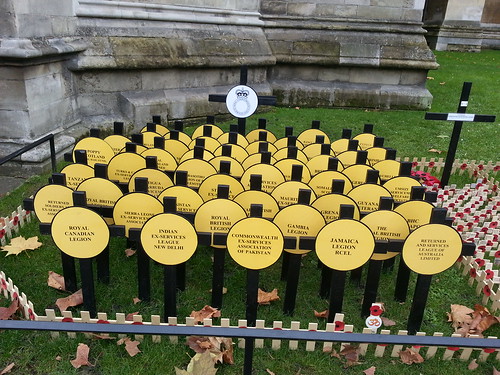
and that those who stayed at home weren't safe either.
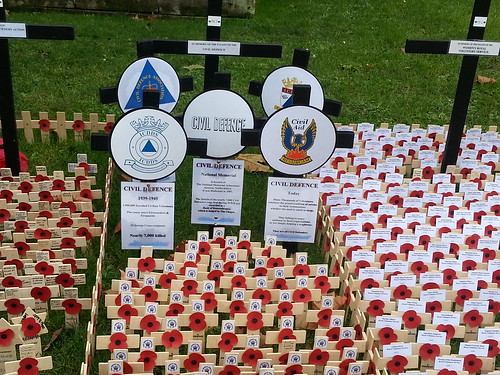
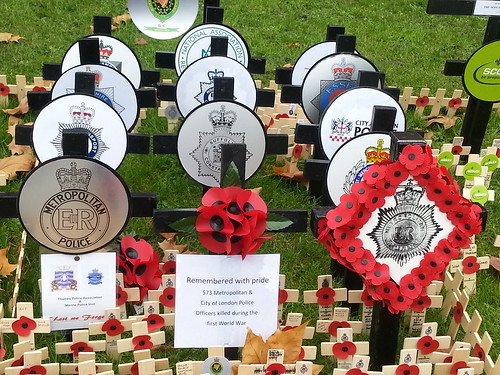
From the first words of the service - We gather today as those to whom much has been given, and from whom much is expected - it was a commemoration of duty and service. After the two minutes' silence (which fell exactly after the anthem; I have no idea how many times someone must have rehearsed that; it has to be the one set of pips you'd never wish to crash) there was the Last Post and Reveille, a prayer, and then a very strange and beautiful thing - the "trench" cello played by Steven Isserlis. It was a quiet, muted sound (my seat was only about 3 metres from the little platform they'd rigged up), but gorgeous; the idea of this object from the trenches still sounding out its song (in this case the Sarabande from Bach's Cello Suite no. V) was astonishing.
Walking past the Tomb of the Unknown Soldier on the way out, people were taking off their paper poppies and scattering them over the inscription, creating a carpet of flowers. Emerging blinking into the sunlight, the first person I saw was Baroness Williams, talking animatedly; it seemed entirely right that the daughter of Vera Brittain should still be around, still intensely engaged, still making a point.
Subscribe to:
Posts (Atom)