Saturday, May 28, 2011

2011 books, #46-50

Deed to death, by D B Henson. Kindle edition.

One of the interesting things about choosing the "under £1" option for Kindle books is that you get a real mixture - first novels by established author to get you to pay more for the others in the series, books which are only available electronically, and so on. This one appears to have gone out as a Kindle edition to test the waters for a print-run and is currently unavailable on Kindle but the paperback is in preparation.

Scott Chadwick falls to his death from the top of the hotel he's constructing, three days before his wedding. His fiancée is determined to prove that Scott has been murdered rather than having committed suicide, and her need for this increases when Scott's estranged brother Brian contests his will. It's a workmanlike sort of book - the plot's well thought-out and resolves satisfactorily, and while the writing style is a bit plodding, it's a nice fast read.

Street dreams, by Faye Kellerman [audiobook]. Read by Liza Ross. Oxford: Isis, 2004.

A Rina and Peter Decker novel but with the concentration on Cindy Decker. Thankfully, Cindy seems to be growing up a little since the last book she starred, in which she was extremely irritating. The story starts with Cindy finding a newborn baby buried under a rubbish heap, and tracking down her mother, a learning disabled girl almost as vulnerable as the baby. Further investigation uncovers a violent crime, and introduces Cindy to personal danger. Meanwhile she meets a handsome paediatric nurse who turns out both to be an observant Jew, which makes her stepfamily very happy, and also Ethiopian, which causes slight surprise at the Sabbath dinner table. Peter Decker is at his irascible best in this one, and with any luck Cindy's more recalcitrant days are behind her.

Unholy angels, by Karen Fenech. Kindle edition.

Liz Jansson's marriage was over well before she left her husband and filed for divorce; but Peter Jansson's suicide, a month after she moves out of their house, looks like a moment of despair at her betrayal; that's certainly what their son, Will, believes. Will is adopted by the adherents of a Satanic group which contains some of the most prominent members of the community, while Liz starts a liaison with the new sheriff, Doug McBride. As she begins to discover more about her husband's involvement in the cult, Liz realises there is nobody in the community she can trust. The writing style is quite basic, but it does have a tautly-written plot with a couple of good twists in the tail.

Gone, by Karen Fenech. Kindle edition.

This book starts with the execution of FBI agent Clare Marshall's mother for killing one of her children, and wounding Clare, twenty-four years before. After a chance meeting with a social worker during a shoot-out, Clare hears news of her younger sister and follows her trail to Farley, South Carolina. When she gets there she finds that her sister has disappeared again, and that the head of the FBI in the area is her former lover Jake. Clare tracks her sister Beth, but someone is tracking Clare...

Winterkill, by C J Box. London: Penguin Puttnam, 2010. Kindle edition.

Game warden Joe Pickett thinks his life is bad enough when he meets a colleague from the Parks Service who has gone insane and started shooting elk indiscriminately, to the extent that he's trying to fill his rifle with cigarettes. However, when the man escapes after Joe arrests him, he's found with two arrows through him and his throat cut. The case is taken over by a female bureaucrat who is truly scary, and meanwhile Joe's foster-daughter April is taken from school by her birth-mother who has come back to town in an encampment of anti-government survivors from Waco and other sieges. Joe is a good man, as is pointed out by one of the slightly more ambiguous characters in the book. The plot's good and it's a riveting read. I'm slightly amazed, given the number of basic errors in it, that this is one with a genuine publisher, but the plot does carry you over that to an extent.

2011 books, #41-45

The whisperers, by John Connolly [audiobook]. Read by Jeff Harding. Oxford: Isis, 2011.

A Charlie Parker book. Brought in to investigate the apparent suicide of an Iraq veteran, Parker uncovers a network of smuggling, and an epidemic of deaths, among the former combatants. Another very gripping John Connolly book, with the usual slightly supernatural elements he introduces. Ironically, I listened to the whole of Saturday Live this morning wondering who the lovely avuncular Irish guest was, and only at the end I caught that it was John Connolly. Like Mark Billingham, obviously someone whose books aren't at all like his personality!

Aberystwyth, mon amour, by Malcolm Pryce. London: Bloomsbury, 2010. Kindle edition.

I'd heard good things about these books from people who also enjoy Douglas Adams's Dirk Gently books and Jasper Fforde, but this first one was disappointing. Louie Knight is a private detective in the Chandler mode, but working in an alternative present Aberystwyth run by Druids. His glamorous client, Myfanwy Montez, a nightclub singer, isn't as she first appears. Somehow, though, Pryce just doesn't really follow through on the premise, and the result is mildly funny but not really funny enough.

Identity crisis, by Debbie Mack. Kindle edition. Also available as print-on-demand from lulu.com

Tightly-written first novel . Lawyer Sam McRea is acting for a woman in a domestic abuse case when the woman's boyfriend is found dead. Sam's client has disappeared and she needs to track her down. At the same time, she finds she has become a victim of theft when someone has applied for a large loan in her name. The themes of murder, identity theft and the mafia intertwine. A very likeable and entertaining protagonist and an excellently-written plot.

Mennonite in a little black dress, by Rhoda Janzen. Atlantic Books, 2011. Kindle edition.

Rhoda Janzen's husband left her for a guy he'd met at Gay.com the week she got into a serious car accident. With no alternatives, she leaves hospital to go to her family home, among the Mennonite community she'd fled at the age of 18 and never returned to. Her family and the community welcome her back with strange food and stranger dating advice, and she remembers all the reasons she wanted to leave in the first place, but also the things she didn't realise she'd lost in return. This is a lovely heartwarming book as well as being sharply funny.

An expert in murder, by Nicola Upson. London: Faber and Faber, 2009.

Period thriller with the author and playwright Josephine Tey as the main protagonist. Tey travels to London from the Highlands in the same train compartment as a young milliner who is a fan of the author's work and is coming down to see her play Richard II. Shortly after the train arrives at Kings Cross, the girl is found murdered in the compartment. Tey's friend Archie Penrose, a police inspector, is called in to head the case and Tey finds herself becoming involved in it. A very interesting setting in theatreland of the 1930s with a wide variety of suspects and a few genuinely surprising twists and turns. A nice element is the setting of Scotland Yard where it actually was in the 1930s, in the Norman Shaw buildings in Derby Gate which now house MPs' offices; often the different locations of Scotland Yard, particularly this one, are glossed over.

Saturday, April 30, 2011

2011 books, #36-40

Murder on the Eiffel Tower by Claude Izner. London: Gallic Books, 2007.

I loved this. It has a real sense of the 19th century French novel, with people knowing other people and moving in Certain Artistic Circles, and so on. The authors (a pair of sisters who are both bouquinistes on the banks of the Seine) are obviously allied to those people of the time who were fans of Balzac; and horrified by Zola. You get the sense of the huge development in Paris at the time (people are constantly asking other people for directions) and the sense of pride and progress the Tower produces... The detective plot is almost secondary, but also very satisfying... A truly French novel, beautifully translated.

Burn baby burn by Jake Burns. London: HarperCollins, 2010. Kindle edition.

Marcus Green planned the death of his father when he was 6 years old, and was convicted of burning down a house with his teacher and her two children inside it at the age of 13. Now he's out of prison and back in society again, and young girls are disappearing. Donna O'Prey and her boss Dexter, part of a private security firm, are engaged by the latest girl's father to find her. This book started out well but is ultimately a little bit disappointing. It does have an unexpected twist in the tail though, and some engaging characters.

More twisted by Jeffery Deaver. London: Hodder, 2007.

Another volume of very, very good short stories from Deaver. His tendency to pull the rug out from under the reader works just as well, if not better, in the short form, and there are more twists than a corkscrew. There's also a longer story, almost a novella, featuring Lincoln Rhyme in this volume. This really is a masterclass in how the crime short story ought to be written.

Dying to sin by Stephen Booth [audiobook]. Read by Graham Padden. Rearsby, Leics: Clipper, 2009.

Another extremely good Stephen Booth Diane Fry/Ben Cooper novel, read by a very good reader. Building work at an isolated farm unearths two bodies, seemingly buried several years apart. A combination of local superstition and the hard realities of migrant labour keep this story flying along; Cooper is almost absent from this one other than as an adjunct to his girlfriend, which is a shame, but there are some good Fry moments. The Peak District, as ever, features large in this story.

The language of bees, by Laurie R. King. London: Allison and Busby, 2010.

A Mary Russell and Sherlock Holmes mystery - although these really need to be read in chronological order starting with The beekeeper's apprentice. Set in 1924, this one takes us from a mysteriously self-destructive beehive to peril in ancient stones in Orkney, via the intriguing idea that Sherlock Holmes and Irene Adler had a son who is now approaching 30. As ever, the plot rattles along; unlike the previous book, Locked Rooms, there is little psychological analysis, but some fascinating period details regarding new spiritualist religions, and some perspicacious comments on the post-War era. And as ever, I continue to be stunned that the author is from the US and still lives there.

Saturday, April 16, 2011

2011 books, #31-35

Sinema: the Northumberland massacre, by Rod Glenn. [S.l.]: Wild Wolf Publishing, 2011. Kindle edition.

A man whose name we never discover decides to commit more murders than anyone in history, and methodically chooses a small Northumberland town near Rothbury. I really didn't like this book. It's gory, certainly; but that's not totally offputting in itself. I think it was the complete moral vacuum in the book. The only thing which makes a story like this at all fascinating is learning why the crime has been committed, and the character himself really doesn't seem to have a reason, so it's ultimately all very pointless. One tiny point compared to the general non-interest of the book, but an irritating one; all brand and pseudo-brand names are italicised and capitalised, so you get Parka-wearing characters carrying SPAR bags containing bottles of Coke.

Sweet little lies, by J T Ellison. Kindle edition.

This is a book of short fiction, some of it extremely short in the flash fiction mould. I'm not completely convinced that flash fiction works for crime (in the way it undoubtedly does for fanfic, sci fi and fantasy), and this hasn't convinced me. There's a really good story in there, Killing Carol Anne, but as this is the story which led me to this book in the first place, it was a bit disappointing. I'll certainly go back and read more of Ellison's full-length novels and longer short fiction, though.

The Goliath bone, by Mickey Spillane with Max Allen Collins [audiobook]. Read by Jeff Harding. Oxford: Isis, 2009.

This is a Mike Hammer novel constructed from Mickey Spillane's notes and written by his literary executor. Two young archaeologists have discovered an enormous femur in the Valley of Elah, and both the Israelis and Al-Qaeda are interested in acquiring it. Hammer, although well beyond retirement age, and his trusty secretary-fiancée Velda, leap into the investigation. This is an entertaining listen, despite the unlikely premise. I'm not convinced I'd have finished this in book form, but as ever, Jeff Harding's reading is as much fun as the book itself.

Careless in red, by Elizabeth George. London: Hodder, 2009.

When Elizabeth George killed off Helen Lynley I swore off these books, but a couple of people whose opinions I respect persuaded me that this was a return to form, and indeed it is. The Cornish setting is interesting given how urban so many of the Lynley mysteries are, and the interplay between Lynley and Barbara Havers is wonderful. This makes up for the plot itself panning out in a somewhat disappointing way.

The comfort of things, by Daniel Miller. London: Polity, 2008.

This was the April Kniterati book, and a non-fiction choice. Daniel Miller and his assistant/student spent 18 months in a single London street, establishing a relationship with its residents and learning about them through their possessions (or lack of them). Some of the stories, particularly of the single men in the street, are quite heartbreaking; others are gently funny or moving. I did wonder about the conclusions Miller seemed to pick effortlessly out of thin air though - I kept wanting to demand that he show his working. A very interesting book, but it's ultimately as much about Miller as it is about the people he's studying.

2011 books, #26-30

The black ice, by Michael Connolly. London: Orion, 1993.

A Harry Bosch novel I somehow missed reading earlier. A corpse in a hotel room appears to be that of a missing LAPD narcotics officer. Rumours abound that the officer had also been drug-dealing in a drug called black ice, which had been coming over the Californian/Mexican border, and had committed suicide rather than being found out. Harry isn't so sure, and carries out a maverick investigation on both sides of the Mexican border, leading him into a web of police corruption and genuine danger. As ever, tightly plotted and well-written.

Blue heaven, by C J Box. London: Corvus, 2010. Kindle edition.

Two children, William and Annie, go on the run after witnessing a murder carried out by four men. Quickly we realise that the four men are retired police officers from Los Angeles who have retired to their relatively quiet rural backwater (the Blue Heaven of the title), and they infiltrate the search for the two children in order to kill them. As well as being a very suspenseful book set over just 48 hours, it also has time to talk about the plight of ranchers trying to continue to eke out a living in a picturesque area where everyone wants a detached house and a couple of acres of land. Excellent.

Painless, by Derek Ciccone. [S.l.]: Dog Ear Publishing, 2009. Kindle edition.

Billy Harper is trying to rebuild a life and rents a cottage from Beth and Chuck Whitcomb in a small, exclusive town in Connecticut. It soon becomes apparent that their six-year-old daughter Carolyn is very different, and when the family finds out what the problem is they barely have time to absorb the diagnosis before a covert operation called Operation Anasthesia starts hunting Carolyn to exploit her "gifts". There are some very surreal elements to this, and some of it's quite science-fiction-like; it's also genuinely scary in parts. Highly recommended.

Fifth Avenue, by Christopher Smith. Kindle-only edition, 2010.

It's rare that you get a review which compares a novel adversely with a Jeffrey Archer, but this is sort of Kane and Abel revamped for the 21st century, but without any of the whatever-it-is which makes Archer's books bestsellers. A cast of extremely unlikeable mega-rich New Yorkers seem to have nothing better to do than take out contracts on each other while swanning round beautiful settings. I did finish this book, but only because it also has the advantage of not being very long, but it was a close call.

Truth dare kill, by Gordon Ferris. London: Corvus, 2011. Kindle edition.

Danny McRae has just about survived WWII, albeit with severe facial injuries, frequent blackouts and the loss of a couple of years' worth of memories. He's scraping along as a private investigator, having been a detective in Glasgow before the war, when a client asks him to locate the very man who sent him to France as an SOE officer in the first place. Meanwhile, a serial killer is stalking and killing prostitutes in the area, and Danny can't be totally certain that the killer isn't him - only unlocking his memories is likely to solve the dual mysteries. This is a really fast-paced noir novel set in a bomb-ravaged post-war London which is almost an additional character.

2011 books, #21-25

Stone kiss, by Faye Kellerman [audiobook]. Read by Jeff Harding. Oxford: Isis, 2003.

Another Kellerman I'd read but forgotten most of - this time set in the Orthodox community of New York, where Decker is embroiled in his half-brother's family's troubles - a murder and a missing niece. It rattles along quite well, but ultimately, there's something unconvincing about Decker going it alone in New York rather than letting the NYPD deal with the case, given his attitude when on home turf. Another excellent Jeff Harding reading though.

Sugar and spice, by Saffina Desforges. Kindle edition.

I think this is the first book I've read which is only available in electronic editions, which is interesting; and it's a strange one. Two boys find a severed arm in a canal, which turns out to belong to missing ten-year-old Rebecca Meadows. The usual (paedophile) suspects are rounded up, and one man in particular seems to be a likely candidate. After some somewhat extreme police brutality, he confesses, but his solicitor is convinced he's innocent. Meanwhile, a father who is increasingly concerned about his own fantasies about young girls is seeking help at a specialist clinic. In parts, this reads like an undergraduate abnormal psychology course, but Desforges makes her characters strangely compelling, and it's an interesting exploration of some pretty unpleasant human behaviour which fails to dehumanise most of the characters.

Invisible, by Lorena McCourtney. Grand Rapids, Mich.: Revell, 2004.

Ivy Malone's best friend dies, and she gradually becomes aware that she's all-but-invisible, as a little old lady, to the rest of the world. Rather than giving up and fading away, she decides to use this to her advantage in solving the mysteries of a vandalised graveyard and a missing neighbour. This is a gentle book, very much a "cozy" in US crime novel terms, but it rattles along very entertainingly.

Wading home: a novel of New Orleans, by Rosalyn Story. Chicago, Ill.: Agate, [n.d.]

This was another Kindle special offer, and it's a wonderful book. A young jazz trumpeter, Julian, is playing in Japan when he hears news of Hurricane Katrina, and goes home to New Orleans to find his father who had intended to weather out the storm. Going home means Julian has to confront all the reasons he left in the first place, and also brings him into contact with family and old friends who make him reconsider his life. There's a wonderful cast of characters, and it's a genuinely moving read from start to finish.

B**locks to Alton Towers: uncommonly British days out, by Robin Halstead, Jason Hazeley, Alex Morris and Joel Morris. London: Penguin, 2006.

This is just a lovely, gently funny, knowing book about the "characteristically British mistrust of ostentation [and] love of the modest, the enthusiastic and the unusual... We also seem to have a disproportionate affection for the barely-buttoned-down insanity of the Victorians... This is the antithesis of one-size-fits-all entertainment". From the Morpeth Bagpipe Museum to the Porteath Bee Centre, the David Beckham Trail to Diggerland, these are attractions mainly staffed by enthusiasts and usually catering to some overwhelming obsession. Throughout, the locations are treated with affection and wit; and you learn a smattering of history along with each entry.

Sunday, April 03, 2011

Knitting and Crochet Blog Week, Day seven (2KCBWDAY7)

I'd gone to bed nice and early for a change, and then I remembered I hadn't posted today...


Write about your typical crafting time. When it is that you are likely to craft – alone or in more social environments, when watching TV or whilst taking bus journeys.

My typical crafting time these days, because I have a nearly-2-hour-commute each way to work, happens on trains. And it's semi-obsessive. I wouldn't say my commute is ruined if I can't get an aisle seat with my left arm in the aisle, but it's... in modern jargon... compromised...

I have a travelling project, and a knitting-at-group project in my bag; sometimes those are the same thing, but mostly I can concentrate more on a train project than on a talking-to-people project. I listen to podcasts while travelling - probably a subject for another blog post. I carry a nice little SIGG water bottle filled with home-made fizzy squash, and I like this small space at the beginning and the end of the day where nobody talks to me.

About a month ago, a knitter whose train I catch a couple of times a week realised who I was and friended me on Ravelry; and although I used to see her knitting quite regularly before she friended me, somehow I've not managed to get onto the same train carriage again! So, sorry - not at all intentional - talking to another knitter would be lovely!

At home I knit wherever and whenever. It might be propped up next to the cooker waiting for food to sort itself out, it might be standing next to the radio while cricketers decide what's happening. I do have a sort-of-dedicated-chair for knitting but equally I have a chair in front of the PC where I can knit while catching up with Ravelry or Radio 4...


Saturday, April 02, 2011

Knitting and Crochet Blog Week, Day six (2KCBWDAY6)

So after yesterday's blip: today's theme:

Is there a pattern or skill that you don’t yet feel ready to tackle but which you hope to (or think you can only dream of) tackling in the future, near or distant? Is there a skill or project that makes your mind boggle at the sheer time, dedication and mastery of the craft? Maybe the skill or pattern is one that you don’t even personally want to make but can stand back and admire those that do. Maybe it is something you think you will never be bothered to actually make bu can admire the result of those that have.

I don' t really understand the idea of feeling "ready to tackle" a skill. In my experience, you see a project which demands that skill, and if you like it enough, you're going to make it. I haven't done much teaching of beginners, but I'd always say "whatever you want to" when they say "what should I make next?". I've seen people working on both-sides lace projects when they've been knitting for less than a year, and people happily cranking out garter-stitch blankets after many years' experience.

Having said that - yes, there are things which make me boggle. There were some fabulous crocheted scarves at the last two years' I Knit Weekender, made by someone with a French name (please, anyone)? in what looked like #8 perle cotton. There was an Irish crochet wedding dress, a photo of which was shown to me on a train, because the husband of the woman who'd made it in the 1970s wanted to take a phone-video of me knitting beads into a shawl using a crochet hook. (The bride had also crocheted bodices for her three bridesmaids; he didn't have pictures of those). Anything at all Debbie New does just alters my brain in strange and subtle ways.

I'm very glad I started knitting when I did, and where I did; there was no notion of what was easy, and what was complicated, because I really didn't know any other knitters, apart from girls my age and one or two of their mums. In some ways, obviously, this made the task harder; but in other ways, there were no boundaries. I've learned more in the last 10 years than I did in the previous 15 about knitting, because of the Internet, but I've also learned that some people think there's a right way, and a wrong way, to do things; and that's not always helpful.

Friday, April 01, 2011

Knitting and Crochet Blog Week, Day five (2KCBWDAY5)

Today's challenge:

This is an experimental blogging day to try and push your creativity in blogging to the same level that you perhaps push your creativity in the items you create.

I'm sure that if I'd left home later than 6:45 this morning or got home earlier than 9:35 this evening, I might have had some creativity... I couldn't even knit either way (rare) because I was stuck in a window seat next to one of those Daytripper Important Chaps (sort out the acronym yourselves) who thinks that sitting with his legs wide apart is the way to impress people on commuter trains; different chap, both journeys.

So - I'm just going to blog about the thing I don't normally blog about - work.

Tonight, I went to a leaving do for someone from my previous job. It was for someone I really, really liked while I was working with her, but I was also interested in catching up with people. It was a nice evening, after my initial entrance to complete embarrassed silence other than the few early arrivers who remembered me - it's been well over 3 years since I left ... I remembered why I loved working for the company -some seriously good sarcasm, genuine friendship and general intelligence - and why I left.

I love my current job (today's been a bit trying because it's been a lot like my last job!) but because we're all working in central London and living elsewhere, there really isn't the cameraderie. It's taken me a while to build up people I know and trust as friends; and ironically I had to pass on drinks at work to get to the leaving do in Cambridge...

Not a groundbreaking multimedia post; but at least a post!

Thursday, March 31, 2011

Knitting and Crochet Blog Week, Day four (2KCBWDAY4)


Today's prompt:

Whatever happened to your __________?

Write about the fate of a past knitting project. Whether it be something that you crocheted or knitted for yourself or to give to another person. An item that lives with you or something which you sent off to charity.


I was mulling this one over last night on my way to knit night at I Knit London; and there, I met a couple of lovely women from Chicago who had met through knitting and had included IKL's knitting group on their itinerary of London. Totally aside from it being really interesting to meet more people from Chicago, a couple of the phrases one of them used struck me - charity knitting versus selfish knitting.


That sort of knocked me back. I knew exactly what she meant on one level; and then not on another. On a given day, in a given year, I suppose one of my on-the-go projects might be for me; but generally the other two (I try not to keep more than three things going) will be for someone else. Sometimes that someone else isn't terribly definite (I stash finished socks until they find the perfect recipient, or I just cave in and wear them myself; I do small amounts of test knitting which sit around until someone has a child who's the right size, that sort of thing...) but mostly, I do know the people I give knitting to. I do a small amount of charity knitting; but a very small amount. I wouldn't necessarily categorise the rest of my knitting as selfish though.


Before that - and I sort of had to get that off my chest without, actually knowing where I was going with that one - my subject for Where are they now? was a couple of baby/toddler cardigans I made quite some time ago.


The first one was made in the late spring of 1997, and I bought the yarn in a Phildar in Cahors, and cast on in the garden of the very first gîte (or, indeed, holiday) my ex-husband and I could afford after spending all our money in the previous few years making our house liveable-in. [On the way home, the car broke down irreparably around Orléans; and yet it still sticks in my mind as a really excellent holiday.] It had a garden full of butterflies, and, in between aiming the camera and the binoculars at them, I knitted this cardigan full of Weather. It had lightning clouds, and possibly ducks, and all sorts of little pictorial Fair Isle on it; and it was made for the prospective first child of college friends. All three of their children wore it; and then it was passed on to a sibling's children, and both of those children wore it. Somewhere, I have a picture of the Fifth Recipient wearing the cardi (and sorry, Anne, I can't find it). This was about 10 years later. The cuffs had almost entirely gone, and the general surface was pretty scrubbed, but it was a lovely picture of a small child, with food all over its face, wearing what was recognisably a completely knackered-through-wear Weather cardi.


The second was a cardi made in about 2001, in gold, orange and red DK cotton (three plies, one of each colour). Again, I made it for Big Sister, Little Sister wore it, and then it was passed along the road to the neighbour; which I realised when said neighbour came into the library one Saturday morning with her twins, and the little girl was wearing it, complete with the Fimo buttons I'd made for it, intact... We were ceremonially introduced (I was Suzanne's-Friend-Liz-Who-Knitted-The-Cardigan). I mentioned at that point that I had another of those buttons at home (they were made for a City and Guilds project). About a year later, the mother contacted me, to say it was a bit cheeky, but did I still have the button, as the cardigan was good as new but they'd lost a button and they wanted to pass it on to another family...


Seems to me that it's a very good reason to knit. You give knitted gifts to people, and sometimes they just don't connect, and are never worn. Sometimes they do connect, and the same person wears them and wears them until they wear out (my Dad's getting to that stage with the first Felted Tweed scarf I made him, I think; socks are good for that, too). And sometimes they do connect, and they're passed on, and whole families wear them, and friends of whole families.


It's heartwarming to know where things are occasionally; but it's not essential to making them in the first place...


Wednesday, March 30, 2011

Knitting and Crochet Blog Week, Day three (2KCBWDAY3)


Today's challenge:

How do you keep your yarn wrangling organised? It seems like an easy to answer question at first, but in fact organisation exists on many levels. Maybe you are truly not organised at all, in which case I am personally daring you to try and photograph your stash in whatever locations you can find the individual skeins. However, if you are organised, blog about an aspect of that organisation process, whether that be a particularly neat and tidy knitting bag, a decorative display of your crochet hooks, your organised stash or your project and stash pages on Ravelry.

I love the proviso that "organisation exists on many levels". My entire life seems to consist of small pockets of organisation surrounded by seas of relative chaos. But some of those small pockets of organisation are knitting-related...


This is my pretty-needle stash. It lives on the counter between the kitchen and the dining room, behind the digital radio and the bowl that, at the weekend, holds vegetables, but by this stage of the week is somewhat bare. (One lemon, one hunk of ginger and a head of garlic at the moment!) And, these days, behind my brand-new James Naughtie egg-cup. This is where pretty plastic needles (I particularly love the Durex brand ones from the 50s) and other favourites live...

Otherwise, when organising, throwing some purple at the problem always helps.

The folder on the left holds my fixed circular needles - it holds an amazing number. It's made of thick, rip-stop nylon, and has little tabs you can write the needle size on. It's quite brilliant, made by a company called Happy Bags which seems entirely untraceable on the Internet, and it was a present from a friend in the US, probably about a decade ago. I've never seen anything quite as useful for needle storage before or since.

The box on the right holds small/short DPNs and stitch holders. Both of these live in the top couple of drawers of a yarn chest in the dining room.

Otherwise, my main organisational tools are Ravelry (queue, projects, etc.) and a couple of spreadsheets on my PC. I start one each year for finished objects (dates, yardage, weight knitted up), and have a running one for the Stash Inventory; the main Stash is in 14 plastic crates in the loft so a spreadsheet is a bit vital to avoid running up and down there all the time...

Having said that, I also have baskets, boxes, bags, mailing envelopes, etc. etc. of yarn kicking around the place too... And thankfully, a near-photographic memory of what's where... Having said that, the Stash can still surprise me.

Tuesday, March 29, 2011

Knitting and Crochet Blog Week, Day two (2KCBWDAY2)

Today's theme:

Look back over your last year of projects and compare where you are in terms of skill and knowledge of your craft to this time last year. Have you learned any new skills or forms of knitting/crochet (can you crochet cable stitches now where you didn’t even know such things existed last year? Have you recently put a foot in the tiled world of entrelac? Had you even picked up a pair of needles or crochet hook this time last year?

Well; I think I learned a lot over the last year; but you wouldn't necessarily know it from my projects. I think that's because I have such a long list of projects that new techniques find it difficult to sneak in under the wire all that quickly - my project list is like trying to stop a supertanker in its tracks...

KnitCamp

I took a series of excellent classes at Knit Camp last year. Many things have been said about this event - and most of the stories about the organisation are true, particularly the more extreme ones - but the standard of tuition was impeccable. I want to finish my little Roositud sampler, do more double knitting (and we have a chap at knitting group who does double knitting all the time so I know where I can go for help) and after two years promising myself I'll steek, I still haven't done it, but this year...

One thing I have tried to put into practice this year is knitting things which fit. Joan McGowan Michael's class was a bit of an eye-opener, and proof that yes, I am actually an extremely awkward shape (and regardless of what I weigh, realistically always will be)! So I've tried to make things which don't swamp me. That means that I'm currently rather self-conscious about anything I've knitted recently because it feels a bit more fitted than I'm used to, but that certainly works better for work-wear. (I have no decent pics of either of these projects though, as taking photos with the self-timer really doesn't work; maybe when my parents visit in a couple of weeks I'll be able to get Dad to take some).

Lanthir Lamath

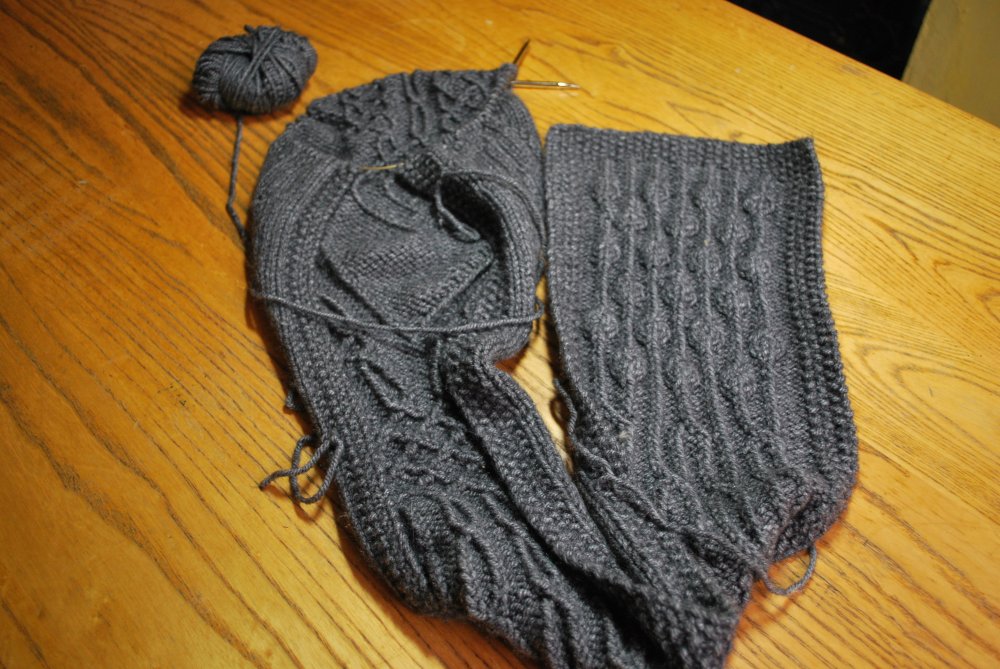
Another wonderful learning experience this year was knitting the Lanthir Lamath hooded scarf (Ravelry link; commercial pattern still in preparation) along with Ann Kingstone, a wonderful designer I met at KnitCamp. One of the (many) interesting things about Ann is that she's a true left-handed knitter (as opposed to me, a left-hander who knits); she does everything the leftie way round. And fascinatingly, she has a right-handed twin who's able to do demo videos the rightie way round. But that does lead to a difference in terminology in her patterns - Ann will talk about the active or passive needle rather than the left or right one - and that in turn really trips an "aha!" switch in leading to a different way of thinking about making a fabric. It's little things like that...

There were also several lovely technical twists in this pattern - a centred double increase which you have to watch the video several times to master, and then shortly after becomes almost second nature, and which matches the centred double decrease which I love; a different way of making short rows neat; some wonderful twisted cabling. And all in a lovely, friendly, supportive knitalong group.

Misc.

Small technical things - I think I've nailed the M1R/M1L/M1K/M1P increases thing so I don't get holes. This has been a problem for ages, so I'm glad to have sorted that out...

And although I say it in the linked post - managing to cast on 42 stitches in a long-tail cast-on and not spend the whole 3 hours of Nancy Bush's class doing so made me tearful with joy (thankfully not in the actual class; afterwards while contemplating the sheer beauty of my garish little sachet...)

Often I learn new techniques by teaching others, but I haven't done any formal teaching this year; need to push myself a bit further without that prompt, maybe. The technical thing I do really want to learn next is brioche - Nancy Marchant's brilliant book shouldn't be allowed to languish on the shelves any longer.

Monday, March 28, 2011

Knitting and Crochet Blog Week, Day one (2KCBWDAY1)

So, I heard about the second annual Knitting and Crochet Blog Week over at Wibbo's blog at the beginning of the month, and it seemed like a good idea to get myself kick-started again - if there's anyone still reading this, it's obvious that my blogging mojo vanished over the winter and I didn't want to put up another book review post (even though there's one just about ready)! But British Summer Time has started so I'm hoping I'll feel less like hibernating...

Today's topic:

Part of any fibre enthusiast’s hobby is an appreciation of yarn. Choose two yarns that you have either used, are in your stash or which you yearn after and capture what it is you love or loathe about them.

I should probably state now that I am not, and nor have I ever been, a yarn snob. I have a lovely test-knit on the go in James Brett Marble, a soft acrylic; and I'm just as likely to rhapsodise over something by King Cole as by Noro (in fact more so - King Cole don't have a nasty habit of knotting their yarns in the middle and losing the colour progression! But I digress).

However, sometimes you do knit with a posh yarn which just stops you in your tracks. Such is Casbah, by Hand Maiden.

Vital statistics: sock weight; 81% merino, 9% cashmere, 10% nylon. 325m/115g. Superwash.

It's not the longest yardage you'll ever see in a sock yarn, but the cashmere gives it a wonderful smoosh, and every stitch is enjoyable to knit. It comes with a fairly hefty price tag, but it's totally worth it. This is destined to make a Haruni shawl, when I can round up the nearly-a-whole-skein Gerard from I Knit London very kindly passed along to me after he ran out very near the end of his shawl, and get the two in the same place long enough to start knitting...

In terms of the "loathed" yarn, the only one I seriously hate is Rowan's KidSilk Haze. However, Wibbo's blog post today has summed up our mutual loathing of the stuff beautifully. (I'd also add to the litany of faults that it's the only yarn I've ever had problems with in terms of it snapping while I knit it - and I'm a loose knitter.)

So in its place, a yarn I love, but have found seriously difficult to use. Step forward, Cherry Tree Hill's Merino Lace in "Fall Foliage".

Vital statistics: 2-ply laceweight. 100% merino. 2195m/227g. Hand wash only.

I just love this combination of colours, and having 2km of yarn in a single skein is very cool. But as serious lace addicts will realise, a highly variegated yarn has its own problems when it comes to lace patterning - you can have colour or pattern, but if you try combining both...

Suffice it to say that a mystery Pi shawl knit-along was frogged about two-thirds of the way through when I realised that nobody could see the lovely patterns in the shawl, and a second attempt at a simpler lace pattern was also abandoned...

Eventually I took a leaf out of Jackie's book (sadly blogless, but jackier on Ravelry) and combined the yarn with something more subdued (an aubergine-coloured Artesano alpaca 4-ply), and it seems to be working.

This is destined to become a Botanical cardi. I'm hoping to get cracking on it again this week, as a couple of gift knits are nearing completion. I have the body made and one sleeve started, and it's not a complicated pattern...

I have History with CTH Merino lace - the first skein I bought was also too variegated for the pattern I wanted to use it with, too... In the end, I ended up knitting one project with it, and then overdyeing it because it had overwhelmed the subtle patterning... Here it is in its original state, with the overdyed project underneath it...

You'd think I'd learn, really! Well, I have, mostly - I'm still attracted to the really heavily variegated yarns, but then I step back and realise that unless I'm making something pretty plain, less is more...

Thursday, March 10, 2011

2011 books, #16-20

Death in Oslo, by Anne Holt [audiobook]. Read by Christopher Oxford. Bath: Oakhill, [n.d.].

The (female) US president is kidnapped on a visit to Norway; the Oslo police and the secret service reluctantly co-operate in trying to recover her. However, unknown to them, the motive for her abduction isn't political. Hanne Willemson, the police detective from 1222, read earlier in the year, also features in this one, and while her presence is as the result of a very unlikely coincidence, she's still a fascinating character.

Home, by Marilynne Robinson. London: Virago, 2009.

This is, as one of the cover reviews says, the saddest book I've ever loved. Jack and Glory end up at home in Gilead, both of them outcasts from their own lives in diffferent ways, and look after their elderly father. Glory has been rejected by her fiançee, Jack has been wandering for many years and has always been the black sheep. Nothing very much happens on the surface of this book, but the old man's dementia and religious conviction lead to a gradual stripping down of the layers, and revelations of what has happened to bring the characters home again. There are glimmers of resolution or redemption, but ultimately this is a heartbreaking book. Another Kniterati book I'd never have read otherwise. I'm glad I read it, and also that I had a good supply of tissues for the end.

The forgotten, by Faye Kellerman [audiobook]. Read by Jeff Harding. Oxford: Isis, 2002.

I realised a couple of tapes into this that I had actually borrowed this audiobook before - but it was a long time ago, and before I started reading this series in chronological order; and Jeff Harding could read the stock exchange prices to me and I'd listen. Another Decker book - the synagogue the Deckers have helped found is vandalised by a teenager called Ernesto Golding, a schoolmate of his Decker's son Jake. Golding confesses, much to the shock of his ultra-liberal parents, and is put into therapy as part of his reparation. However, this is only the beginning of his problems, and Decker gradually uncovers a web of deceit and intrigue, including some unpalatable facts about his younger son's life.

All the pretty girls, by J. T. Ellison. Richmond, Surrey: MIRA Books, 2010. Kindle edition.

For a change, I'm just going to steal the Amazon summary here, because it's better than I'd manage for this book.
When a local girl falls prey to a sadistic serial killer, Nashville homicide lieutenant Taylor Jackson and her lover, FBI profiler Dr. John Baldwin, find themselves in a joint investigation pursuing a vicious murderer. The Southern Strangler is slaughtering his way through the Southeast, leaving a gruesome memento at each crime scene - the prior victim's severed hand. Ambitious TV reporter Whitney Connolly is certain the Southern Strangler is her ticket out of Nashville; she's got a scoop that could break the case. She has no idea how close to this story she really is - or what it will cost her. As the killer spirals out of control, everyone involved must face a horrible truth - that the purest evil is born of private lies.
This is a debut novel, but it certainly doesn't feel like one - extremely gripping.

The glassblower of Murano, by Marina Fiorato. London: Beautiful Books, 2008. Kindle edition.

This is a wonderful book, and the fact it's set in Venice is absolutely vital to the plot and atmosphere. Leonora Manin's husband has left her, and she leaves London for her father's city of Venice, to continue to make a living as a glass artist. She is engaged by a company in Murano on the grounds of her own skill and her ancestral name; her ancestor Corradino was a famous glassblower in the 17th century. Gradually her own growing curiosity about the mystery of her ancestor, and the possibility of a new romance, lead her to try and discover her past. Meanwhile, we begin to learn the story of Corradino through his own eyes. This is beautifully written and there are some very puzzling parts of the 17th century story which are gradually resolved as the novel comes full circle.

Sunday, February 27, 2011

Quick single

I have loads of things to blog. But for the moment, just posting this photo.

Square on the bottom, 22 sts, 44 rows, Peace Fleece 3.75mm needles, knitted while at Textiles in Focus yesterday.

Square on the top, 22 sts, 44 rows, Peace Fleece 3.75mm needles, knitted while listening to England's World Cup innings against India this afternoon...

I ought to be picking up stitches for a neckband. Don't dare though, in case of strangulation... This might be a good time to spin some laceweight...


Sunday, February 13, 2011

2011 books, #11-15

Another clutch of books - I'm reading a lot more this year, I think due to the Kindle - so much easier to read and knit on the train!

I shall wear midnight, by Terry Pratchett [audiobook]. Read by Stephen Briggs. Oxford: ISIS, 2010.

The fourth and last of the Tiffany Aching series; Tiffany's enemy this time is the Cunning Man, a creature who takes over human bodies to pursue witches. Meanwhile Roland, Tiffany's former beau, is marrying another girl. The Nac Mac Feegles add their usual comic interest, and as ever Granny Weatherwax and Nanny Ogg provide a source of wisdom and weirdness. A very good finale to the series.

Executive power, by Vince Flynn. New York: Pocket, 2004.

The next in the Mitch Rapp series, set in the Middle East and among the upper echelons of the CIA. One of the things I like about Flynn is that the narration shifts ever so slightly depending on the point of view of the character being described; so while you're reading the Israeli's point of view you understand it entirely; and then you move to a Palestinian character with an opposite opinion and that's perfectly comprehensible too. However, there's still a sense that the US actually understands what's going on and knows best, which is less attractive. This thriller rattles along, albeit somewhat shapelessly. My only real criticism of it is that he's turning Anna Reilly, Mitch's wife, into a bit of a shrew, which is a shame.

Defending evil, by Charles Shea. Kindle edition.

Travis Knight and his partner Ray are up-and-coming lawyers in Atlanta, Georgia; and none too scrupulous about the clients they take on. When they take on the case of a former schoolfriend, and famous quarterback, accused of murdering his wife, they find out very quickly that the man is guilty. Then the threats begin... This is tightly written and plotted, and has a twist about two-thirds of the way through which is surprising but not entirely unexpected.

It's your time you're wasting: a teacher's tales of classroom hell, by Frank Chalk. [S.l.]: Monday Books, 2011. Kindle edition.

The title says it all; this is a collection of blog posts about life in what Alastair Campbell once described as "bog-standard comprehensives". The author is the same age as me, and seems to have gone to a similar (quite good) comprehensive school. Some of the anecdotes here are hilarious, some are just sad, and some made me quite fearful about the future. Throughout, though, there's a battered sense of compassion for the kids, whether they're there to learn or not.

The hanging shed, by Gordon Ferris. [S.l.]: Corvus, 2011. Kindle edition.

Douglas Brodie has drifted since being demobbed in 1945; he's making a desultory effort to be a freelance crime reporter in London, having left the police to join the Army in 1939. Out of the blue he receives a phone call from a former schoolfriend, Hugh Donovan, who has been condemned to death for raping and murdering a young boy. Brodie returns to his native Glasgow at Donovan's request. All the evidence points to Donovan's guilt, but he's convinced he's innocent, and Brodie reluctantly starts to dig into the case with the help of Donovan's barrister Sam Campbell. This book is as interesting for the period details - it has some elements of John Buchan or Dornford Yates, but written with today's frankness of gruesome details. I've downloaded another couple of Ferris's books on the basis of this.

Saturday, February 12, 2011

Bit of progress...

This week's progress has been socks, and more socks...

First the Hederas. Done! Possibly aided by a couple of Journeys from Hell this week...


And then the Monkeys.


This yarn is a reminder of an extremely nice day, and so I'm very glad it's behaving nicely with this stitch-count and pattern No guarantee it's not going to go berserk on the gussets in this sock - it would suit a sock without such things better, but the legs will be lovely...

I'm working on the Big Black Sweater this weekend...

Tuesday, February 08, 2011

Crushed by the wheels....

For the first time ever (when it's not two weeks before Christmas with a stupidly overambitious list of projects in front of me, anyway) I'm feeling ever so slightly oppressed by my knitting.

I think I know why - on the 1st February I was working on 4 knitalong projects, and this situation obviously doesn't agree with me. One of those proejcts is finished, but I think the recipient calls in here every now and then, and one of the other non-KAL things I finished needs blocking...

In addition, I have finishitupitis. The Yarn Harlot recently blogged this and I realised that was exactly what it was. Normally, not a problem.

It might be having 6 WIPs on the go just after Christmas. It might have been starting KALs when actually, I still had a Christmas present to finish until about a fortnight ago! It might be something else entirely. Such as setting off from home and the temperature being 20C below what it's going to be in the office 2 hours later, and not having enough cardis. Whatever it is, it's sending me into paroxysms of indecision.

Everything I'm working on is, as far as I remember, enjoyable. Everything I'm working on is currently for me. (Maybe that's an additional problem; those usually end up at the bottom of the heap. It's fairly striking that everything I've finished since Christmas has been for other people...)

So I thought I might just blog them, and then blog progress on them, and maybe feel better about them...


WIP the first: Hedera
Started because: knit.sock.love. knitalong on Ravelry
Yarn: Legolas, dyed by Wibbo as a Christmas present.
Needles: 2.5mm KnitPro Harmonies
Reason I'm enjoying these: Lovely simple lace pattern, beautiful colour in the yarn (also, gift yarn which means I get to keep the result).
Oppressive because of the whole KAL ethos - there are always some people who will finish this project on day 1 - normally this is no problem. I'm sometimes one of those people. This time, not so much...
Progress: about 35% on this photo, but progress has been made since.
Theoretical deadline: end of February for the whole competitive KAL thing.


WIP the second: Monkey
Started because: knit.sock.love. knitalong on Ravelry
Yarn: Lorna's Laces Shepherd Sock, in colour Franklin's Panopticon.
Needles: 2.25mm; combination of 3 Colonial Rosewood needles and one KnitPro Harmony to make up the set.
Reason I'm enjoying this: The yarn was a gift from Franklin (so I get to keep the finished object); I am very intrigued as to how it will knit up; I'm using my favourite needles.
Oppressive because: see WIP the first...
Progress: well, there you see it....
Theoretical deadline: end of March for the whole competitive KAL thing.


WIP the third: Lanthir Lamath scarf/hood [Ravelry link]
Started because: Ann Kingstone knitalong on Ravelry
Yarn: Bergère de France Baltic, in Tourmente
Needles: 5mm Addi Turbos
Reason I'm enjoying this: Nearly every stage has had something challenging in it - Ann is a superb technician as well as a really interesting designer.
Oppressive because: the KAL thing, but also I'm not getting the short rows neat enough at the top of the hood. Hence the rather odd photo - normally I'd take a picture at the end of the row. So I'll have to go back and study the directions. It's probably unfair to label this oppressive given that it's just technically challenging and that's always a good thing!
Progress: about 52%, unless I rip back to the turning point, in which case 50%
Theoretical deadline: end of February to keep up; and it'd be nice to wear it this winter.

WIP the fourth: Botanical Lace cardi
Started because: Need for work cardis...
Yarn: Combination of Cherry Tree Hill Laceweight in Forest Fire and Artesano Alpaca 4-ply, colourway unknown at the moment but basically aubergine.
Needles: 4mm Addi lace.
Reason I'm enjoying this: You know, I can't remember; it's so long since I knitted on it. But I do love the colours. The laceweight was almost impossible to knit into lace on its own so I took a leaf out of blogless Jackie's book and combined it with something else.
Oppressive because: it's still not finished, and I still need a cardi. And I can't find the pattern, which has the modifications I made scribbled on it...
Progress: about 60% - the body is done and one sleeve is started...
Theoretical deadline: well, none really; but I'd still like to wear it this winter!

WIP the fifth: Alpaka Tunic
Started because: liked the pattern...
Yarn: Rowan All Seasons Cotton - I think the colour is called Paprika. It's more orange and less pink than the photo.
Needles: 4.5mm KnitPro Spectra.
Reason I'm enjoying this: Uhm. Again, it's been too long. But I still want the finished object...
Oppressive because: Actually, this one isn't. It could be worn at any time of the year...
Progress: about 15%; one tiny sleeve and about a third of the front done.
Theoretical deadline: n/a really

WIP the sixth: Asteria cardi [Ravelry link]
Started because: NEEDED a cardi!
Yarn: Debbie Stoller Full 'o' Sheep, in black.
Needles: 5.5mm Addi Turbos
Reason I'm enjoying this: The way this pattern is written is really interesting - there's a chart for which decreases kick in when, and it's exactly the sort of guide I'd write myself if things started getting too complicated (it's set-in sleeves, knitted in the round from the bottom up, so you've potentially got underarm, sleeve, neck and back neck decreases going at the same time).
Oppressive because: it's too damned heavy to take anywhere, but I don't have enough knitting time to do it at home...
Progress: 75% in yarn terms, probably 40% in effort terms
Theoretical deadline: NOW!

So, there you go. Not sure what I'm hoping to achieve by this...

Anyway, if there's a lesson to be learned from this post, it's that things don't get knitted if you don't knit on them. I'm off to crank out another few rows on Asteria, and hope the people with control of the window in our office don't open it too far in the next couple of weeks...

And if you're either too old, or too young, or too cool, or too wise to know where the post title came from, I offer you this hilariously typical example of kulcher from my teenage years. Isn't it strange that the songs you actually like have completely escaped you, while this sort of thing burns itself into your head forever?...


Friday, February 04, 2011

2011 books, #6-10

One of these days I'll post something other than book reviews. Today I'm off work (woke up feeling really flu-ey) so this may be the day! But first - book reviews.

Trick of the dark, by Val McDermid. London: Little, Brown, 2010.

This is a very good book. It dots around between different points in time while never making that fact irritating (and never having to make you work too hard); the narrator is interesting and sympathetic but complex; there are some really well-drawn characters. The book-within-a-book adds a great degree of depth to the story. However, without spoiling, I found the eventual dénouement a bit of a disappointment - there's too much of an Agatha Christie-style deus ex machina about it. Having said that, maybe I wasn't paying sufficient attention and maybe clues were strewn which I'd missed. I'd still recommend it as a genuinely good read though - McDermid really knows her stuff.

The barred window, by Andrew Taylor. Bath: BBC; North Kingstown, R. I. :Audiobooks America, 2008.

Another very strange and slightly scary novel by Andrew Taylor. The pleasure of listening to this was somewhat marred by disk 6 (of 10) being just about unplayable - does make a bit of a difference to a suspense thriller, really! As with many of Taylor's, it's quite difficult to work out what's happening when, and whether we're in the present or the past. Facts creep up on you gradually, and when the full picture's shown it isn't the one you imagined at all. Definitely recommended (although not worth bothering to get the Cambridgeshire public libraries' set - I'm intending to return it with a label pointing out the faulty disk...)

The hour I first believed, by Wally Lamb. London: Harper, 2009.

A book group book, and quite a substantial one at 600+ pages, this was a seriously good read, and not something I'd have heard of otherwise. Caelum Quirk and his wife move to Colorado to save their marriage, end end up working at Columbine High School. The 1999 shootings there send their lives into even more chaos, and they return to Connecticut. This is a big, shapeless, wide-ranging book which shows the flip-side of the American dream; characters are thrown around like flotsam in their own lives, the lives and dark histories of Caelum's family over nearly 200 years are examined, and although ultimately there's a hint of redemption in the title, and a flicker of it towards the end of the book, the soundtrack to this one would probably be made up of Springsteen's episodic meanderings in "Nebraska" and "The Ghost of Tom Joad", rather than the dark relentlessness of "Darkness on the Edge of Town".

Kill&cure, by Stephen Davison. Kindle edition.

This is a gripping story, centring around gene research for cancer and the lengths to which companies will go to preserve their secrets while trying to gain those of others. Ultimately it's satisfying, but while the first couple of chapters are meant to be fast action and deliberately drop you into the middle of the plot, the effect is more chaos and confusion. My other quibble was with the quality of the proofreading - missing words, and the odd tell-tale signs that the book had been OCRed and then not really re-read properly. Having said that, this was either a free or a £1 book by an author whose work I'll be looking out for in the future.

The burning wire, by Jeffery Deaver. London: Hodder and Stoughton, 2010.

A Lincoln Rhyme and Amelia Sachs book, and well up to the standard of the first couple. This is a superb rollercoaster chase through New York, in pursuit of a criminal intent on using the electrical grid system to kill, seemingly indiscriminately. There are all the standard Deaver techniques - nothing's what it seems, terrifying scenes melt into anticlimax while the real action is happening elsewhere and so on. But there are some new twists - people who look like classic redshirts, something Deaver's used often before, turn out not to be so, and seemingly random incidents turn out to be connected. The final twist in the tale, another chapter in Rhyme's battle with his own body, is signalled out so far ahead that it might be visible from space, but that's OK.


Saturday, January 15, 2011

2011 books, #1-5

First thrills, edited by Lee Child. Corvus: 2010. Kindle edition.

This is an excellent collection, with only one slightly duff story in it. There are stories by well-known authors like Child, Jeffery Deaver, Alex Kava, CJ Lyons, Heather Graham and so on, and also (the point of the collection) stories by unpublished or just-published authors, which are equally strong. There are a mix of seriously creepy stories, one zombie tale, a couple which cross over into science fiction or fantasy and several with wicked twists in the tail. Highly recommended and a great first read for this year.

Cambridge blue, by Alison Bruce. Robinson, 2010. Kindle edition.

A new-to-me author; downloaded this, like the last one and the next one, as part of Amazon's £1 Kindle promotion over Christmas. The thing which always worries me slightly about books set in locations I know well is whether they twist the geography, but this is perfect; when the main character, a young policeman called Gary Goodhew, walks the streets of Cambridge, you know exactly where he is at any time. This covers a series of murders over many years, and the characters are largely believable. The one weakness may be Goodhew himself, though - he does go off being a complete maverick, in the Morse mode; but it doesn't seem realistic that he's able to do this as a DC, given the number of warnings from his boss he ignores along the way.

1222, by Anne Holt. Corvus, 2010. Kindle edition.

This is an amazing 'locked-in' type of thriller - the express from Oslo to Bergen crashes on a mountainside near a large tourist hotel in the middle of a snowstorm (at an altitude of 1222 metres) and the passengers are taken in. The weather gradually worsens and nobody can leave. Then the first murder is discovered... The only police seem to be guarding a mysterious personage on the top floor, and the only investigator present, Hanne Wilhelmsen, is a retired police officer who is paraplegic as a result of a shooting years before. At one stage, the author invokes And then there were none, but this is just so much better than that. I think it would make a fantastic disaster movie as the circle of suspects narrows and the weather becomes a main character in the drama. I'll be looking for more in this series.

Strange affair, by Peter Robinson [audiobook]. Narrated by Ron Keith. Rearsby, Leics: Clipper, 2005.

An Inspector Banks novel and not one of his best. It chugs along OK, and Banks is always an interesting character, but I had the feeling that it could have been about three-quarters the length without losing much of the plot or characterisation. The reading wasn't great either; the Banks books are usually narrated by someone else, and this reader hadn't gone with the same pronunciation - a character pronounced GRIZE-thorpe for the rest of the audiobooks suddenly becomes GRISS-thorpe, causing much shouting in the general direction of the CD player here.

Blood, sweat and tea, by Tom Reynolds. London: HarperCollins eBooks, 2009. Kindle edition.

I've been meaning to read this for a while; I started reading "Tom Reynolds" (actually Brian Kellet)'s blog three or four years ago in the wake of the 7/7 attacks on London, but hadn't gone all the way back to the beginning. Reynolds is an ambulance driver and first responder for the London Ambulance Service, based in Newham. He recounts his shift when he finishes each day, partly as catharsis and partly for the sake of public information. Sometimes it's euphoric, when he or his crew have actually saved a life, sometimes desperately sad. He worries about emotional burnout and the way the world's going, while trying to avoid suicidal pedestrians leaping in front of his ambulance. He comments on the emergency services and the NHS, drug and alcohol misuse and the increasing misuse of the ambulance service for minor injuries. He claims to hate everybody, regardless of race, colour or religion; but the amount of compassion in these diaries exposes this as a lie.

Sunday, January 09, 2011

Stumbling towards Bethlehem...

... and out the other side. Happy New Year, all!

The 6 weeks or so before Christmas passed as something of a blur of activity and tiredness. I had a work trip to Luxembourg - am determined to share some photos of that as I have some nice ones - and then a visit from the parents the following weekend, and then we went into the Christmas countdown...

And in the middle of all that, bouts of half an inch of snow, or a spot of black ice, or whatever, brought the transport system here to a halt. I could totally understand that -15C near Huntingdon didn't make the power-lines very happy on December 21 though. Temperatures of -7C here on the same day didn't make a fruitless hour standing at the station very happy either; thankfully I have limited work access from my home PC... Struggling back and forth for most of December from King's Cross (which was trying to operate trains to Scotland and back at the same time, and mostly failing) was incredibly draining and stressful. Unexpectedly so, given the previous winter, but that was just after Christmas when you generally expect everything to be just a bit shit.

Losing PC access for a chunk of November, equally so; thanks muchly to Nick who recommended a good, reasonably priced repairer (these guys, if anyone in the local area needs one!) and helped me get the Humungous CPU back and forth, while being optimistic that I was unlikely to have lost all my data; which I didn't. It was, as he'd originally diagnosed, a burned out power supply. (And I am so profoundly glad I didn't get rid of my sewing machine trolley last year when I was looking to tidy the cupboard under the stairs - it did the job womanfully.)

There's still stuff I haven't caught up on though - somewhere, there's a bit of paper with all the November and December knitting on it, in terms of weights and metreage. I think it may be in the pile by my left elbow. Doubtless I'll find it eventually. Hence no guessy-game competition this year (although Steph and Valerie had to wait over a month for their stash from the anniversary one, so possibly just as well!)

Anyway. The New Year's Resolutions generally centre around Getting My Stuff Together and Keeping in Touch More (again). But 2010 wasn't the best of years or the worst of years. There was KnitCamp, which was actually some of both (awful before and after, wonderful during); my parents got down for a couple of visits which hadn't happened for a few years due to cat issues; I saw some really good plays, knitted some excellent things, read some really good books...

Couple of Christmas-related photos. First, nephew next to my parents' Christmas tree, wearing his Birthday Jumper.


Doesn't look too distressed with auntie's knitting. Fibre snobs, look away now. That's James Brett Marble. 100% acrylic, supersoft, lovely colours, and priced very appealingly. And it fits the way it was meant to. (His Christmas sweater, not so much; but that was top-down so all I had to do was lengthen it a couple of inches and it ought to be back to them in the post tomorrow.)

Second, Christmas present from my parents.


It's a Kindle. You mightn't have guessed this because I do seem to have a compulsion to make any piece of technology I own look either cute or antiquated. In this case, I think I've achieved both with the slightly steampunk hemp cover which arrived yesterday. It's a lovely bit of kit - had a few teething troubles working out how to transfer books to it without Wi-Fi, but it turns out to be dead easy, although something which should possibly be included in the Quick Start guide rather than after half an hour's study of the help forums... The first two books I've read so far this year have been in Kindle format - am going to have to go back to Dead Tree Format for the next few though, because I've got a couple of best-sellers out of the library and am determined to diminish the Huge Heaps of Books on the Piano this year. And get rid of the piano, too. We'll see how we go.

Anyway, I'm sort of back. Hoping to blog at least weekly for the next couple of months, and probably more often after the Death of Winter.

I've finished two knitted items already this year, but can't blog either for different reasons; and I still have one Christmas item on the go - the recipient Knows Who She Is...