My father and other working-class football heroes, by Gary Imlach. London: Yellow Jersey Press, 2006.
This is a wonderful book. Gary's father Stewart Imlach played in a cup-winning team for Notts Forest, and in a World Cup for Scotland, in the 1950s. After Stewart's death, Gary realises that he knows much too little about his father's life and times, and goes to investigate. What results is a picture of English and Scottish football of the 1950s and early 60s, and the vast gulf between these professionals and contemporary footballers. Gary Imlach is an excellent sports journalist, particularly known for his cycling coverage, and managed to draw me in to that sport; it shouldn't really be a surprise that he had me completely absorbed by football half a century ago, but this is definitely one for anyone interested in social history or family research, whether interested in football or not.
Compulsion, by Jonathan Kellerman [audiobook]. Read by Jeff Harding. Oxford: Isis, 2008.
Really couldn't get into this one, and thought the plot was a bit of a mess. Jeff Harding's reading meant I'd go through to the end with it, but really, I couldn't do a proper summary of this one. If you like Alex and Milo working as a team, it's probably an OK one, but I couldn't get enthusiastic about it...
A faint cold fear, by Karin Slaughter. London: Arrow, 2004.
Sara Linton is called to the local college campus to examine the body of a young man who has apparently jumped off a bridge into the lake; while Sara is engaged in this, her heavily-pregnant sister Tessa is brutally attacked. Sara and estranged husband Jeffrey investigate, but their task isn't helped by former policewoman Lena Adams, now a security guard from the college, who appears to be hiding things. Very good, tightly-plotted novel; one slight whinge is the late discovery of something the readers couldn't have been expected to guess (is there a technical word for this?), but the result is satisfying enough that this isn't overly annoying...
Savage moon, by Chris Simms [audiobook]. Read by Toby Longworth. Bath: BBC/Chivers, 2008.
I was beginning to think I'd gone off audiobooks after several I couldn't really concentrate on; not this one, though. Something, or someone, is killing and savaging people in the Saddleworth Moor area where there have been mysterious sightings of a large black cat. The victims are found with their throats ripped out and clutching long black hairs. DI Jon Spicer is unconvinced by the big cat theory, and finds himself hunting down a killer; meanwhile, he's worried about his wife, who is becoming obsessed by civilian deaths in Iraq and may not be coping with their new baby. Toby Longworth's reading is as good as you'd expect from this veteran of the BBC radio theatre company.
Bruno, chief of police, by Martin Walker. London: Quercus, 2008.
I heard about this series on Radio 4's Food programme, due to the concentration there is on the food of the area. When that area's Périgord, it makes for excellent reading and eating... At first, I wondered if this series was going to be rather like the Hamish Macbeth books; but there's a harder edge to these, both in subject-matter and in a lack of romanticism where it matters. The local mayor, for instance, could be a comic figure, but turns out to be an énarque with his fingers in many important political pies; and the eventual dénouement of the plot is buried deep in France's history of racial and political tension. I'll certainly be reading more of these; it's an area I love and there are some very engaging characters here.
Saturday, August 31, 2013

Friday, August 30, 2013
Postscript
Seamus Heaney, 13 April 1939 - 30 August 2013
Saddened and surprised to hear of Seamus Heaney's death today. I still have the much-annotated A-level Selected poems 1965-1975*, and have continued to read and collect his poems and essays over the nearly 30 years since. Stepping stones is still sitting on the "unread" pile on the piano.I have too many favourites; but I love the last lines of this, as someone who spends too little time living in the moment.
Postscript
And some time make the time to drive out west
Into County Clare, along the Flaggy Shore,
In September or October, when the wind
And the light are working off each other
So that the ocean on one side is wild
With foam and glitter, and inland among stones
The surface of a slate-grey lake is lit
By the earthed lightening of flock of swans,
Their feathers roughed and ruffling, white on white,
Their fully-grown headstrong-looking heads
Tucked or cresting or busy underwater.
Useless to think you'll park or capture it
More thoroughly. You are neither here nor there,
A hurry through which known and strange things pass
As big soft buffetings come at the car sideways
And catch the heart off guard and blow it open
From The spirit level, 1996.
*One of the first things I knew about Heaney was that he was prepared to engage with his readers; my English teacher had been to several talks he'd given, and when we had a somewhat lively dispute in one lesson on what was meant in a particular poem, Mr Doyle wrote to Heaney asking which version was right, thinking that he might answer. A month or two later, there was a reply; neither version was what Heaney had been thinking while writing the poem, but both were really interesting interpretations; and he added that we sounded like a fun group to teach. Lessons learned: a) authors are actual people who sometimes write back; and b) this writing and reading thing is a two-way street. Now, in the age of interactivity, both are somewhat taken for granted; then, it felt like a total revelation.
Sunday, August 18, 2013
2013 books, #66-70
On Canaan's side, by Sebastian Barry. London: Faber and Faber, 2011.
Lilly and her fiancé Tadg flee Ireland for America; Tadg is in the Black-and-Tans and has been put onto a death-list by Republicans for alleged atrocities. Seven decades later, Lilly tries to make sense of her life as an 89-year old, in the context of the death of her soldier grandson. Lilly's story mirrors the history of the twentieth century, but weaves obliquely in and out of it. This is a sad, sad book, with luminous moments of language. Lilly is an everywoman, present at the Easter Rising, with a brother in WWI, a friend in WWII, an employer involved in the Civil Rights movement, a son in Vietnam and a grandson in the Gulf War; and still remains somehow wrapped in her own cocoon. There is so much loneliness here... and, if you're me, quite a lot of frustration at Lilly's lack of curiosity about the world around her... Barry's skill at writing a first-person female narrative is impressive, though.
The kill room, by Jeffery Deaver. London: Hodder, 2013.
A Lincoln Rhyme/Amelia Sach book; and another excellent one. An anti-globalisation activist is killed in the Bahamas, and an assistant district attorney comes to Rhyme saying she wants to prosecute the head of an ultra-secret government agency for commissioning the death. Rhyme can't mobilise his usual forces, but Lon Selitto is never averse to working as a double agent, and there's an excellent new character, a police sergeant in the Bahamas. Meanwhile, someone is working to get Sach out of the police force on medical disability, and Rhyme has surgery of his own to face. As ever, Deaver merges the personal and the criminal, but this time it has a twist of the post-9/11 political, too. And as ever, there are twists, turns, and false alarms; increasingly, he's taking you along with these as a knowing participant. Most of the time.
Gone tomorrow, by Lee Child. London: Bantam, 2009.
After about two pages of this, I realised I'd already read it. Or had had it read to me. I see I completely failed to register any plot details that time round... The initial scene is extraordinarily arresting, and somewhat terrifying. After that, the rest of the plot is slightly amorphous; there are atrocities in Afghanistan, there are killings in New York, but the reason I couldn't remember what happened is that once you get onto the plot track, there's one seismic shock, but it has a lot less in the way of plot than most of the Jack Reacher books do. A good read for all of that. Again.
Dead man's time, by Peter James. London: Macmillan, 2013.
Creepy one, this. We already know that an ex-convict and Roy Grace's ex-wife are moving closer and closer to him, his new wife Cleo and their infant son Noah. In the middle of this slow burn, a 98-year-old woman is tortured to death in her home while an estimated £10 million of antiques are stolen, and her 95-year-old brother, an equally wealthy antiques dealer, is using his connections to find and punish the people responsible. The story starts in the early 20s in New York, and the stories are intertwined; I think I enjoyed this even more than the last couple of Roy Grace novels.
Six years, by Harlan Coben [audiobook]. Read by Kerry Shale. Rearsby, Leics.: Clipper, 2013.
The love of Jake Fisher's life, Natalie, married another man six years before the story starts. When Fisher comes across the husband's obituary, he can't stay away and attends the funeral. But the grieving widow isn't Natalie. As Jake investigates, he finds that the more he discovers, the less he knows - and there are a number of people who are extremely keen to keep him in ignorance. This is Coben at his best - you're as lost as Jake is, and each time a new explanation seems to work, it gets darker and darker. An excellent reading by Kerry Shale, justifying his near-national-treasure status again...
Wednesday, August 07, 2013
Hatopia
Contributing to the announcement of a new collection by Woolly Wormhead. But this one, with a difference.
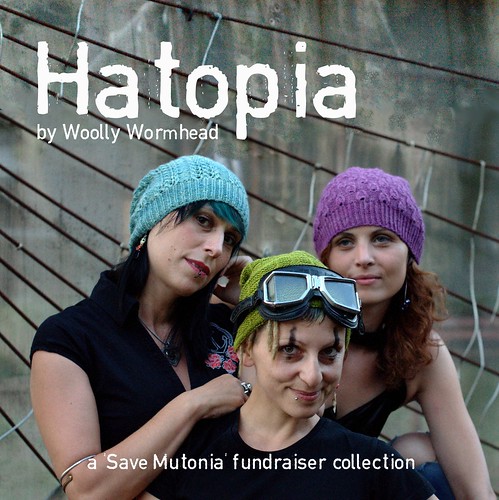
People who follow Woolly's blog will find mentions of the community in northern Italy she and her family moved to several years ago. Now that community is threatened by the actions of one local person, and its residents, many of them artists, face substantial legal fees in their battle to remain and preserve the artworks around the site.
So, what do you do as a designer when faced with that sort of fundraising challenge? You put together a collection, and donate the proceeds to the fund.
And a fine collection it is (as copy-editor, I had a sneak preview, obviously!). I've only knitted two of these, Encircle:
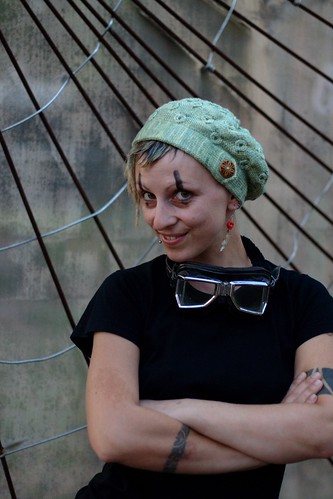
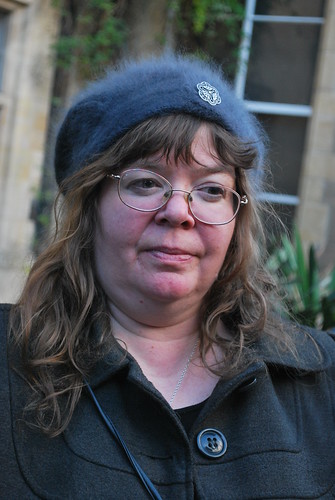
(Silvia rocks this design above - this is my more staid and much more fluffy version below)
and Pavone (Italian for peacock)
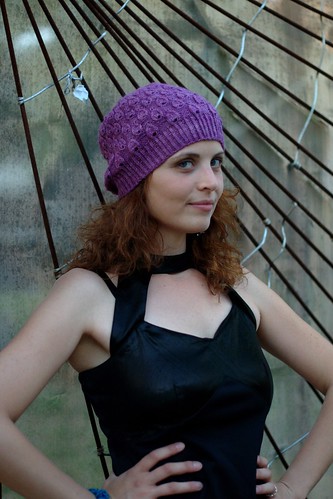
(Sara wearing a less drapy version than the one I test-knitted, modelled by Anya against the background of the building we work in)
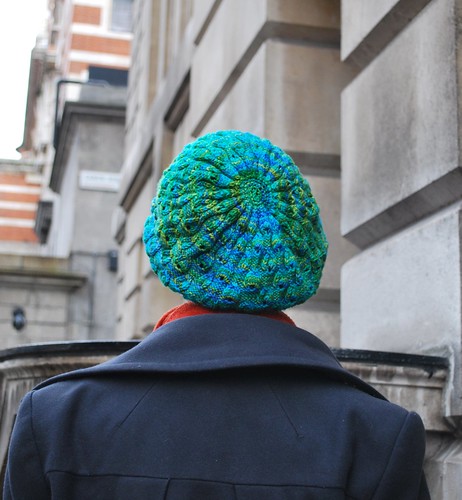
I can attest to the excellence of both. Looking forward to choosing the next one...
You can buy the collection through Ravelry (recommended if you're a member - then it's in your library and you can print out bits and bobs as you need them); if you're not a Ravelry member, you can also get it via Woolly's website.
I'm going to finish with the words of the community in their Statement. And when you've read it, if you want to know more and offer support, there's a Facebook page; and there's a petition at Change.org, and the Twitter hashtag in English is #savemutonia.
Our Statement
The Mutoid Waste Company arrived in Santarcangelo di Romagna, Italy in 1990 to perform in that year's "Festival Dei Teatri", a renowned annual festival held in the town. From that time on Santarcangelo became a base for the group and it became their home. Their art, their way of life and they themselves became an accepted part of life in Santarcangelo. Over the last 23 years they have increasingly collaborated on projects with local institutions such as schools, and their ties with the local community have strengthened. In recent years some of the Mutoids have chosen the Yard as a safe place to raise their own children.
The Yard is unique: a place that follows the rules whilst living completely outside them, a place that advocates an alternative outlook on life, a place that allows people to discover new things - and it's wonderful that such a place is considered a true part of Santarcangelo and that the locals readily accept the Yard as part of their community.
Unfortunately the Yard currently finds itself under a very real and serious threat of eviction - a reality which would not only destroy this unique community but also disperse its inhabitants and their artwork.
Despite these many years of mutually respectful cohabitation there is one voice that has continually spoken against the Mutoids presence; a single objector who now seriously threatens this culturally important phenomenon.
Mutonia is not a campsite (even though its inhabitants live in caravans, buses, trucks and temporary constructions that look more like works of art than houses); it's not a standard travellers site (although many of its inhabitants have a semi-nomadic lifestyle); and the group have never illegally occupied the land.
In recent years Santarcangelo's local council has been searching for a solution to the situation, seeking help from other government bodies, with the ultimate aim of declaring the Mutoid Yard as a Site of Cultural Interest.
People who follow Woolly's blog will find mentions of the community in northern Italy she and her family moved to several years ago. Now that community is threatened by the actions of one local person, and its residents, many of them artists, face substantial legal fees in their battle to remain and preserve the artworks around the site.
So, what do you do as a designer when faced with that sort of fundraising challenge? You put together a collection, and donate the proceeds to the fund.
And a fine collection it is (as copy-editor, I had a sneak preview, obviously!). I've only knitted two of these, Encircle:
(Silvia rocks this design above - this is my more staid and much more fluffy version below)
and Pavone (Italian for peacock)
(Sara wearing a less drapy version than the one I test-knitted, modelled by Anya against the background of the building we work in)
I can attest to the excellence of both. Looking forward to choosing the next one...
You can buy the collection through Ravelry (recommended if you're a member - then it's in your library and you can print out bits and bobs as you need them); if you're not a Ravelry member, you can also get it via Woolly's website.
I'm going to finish with the words of the community in their Statement. And when you've read it, if you want to know more and offer support, there's a Facebook page; and there's a petition at Change.org, and the Twitter hashtag in English is #savemutonia.
Our Statement
The Mutoid Waste Company arrived in Santarcangelo di Romagna, Italy in 1990 to perform in that year's "Festival Dei Teatri", a renowned annual festival held in the town. From that time on Santarcangelo became a base for the group and it became their home. Their art, their way of life and they themselves became an accepted part of life in Santarcangelo. Over the last 23 years they have increasingly collaborated on projects with local institutions such as schools, and their ties with the local community have strengthened. In recent years some of the Mutoids have chosen the Yard as a safe place to raise their own children.
The Yard is unique: a place that follows the rules whilst living completely outside them, a place that advocates an alternative outlook on life, a place that allows people to discover new things - and it's wonderful that such a place is considered a true part of Santarcangelo and that the locals readily accept the Yard as part of their community.
Unfortunately the Yard currently finds itself under a very real and serious threat of eviction - a reality which would not only destroy this unique community but also disperse its inhabitants and their artwork.
Despite these many years of mutually respectful cohabitation there is one voice that has continually spoken against the Mutoids presence; a single objector who now seriously threatens this culturally important phenomenon.
Mutonia is not a campsite (even though its inhabitants live in caravans, buses, trucks and temporary constructions that look more like works of art than houses); it's not a standard travellers site (although many of its inhabitants have a semi-nomadic lifestyle); and the group have never illegally occupied the land.
In recent years Santarcangelo's local council has been searching for a solution to the situation, seeking help from other government bodies, with the ultimate aim of declaring the Mutoid Yard as a Site of Cultural Interest.
Photos in this post copyright (c) Woolly Wormhead (1, 2, 4), (c) Franklin Habit (3) (c) Liz Marley (5).
Thursday, August 01, 2013
2013 books, #61-65
On the road bike: the search for a nation's cycling soul, or, Sniffing the yak-skin shoe, or, The great eccentrics of British cycling, by Ned Boulting. London: Yellow Jersey Press, 2013.
This is another lovely book by Ned Boulting. Taking 2012's Tour de France victory by Bradley Wiggins as its starting point, it looks at the people who quietly, doggedly kept British cycling going over the years before this recent trend, in near-invisibility. He talks to people you'd expect - Chris Boardman, for whom he has a huge respect belied by their banter on the ITV4 coverage and podcasts, and David Millar. But he also talks to David Millar's mum; and Ken Livingstone, about cycling in London; and finds there are two Tommy Godwins, very different personalities but champions at the same time; and interviews professional cyclists from the 1950s, 60s and 70s only real aficionados would previously have heard of. Oh, and he goes for a ride with Gary Kemp out of Spandau Ballet and his New Romantic Ride; sort of.
Boulting's not a technical nerd - he's quite happy to admit that he glazes over when people start talking about gear ratios and bottom brackets, and is probably the only person whose puncture Chris Boardman's mended in the last few years - and he came to the sport at the elite level with Tour de France punditry, and only later got back on his bike and started cycling seriously. He still regards himself as an outsider to the sport, and is therefore able to explain beautifully to other outsiders. He's genuinely fascinated by people, what drives them, and their stories, and plays this wonderfully here. If you like Stuart Maconie's books about Britain, I suspect you'll enjoy this one very much - the same sort of affectionate, humorous curiosity and genuine respect for endurance and eccentricity is at work.
Sample (from about two-thirds of the way through): In 1937, Ossie set out to reclaim his record. At exactly the same time an English resident, a Frenchman of Scottish descent (I am not making these people up) called René Menzies launched his campaign. Ossie prevailed, riding a staggering 62,657 miles, beating Menzies by just 1,096 miles. Intriguingly, although scarcely of any relevance, Menzies, who had been decorated for valour in the First World War, went on to become Charles de Gaulle's chauffeur during the next war, a bizarre biographical detail which, by now, probably won't surprise you.
Force of nature, by C. J. Box. Kindle edition.
The third of the Lyon books, and another crackingly good Joe Pickett novel. I think I've said everything there is to say about these over the years, but the way Box keeps producing a consistently high, interesting standard of novel is quite stunning. Again, the theme is very much what people will do when forced to the edge, and as this one focuses on Nate Romanowski and his history in Special Forces, it can be a pretty gory read. Box keeps the characters straight and consistent, though, and the mystery which is set up in Cold wind is finally explained.
The bomber, by Liza Marklund. London: Corgi, 2011.
Can't remember how I came to order this one from the library, but if someone reading this recommended it, thank you! Stockholm is hosting the Olympics, but there's an explosion in the main arena; when all the pieces are collected and DNS analysis is done, the victim turns out to be the head of SOCOG, a former banker. As Annika Bengtzon of the Stockholm evening paper investigates, she discovers a curious absence in the accounts of the victim's life - her husband speaks of her as if he were her PR, and her daughter with hatred. Sources are also telling her that this was an inside job, not international terrorism. And then the bomber strikes again... Tautly plotted and an excellent read.
Maxwell's island, by M J Trow. London: Allison and Busby, [2011].
Picked this up at the library when I realised I was going to be handing in all my reading material; I love these books. Maxwell is at his hilarious best in this one, which involves him, Jacquie and son Nolan reluctantly leading a Year Seven school trip to the Isle of Wight after another member of staff falls down some stairs. This is not the only mishap to befall the cast of this book, and it turns out that the Year Sevens are the least of everyone's problems. There's a huge great plot-plant at the end - one of those things you couldn't possibly have worked out from the previous information in the book - so if you don't like those, you're forewarned; but to be honest, that isn't what you read these for...
Time bomb, by Jonathan Kellerman [audiobook]. Read by Jeff Harding. Oxford: Isis, 2009. [Originally published 1999.]
I'm not the world's biggest fan of Alex Delaware (Kellerman's main protagonist), it has to be said. I picked this one up because I just love the sound of Jeff Harding's voice. But this has an excellent plot, with twists and turns, and a lot to think about. Here, a seemingly straightforward school shooting turns into something very different, and Delaware and Milo are drawn into something horrible and sinister. If you're a conspiracy theorist, this is the one for you. If you're not, it's still pretty diverting.
Tuesday, July 30, 2013
Lyon, days 4 and 5
I've a week off this week, and one of the things I've vowed to do is catch up with blog posts, and projects on Ravelry, and paperwork, and do a bit of prospective stuff for a decorating project later in the summer... So finally, last part of the Lyon saga...
Friday, bright(ish) and early(ish), I set off for the basilica at Fourvières. You can see it from a distance on the first picture of the previous Lyon post, sitting there at the top of the hill like a wedding cake...

I was hoping for High 19th-century Camp, mixed with some art nouveau. I was not to be disappointed, even before I got into the building.

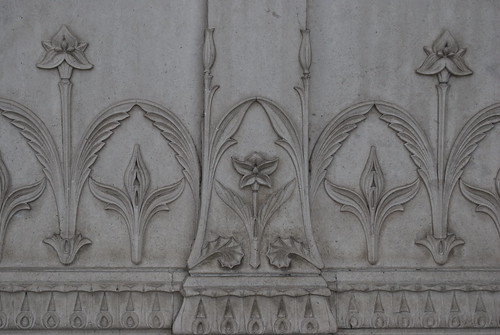
The basilica was erected by the grateful Lyonnais immediately after the Franco-Prussian war in 1870-71, to give thanks to God for having escaped the Prussian invasion. It dates from about the same time as the Sacré-Coeur in Paris, and it has that same quality of no small space being missed
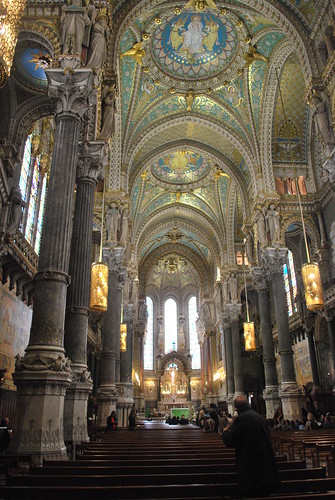
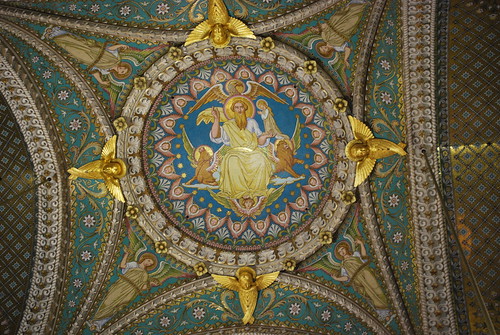
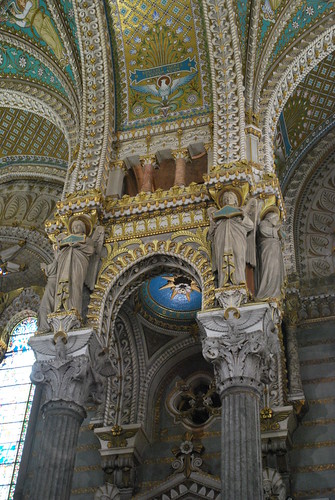
Doves of various kinds are to the fore...
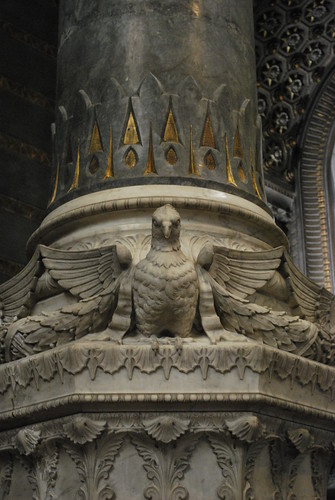
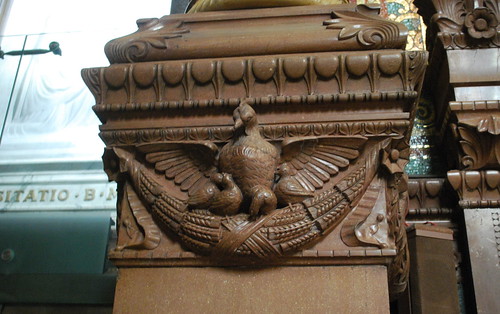
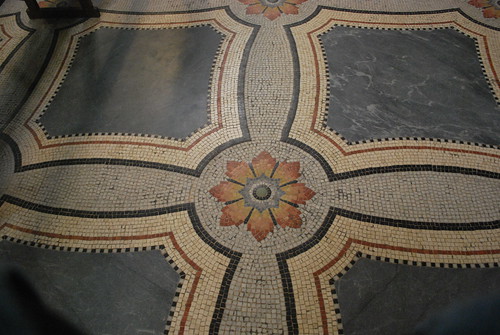
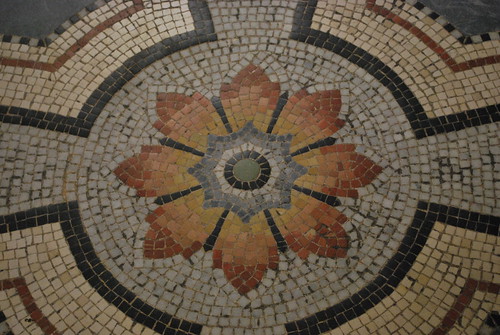
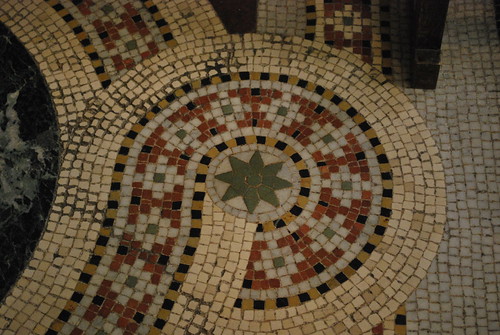
The floor mosaics were rather beautiful...
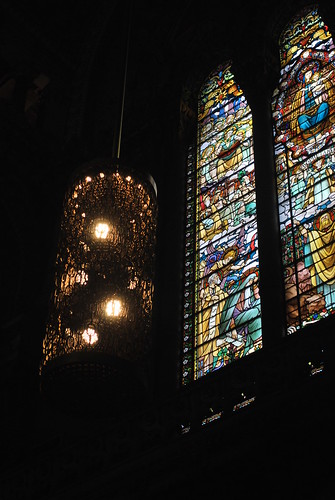
... as were both the windows and the modern light fittings
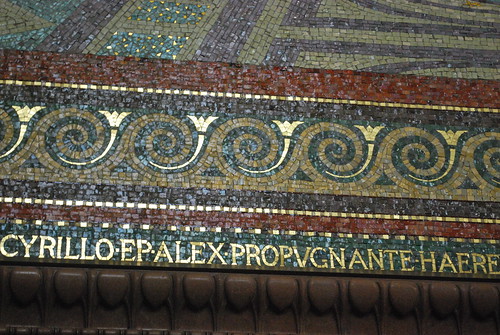
The wall mosaics were beautifully done, too;
and, as inevitable in late 19th century France, Joan of Arc is prominantly featured as a symbol of French pride.
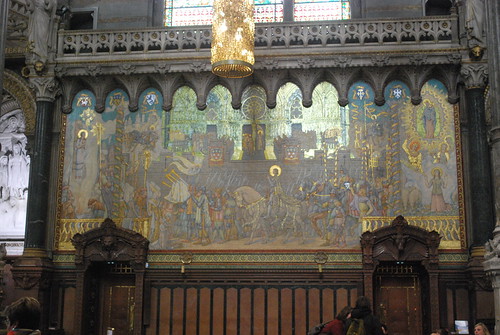
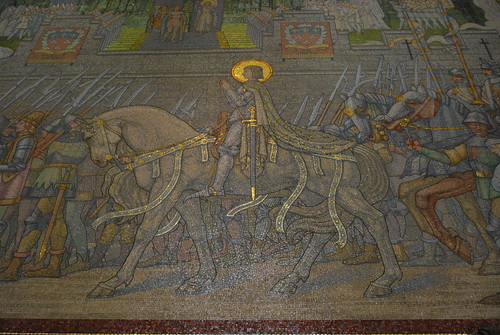
Anyway. It was lovely. If, to quote a friend, you like that sort of thing, of course.
Outside, rather a cheery statue of pope JPII, and a great view over the city.
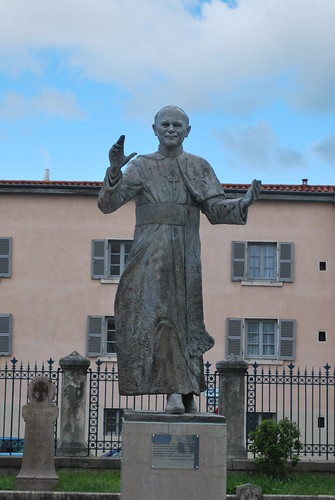
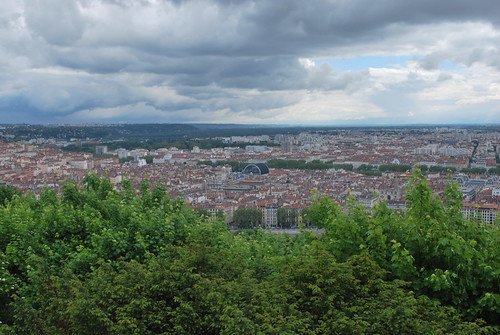
Back down in the funicular to Vieux-Lyon; definitely the right day to see it. For the first time, I did actually feel as if I was in Southern France.
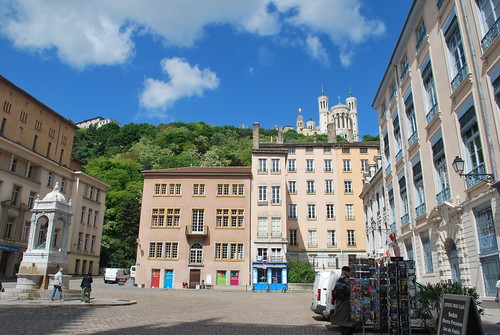
Another cathedral, but this one was under renovation - the only thing showing behind the altar, on a white sheet, was an enormous QR code, which would presumably give helpful information to someone not equipped with a £10 pay-as-you-go Nokia...
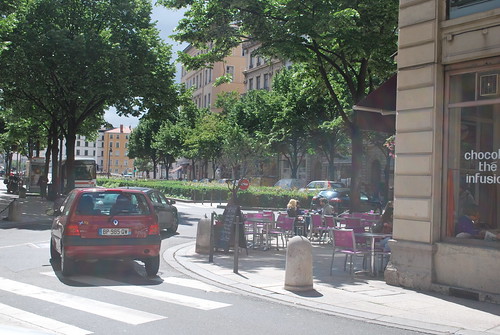
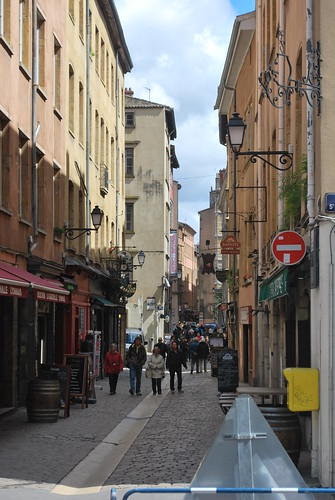
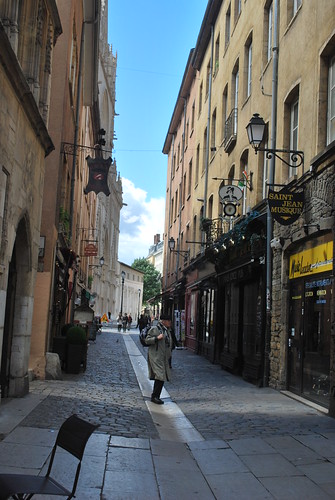
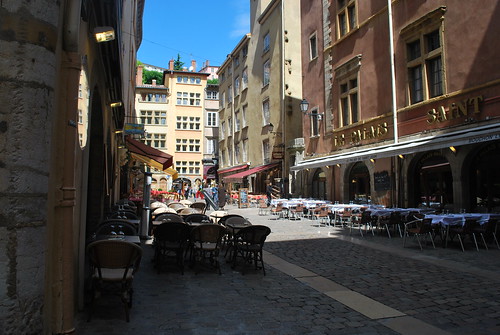
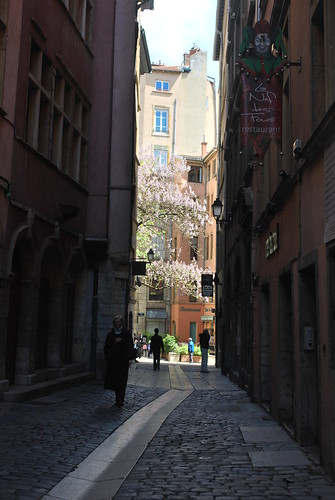
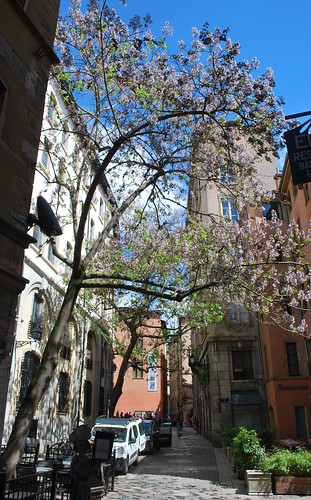
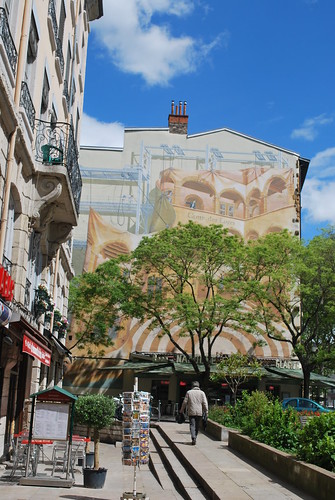
Pretty streets...



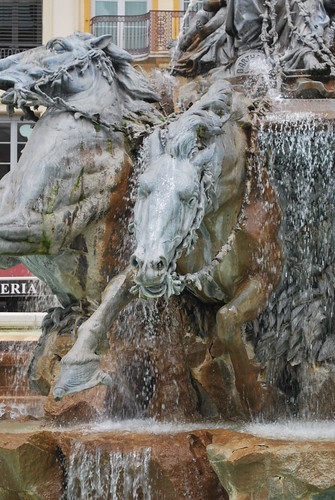
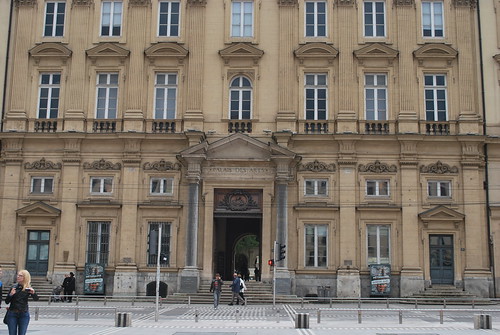


Here's the guy - Louis Janmot, from a self-portrait.

There's a book available about the cycle, which I was able to buy in the museum bookshop... I wandered round the rest of the galleries like a stunned fish, went back to the Janmot room and spent another 15 mins or so gazing and attempting not to dribble too obviously, and then wandered out; although it was drizzling again, the Place de l'Hôtel de Ville beckoned
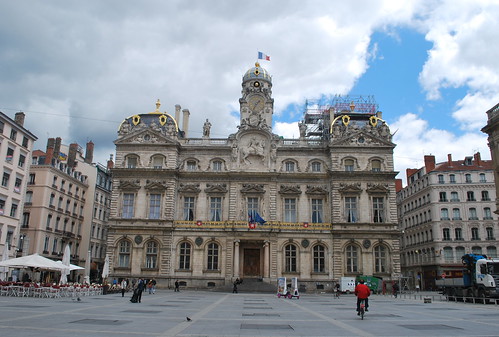
and I had an apéro under the awnings there before heading home - more grilled meat and veg...
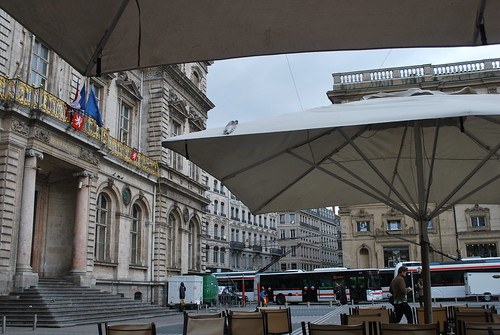
The following day, it was just a matter of collecting together the souvenirs and heading home...

Lovely city. I'll definitely be back.
Friday, bright(ish) and early(ish), I set off for the basilica at Fourvières. You can see it from a distance on the first picture of the previous Lyon post, sitting there at the top of the hill like a wedding cake...
I was hoping for High 19th-century Camp, mixed with some art nouveau. I was not to be disappointed, even before I got into the building.
The basilica was erected by the grateful Lyonnais immediately after the Franco-Prussian war in 1870-71, to give thanks to God for having escaped the Prussian invasion. It dates from about the same time as the Sacré-Coeur in Paris, and it has that same quality of no small space being missed
Doves of various kinds are to the fore...
The floor mosaics were rather beautiful...
... as were both the windows and the modern light fittings
The wall mosaics were beautifully done, too;
and, as inevitable in late 19th century France, Joan of Arc is prominantly featured as a symbol of French pride.
Outside, rather a cheery statue of pope JPII, and a great view over the city.
Back down in the funicular to Vieux-Lyon; definitely the right day to see it. For the first time, I did actually feel as if I was in Southern France.
Pretty streets...
After a rather over-copious and slightly-too-touristy lunch (live and learn!) I ambled back into the middle of town and sat in a café for a while, before finding a yarn shop (yay!!) and making my way to the art gallery. Outside in the square, this statue
Final stop then, the Musée des Beaux-Arts de Lyon
By this time I was, quite frankly, all sightseen-out. But I had a pass which got me in free, and an hour to spare, and there I was; so my plan was to tander through, and if something totally grabbed me by the throat and said LOOK AT ME I'd have a look; but if not, I'd just have a canter through, and a better look next time I come to Lyon. I'm not a complete masochist, though, so I started with the 19th century paintings rather than looking at armour and stuff..
And the first room I came across was the Salle Janmot.
Thud. Love at first sight.
Completely new-to-me Pre-Raphaelite-type painter (technically, apparently, a Romantic/Symbolist, and a formative influence on one of my other favourites, Odilon Redon) - and an entire cycle (Le poème de l'âme/The poem of the soul) in one room. The most beautiful things.
There's a book available about the cycle, which I was able to buy in the museum bookshop... I wandered round the rest of the galleries like a stunned fish, went back to the Janmot room and spent another 15 mins or so gazing and attempting not to dribble too obviously, and then wandered out; although it was drizzling again, the Place de l'Hôtel de Ville beckoned
and I had an apéro under the awnings there before heading home - more grilled meat and veg...
The following day, it was just a matter of collecting together the souvenirs and heading home...
Sunday, July 28, 2013
2013 books, #56-60
Garment of shadows, by Laurie R. King. London: Allison and Busby, 2012.
I did enjoy The pirate king on first reading, checking back... But was extremely glad to see Russell casting off her actor friends and getting back to the plot in this book. There's a slight stretching of credulity at the beginning when Russell develops amnesia, but it does prod the plot along, and gets them back to Middle Eastern derring-do; this time in 1925 Morocco. Couple of nice plot twists, and some detail of the actual politics of the period. Good enjoyable read... This one also contains the novella Beekeeping for beginners which was published as a Kindle standalone; reviewed it earlier this year.
Murder in the Sentier, by Cara Black. New York: Soho, 2002.
Another intrepid female protagonist here in Aimée Leduc, computer consultant and private investigator. When an ex-convict appears claiming to have shared a cell with Aimée's mother, who walked out on the family when Aimée was eight, our girl's understandably curious. When the woman is found dead shortly afterwards, and there are links to a 1970s terror group, Aimée has to investigate; sometimes in a series of very unlikely outfits. I really enjoy these books because the Paris geography is just so excellent; you can walk these books with the map provided in the front, and the atmosphere is spot on. The only thing which jarred in this one was the slightly lame naming of some of the organisations. If the author had used two German surnames, rather than calling the terrorist group "Haader-Rofmein", or had a generic left-wing publishing house rather than using "Tallimard", it would all have been seamless.
A belated catchup on what I read on holiday: books read on the Kindle don't have to go back to the library or head off to the charity shop, so they don't get reviewed.
A textbook case, by Jeffery Deaver. Kindle edition.
This is a novella to introduce The Kill Room, Deaver's newest Lincoln Rhyme novel; and it was an excellent hour or so's read. Although I've enjoyed Deaver's short stories before, something about the shorthand in the writing about characters we know well somehow jarred; but his complete mastery of a plot kicked in. And there are some interesting medical teasers for the next book too (I'm hoping to get hold of it from the library in the next couple of weeks).
The Lewis man, by Peter May. Kindle edition.
The second of this trology. Fin MacLeod has cut ties with the mainland and moved back to Lewis permanently, but can't resist the urge to investigate when a body is found by peat-cutters; the theory that it's a prehistoric bog burial is put paid to when the corpse turns out to be sporting an Elvis tattoo. The body is DNA tested and is found to be closely related to Marsaili, Fin's childhood girlfriend; but Marsaili's father Tormod has always said he was an only child... Tormod is now deep in the throes of dementia, and parts of the narrative show his confusion; Fin has his work cut out to piece together the life story. Gripping, like the first part...
The ides of April, by Lindsey Davis. London: Hodder and Stoughton, 2013.
Taglined Falco: the new generation, which made me worry. Shouldn't have, of course - Flavia Albia is a marvellous character. Davis has wisely taken the action a few years forward, and made Flavia a young widow with an office in Falcon Court, under the reign of Domitian which is considerably more sinister than that of Vespasian. Helena Justina and Falco himself appear as shadowy figures in the background, but the stage is largely left clear for this feisty, articulate investigator. There's one "could have seen it coming a mile off" element to the plot, but it really doesn't matter; with any luck, this is the first of many in this new series. I was sad when Davis announced she'd come to the end of the line with Marcus Didius, but this is a worthy successor.
Sunday, July 14, 2013
Lyon, day three
Eventually! It's been a very busy last few weekends, and photo-heavy posts are always a bit awkward to put together... but seeing the Tour de France pass through Lyon yesterday gave me an additional push to post this...
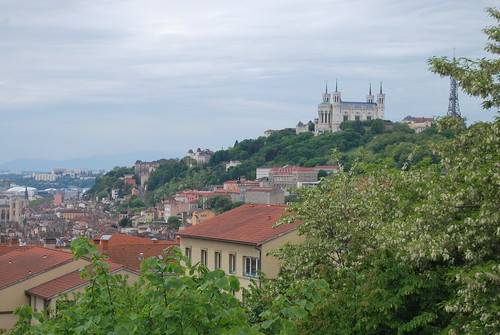
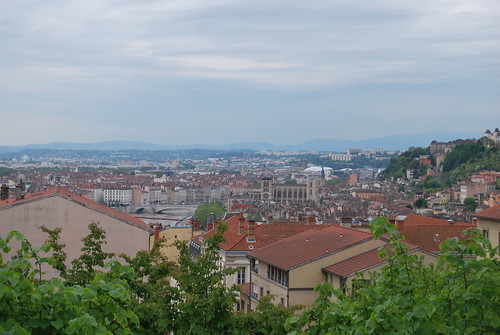
So; day three and the Croix-Rousse. Unlike yesterday's cyclists, who made getting up the hill look pretty effortless, I got up there by an extremely sloping Metro train which was halfway to a funicular. Had a wander slightly down the hill to the viewing platform for a look across the city
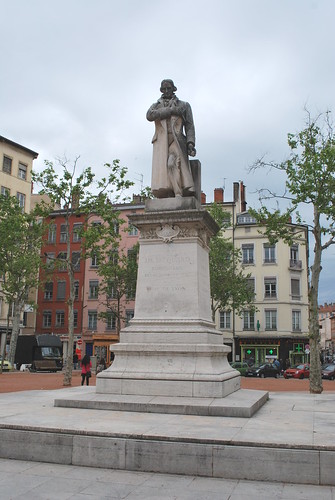
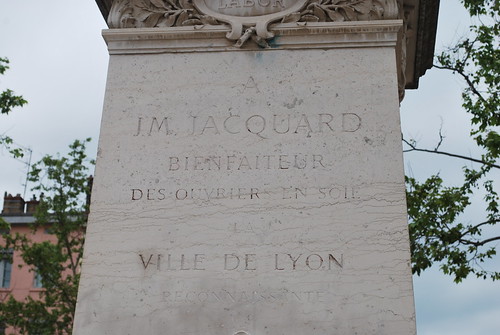
and then a wander slightly back up to the Place Jacquard. Another textile-linked location with a statue looming (sorry) above it:
I was intending to get there early enough to walk up to the Maison des canuts and find out more about the silk weaving trade in Lyon, but a combination of indolence and a short rainstorm as I was due to set out from the studio meant that's one for next time. (There's definitely going to be a next time...)
Croix-Rousse was recommended by a friend, and it's a lovely bit of town; a little like the quieter bits of Montmartre out of tourist season.
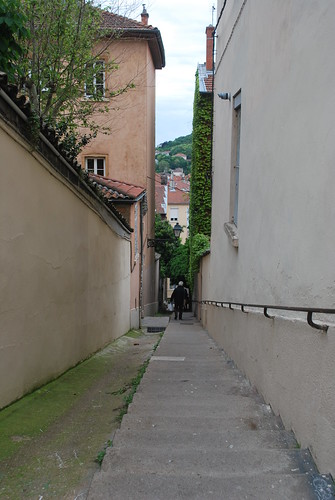

After a wander about, and a purchase of Provençal green beans and olive-wood kitchen implements (box ticked; was really hoping to find some) at the market later, I evaded a creepy man who was intent on taking me for a drink, repaired to a restaurant I'd scoped out on the internet, and had a really excellent lunch with kir à la framboise and pot lyonnais.
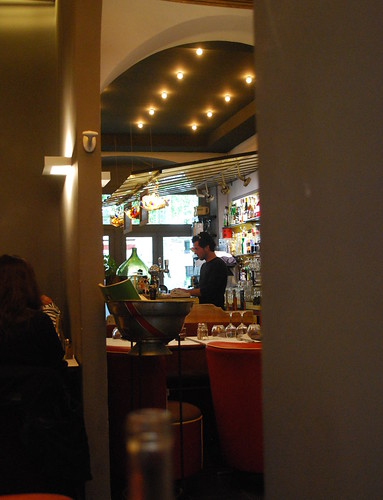
(La Coquette, if you're interested; highly recommended. Really nowhere near as formica-heavy as it looks on the photos...)
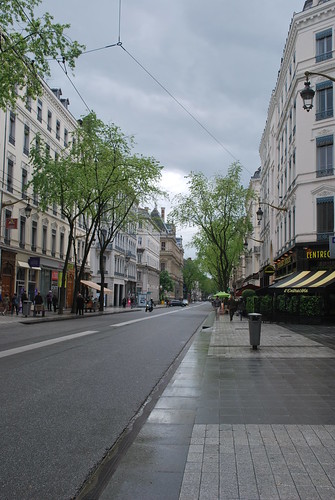
Another short but very sharp rain shower put me off heading over to further heights/viewpoints, so change of plan to take in the presqu-île. This is, according to my guidebook, the top of the Lyon equivalent of Oxford Street. (I don't think the writers of the guidebook have visited Oxford Street recently. Or, possibly, ever. But Rue de la République does have branches of most of the major chains further into town.)
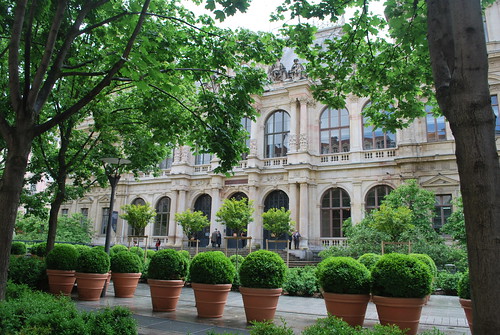
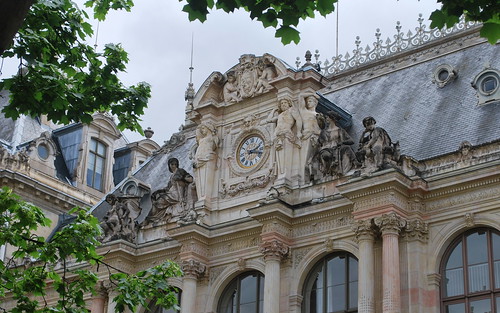
The Palais de Commerce - most large French towns have one of these, but this one is particularly spectacular.
There was a demonstration, or manifestation as the French have it; this seems to fit pretty well, because with all the whistles and the flags and the police escort, it also feels like a bit of performance art. This was a particularly fine-sounding one, so I stopped to watch. Which noble cause was being fought for? World peace? Education? Liberté, égalité et fraternité?
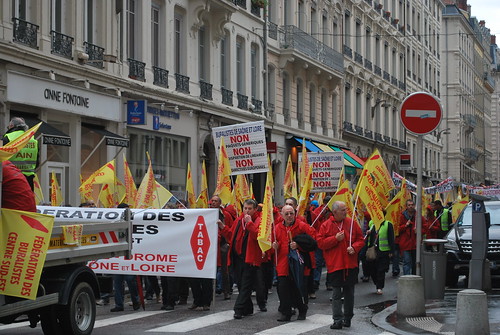
Ah, they're against the ban on plain cigarette packs and closed displays. Ho hum. But I do like the way they finish with "No to EU Directives", which is at least pretty comprehensive and covers all bases!
One of the (many) things I love about the French is their entirely unimaginative way of naming bars and cafés; when you're casting around for somewhere to sell you stamps for your postcards, having incomprehensibly lost one of the US stamps, seeing this
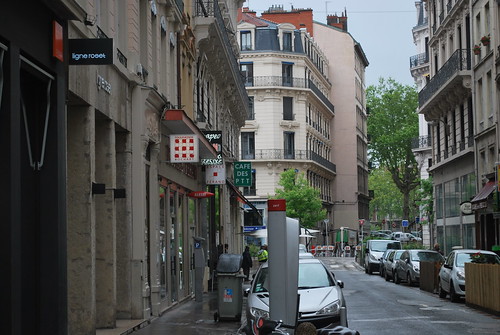
around the corner is great. Where the Café des Postes, télégraphes et téléphones is, there shall be the post office also. And indeed there was.
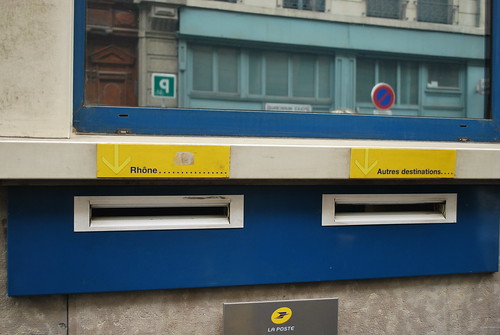
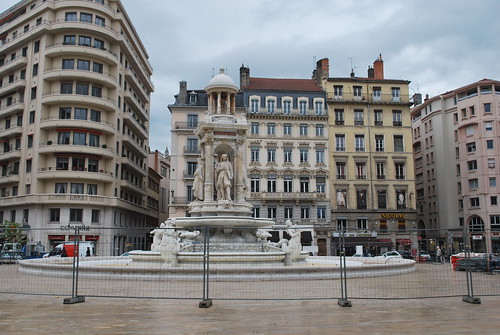
Likewise, I wasn't sure whether this was the Place des Terraux or the Place des Jacobins, but helpfully, there's the Café des Jacobins on the right... Likewise, you always know what you're going to get at the Bar des Sports in a small town (lots of blokes, big screen, Baby-foot, possibly pool table, cheap drinks and a high tolerance of horseplay).
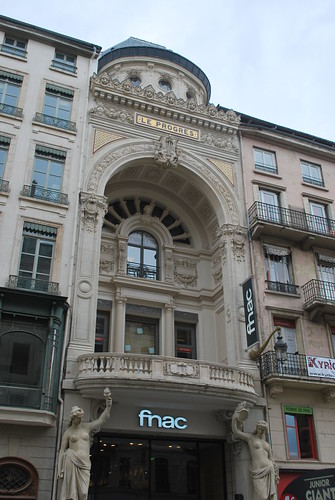
Made a quick trip to Fnac; I do love a Fnac shop. This one is particularly fine.
So many of the French singer-songwriters I like haven't produced anything new in the last few years; thankfully Jacques Higelin is still going strong...
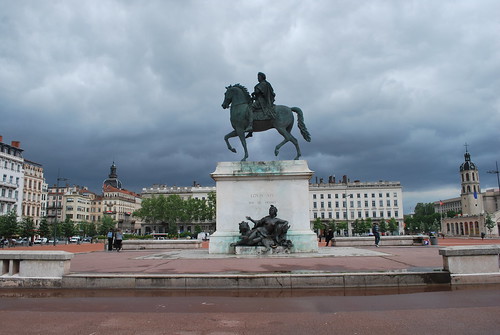
One last picture, of the huge and (on that day) rather desolate Place Bellecour; Louis XIV lords (kings?) it over the square...
At that point the heavens opened. I ducked into a bar for a pre-dinner drink, and then home via the butchers - veal chop, bearnaise sauce and Provençal green beans. Heaven. Particularly because I found Un dîner presque parfait which was just lovely - I gather there are similar formats on UK TV but I never have time to catch up with that sort of thing!
Before dinner, I met my lovely landlord, finally - had to pay him for the rent, and while I'd already pretty much settled in, it being the third day of five, he had another couple of hints and tips. One of the first things he spotted was my knitting:
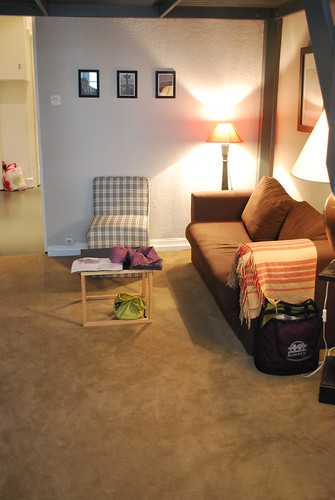
Apparently his wife's a knitter, and he was asking about good UK yarn sites for British wools. I scribbled down some names and URLs including the Ravelry one, just in case!
So; day three and the Croix-Rousse. Unlike yesterday's cyclists, who made getting up the hill look pretty effortless, I got up there by an extremely sloping Metro train which was halfway to a funicular. Had a wander slightly down the hill to the viewing platform for a look across the city
and then a wander slightly back up to the Place Jacquard. Another textile-linked location with a statue looming (sorry) above it:
I was intending to get there early enough to walk up to the Maison des canuts and find out more about the silk weaving trade in Lyon, but a combination of indolence and a short rainstorm as I was due to set out from the studio meant that's one for next time. (There's definitely going to be a next time...)
Croix-Rousse was recommended by a friend, and it's a lovely bit of town; a little like the quieter bits of Montmartre out of tourist season.
After a wander about, and a purchase of Provençal green beans and olive-wood kitchen implements (box ticked; was really hoping to find some) at the market later, I evaded a creepy man who was intent on taking me for a drink, repaired to a restaurant I'd scoped out on the internet, and had a really excellent lunch with kir à la framboise and pot lyonnais.
(La Coquette, if you're interested; highly recommended. Really nowhere near as formica-heavy as it looks on the photos...)
Another short but very sharp rain shower put me off heading over to further heights/viewpoints, so change of plan to take in the presqu-île. This is, according to my guidebook, the top of the Lyon equivalent of Oxford Street. (I don't think the writers of the guidebook have visited Oxford Street recently. Or, possibly, ever. But Rue de la République does have branches of most of the major chains further into town.)
The Palais de Commerce - most large French towns have one of these, but this one is particularly spectacular.
There was a demonstration, or manifestation as the French have it; this seems to fit pretty well, because with all the whistles and the flags and the police escort, it also feels like a bit of performance art. This was a particularly fine-sounding one, so I stopped to watch. Which noble cause was being fought for? World peace? Education? Liberté, égalité et fraternité?
Ah, they're against the ban on plain cigarette packs and closed displays. Ho hum. But I do like the way they finish with "No to EU Directives", which is at least pretty comprehensive and covers all bases!
One of the (many) things I love about the French is their entirely unimaginative way of naming bars and cafés; when you're casting around for somewhere to sell you stamps for your postcards, having incomprehensibly lost one of the US stamps, seeing this
around the corner is great. Where the Café des Postes, télégraphes et téléphones is, there shall be the post office also. And indeed there was.
Likewise, I wasn't sure whether this was the Place des Terraux or the Place des Jacobins, but helpfully, there's the Café des Jacobins on the right... Likewise, you always know what you're going to get at the Bar des Sports in a small town (lots of blokes, big screen, Baby-foot, possibly pool table, cheap drinks and a high tolerance of horseplay).
Made a quick trip to Fnac; I do love a Fnac shop. This one is particularly fine.
So many of the French singer-songwriters I like haven't produced anything new in the last few years; thankfully Jacques Higelin is still going strong...
One last picture, of the huge and (on that day) rather desolate Place Bellecour; Louis XIV lords (kings?) it over the square...
At that point the heavens opened. I ducked into a bar for a pre-dinner drink, and then home via the butchers - veal chop, bearnaise sauce and Provençal green beans. Heaven. Particularly because I found Un dîner presque parfait which was just lovely - I gather there are similar formats on UK TV but I never have time to catch up with that sort of thing!
Before dinner, I met my lovely landlord, finally - had to pay him for the rent, and while I'd already pretty much settled in, it being the third day of five, he had another couple of hints and tips. One of the first things he spotted was my knitting:
Apparently his wife's a knitter, and he was asking about good UK yarn sites for British wools. I scribbled down some names and URLs including the Ravelry one, just in case!
Subscribe to:
Posts (Atom)